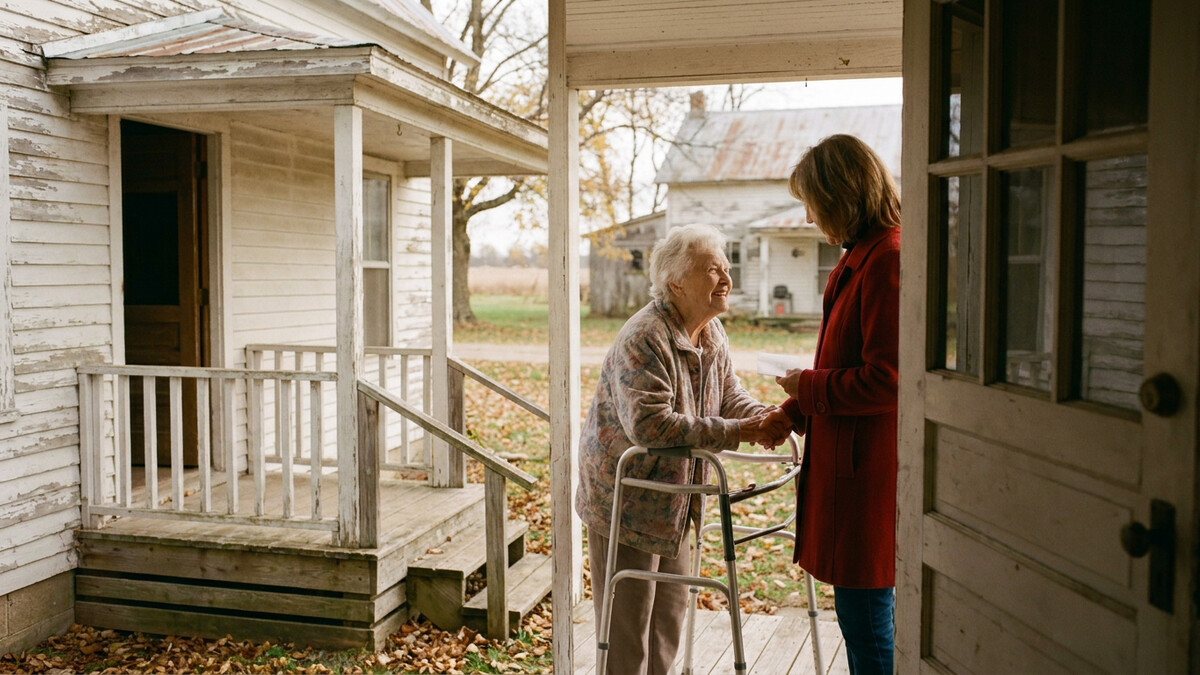
Lois took the photograph in her trembling hands and looked at it for a long time.
She had forgotten Gary had taken it. With the old Instamatic camera, the morning after, when the baby was asleep in a laundry basket by the stove.
"That's him," she said. "That's Jim."
She looked up at the woman in the red coat. At her dark hair and her mother's wide eyes.
"And that's you," she said.
The younger Lois started to cry.
"Come in out of the cold, honey," the old Lois said. "Come in my kitchen."
They sat at the same kitchen table. It was the same kitchen. The woodstove was gone, replaced by an electric range in 1991. But the floor was the same. The window was the same.
"There," Lois said, pointing with her cane. "Right in front of where the stove was. That's where you were born."
The younger Lois looked at the spot on the linoleum for a long time.
"Mama never talked about it much," she said. "She'd just say, You were born in a blizzard, on a farm, and a truck driver saved your life. I asked her a hundred times for his name. She said she never knew it."
"Neither did I," Lois said. "Just Jim."
"So I started looking," the younger Lois said. "After she died. I found the photo. I went to the library and read every newspaper from February 1978. I called the trucking companies that were still in business. I posted the photograph on the internet, in groups for truck drivers and for people who remember the blizzard."
She took out her phone.
"Two weeks ago, a man wrote back from Kentucky," she said. "He said, That's my daddy. James Earl Caudill. He drove for a freight company out of Louisville from 1965 to 1990. He was in the Army in Korea. He talked about a baby he delivered in a blizzard in Indiana for the rest of his life."
Lois put her hand over her mouth.
"Is he living?" she said.
The younger Lois hesitated.
"He's ninety-four," she said. "He's in a care home in Corbin, Kentucky. His son says his mind comes and goes. But some days, he's as sharp as a tack." She looked at the old woman across the table. "His son said that when he showed him the photograph, he looked at it for a long time, and then he said, Where's the lady with the lamp?"
The kitchen was very quiet.
"The lady with the lamp," Lois said slowly. "The kerosene lamp. In the window. That's how he found the house."
"I think he means you," the younger Lois said.
They drove to Corbin, Kentucky, two weeks later, on a Saturday in December.
Lois's grandson drove. Lois sat in the front seat with her walker folded in the back and a covered dish in her lap, because she could not go visiting with empty hands, not even at ninety-two. The younger Lois followed in her own car, with her husband and her two teenage sons.
The care home was a low brick building on a hill outside town. James Earl Caudill's son, a big gray-bearded man of sixty-five who looked exactly like the photograph, met them at the door.
"He's having a good day," he said. "I told him you were coming. He's been asking about it since breakfast."
Jim Caudill was sitting in a wheelchair by the window of the day room, in a flannel shirt, with a blanket over his knees.
He was not huge anymore. He had shrunk the way very old men do. His hands, folded on the blanket, were enormous and knotted and spotted. His beard was white and thin.
But when Lois came through the door on her walker, he looked up, and his eyes were the same.
He looked at her for a long, long time.
"You put a lamp in the window," he said.
Lois could not speak. She nodded.
"I saw that lamp from half a mile off," Jim said. His voice was rough and slow. "In the snow. I couldn't see my own hand. I couldn't see the road. I couldn't see anything. And then I saw that one little light. And I thought, Lord, there's a house. And I walked to it."
"I always kept a lamp in that window when the power went out," Lois said. "My mother did it. Her mother did it. In case somebody was lost."
"Somebody was," Jim said.
Then the younger Lois came into the room.
She came slowly, with her husband and her sons behind her. She stopped in front of the wheelchair. She was holding the photograph.
Jim looked up at her.
He did not know her face. He could not have. The last time he had seen it, it was the size of his palm.
His son leaned down beside him. "Daddy," he said gently. "This is the baby. From the blizzard. From the photograph. This is Lois."
Jim stared at the woman in front of him. At the photograph in her hands. At her face again.
Then his old knotted hands came up off the blanket, slowly, and he held them out in front of him, cupped, the way you would hold something very small and very new.
"She wasn't breathing," he said. "She was blue. I didn't know what to do. I just breathed for her. Three little breaths. Like you'd blow on a candle you didn't want to put out."
The younger Lois knelt down in front of his wheelchair.
She put her hands in his.
"Mr. Caudill," she said. "I'm forty-eight years old. I'm a pediatric nurse. I've worked in the newborn unit at the hospital in Fort Wayne for twenty-two years." Her voice broke. "I've breathed for a lot of babies. I always wondered why I picked that job. Now I know."
Jim Caudill held her hands for a long time. He did not say anything else. He just looked at her and nodded, slowly, over and over, with tears running into his thin white beard.
His son had to turn away. The younger Lois's two teenage boys stood by the door with their hands in their pockets, very still.
Old Lois sat down in the chair beside the wheelchair, slowly, and put her hand on Jim's arm.
They stayed until the light went down outside.
When they left, Lois Fenstermaker gave Jim Caudill's son the covered dish. Chicken and noodles. And one other thing, wrapped in tissue paper, that she had brought from home.
It was a small brass kerosene lamp, old and dented, with a glass chimney.
"Put it in his window," she said. "Just in case."
The next January, on the twenty-sixth, the younger Lois drove to Wabash Corners and sat at old Lois's kitchen table, in front of the place on the floor where the stove used to be.
Then she called Corbin, Kentucky, on speaker. And the three of them, on the anniversary of the blizzard, talked for an hour.