"Stop," Ola Mae shouted. "Stop spraying. Stop."
She had not shouted that loud in thirty years. Her voice cracked. But the young man with the hose heard it. He turned around, startled, with the mist still coming out of the nozzle.
"Turn it off," Ola Mae shouted, waving her arms. "There's a child. There's a child in the flowers."
The young man turned and looked down the meadow.
He saw the little girl in the pink nightgown.
He dropped the nozzle.
Ola Mae was already moving. She could not run. Her hips would not let her. But she walked up the edge of that lawn faster than she had walked in ten years, with her cane, along the meadow, through the mist and the bees, calling.
"Honey. Honey, come here. Come to me."
The little girl stopped chasing the butterfly and looked at her. A strange old woman with white hair and a cane, coming at her out of the flowers.
"Come here, sweetheart," Ola Mae said. "Come on out of there. Right now. Come see me."
The little girl came. Slowly, a little frightened, in her bare feet. Ola Mae took her by the hand and led her out of the meadow, onto the driveway, away from the mist.
The child's nightgown was damp. Her arms were damp. Her bare feet were wet.
"What's your name, honey?"
"Lily," the girl said.
"Lily," Ola Mae said, "let's go find your mama."
The front door of the big gray house flew open. A man came running out in a T-shirt and pajama pants, barefoot, with his phone in his hand.
"Lily? Lily."
It was Brent Calloway.
He saw his daughter standing on the driveway, holding the hand of the old woman from down the road. He saw the spray truck. He saw the young man in the paper mask standing frozen by the meadow, with the hose on the ground.
He stopped.
"What happened?" he said. "What's going on?"
"Your little girl was in the meadow," Ola Mae said, "while that young man was spraying it." She kept her voice steady. "Mr. Calloway, you need to wash her off. Right now. Her arms and her legs and her feet. With soap. And her hands, before she puts them in her mouth. And call the poison control number on that tank."
Brent Calloway looked at his daughter's damp nightgown.
His face went white.
He scooped her up and ran for the house.
Lily was fine.
Her mother bathed her in the kitchen sink. Brent called poison control while the spray tech stood in the kitchen doorway reading them the label on his tank, word by word, his hands shaking. The nurse on the line asked a lot of questions. Then she said Lily had probably not been exposed enough to hurt her, but to watch her closely for the rest of the day, and to call back if she got sick.
She did not get sick.
At nine o'clock, Brent Calloway came out onto his big wraparound deck, where Ola Mae was sitting in a deck chair with a glass of water his wife had brought her. He sat down across from her. He looked like a man who had just driven off the side of a mountain and lived.
"Mrs. Hinshaw," he said. "I don't know how to thank you."
"You can start by canceling that truck," Ola Mae said.
She told him all of it.
She told him about the dead bees every Wednesday. About her record book. About the wind out of the west. About the blue pollen on her dead bees' legs, and the phacelia, and the squash and the tomatoes and the blueberries and the apple trees all over Sourwood Gap.
Brent listened without saying a word.
When she finished, he put his face in his hands.
"I didn't know," he said. "I swear to God, I didn't know. We had ticks last summer. Lily got a tick bite and we were so scared of Lyme disease. A guy at work said these mosquito companies were great. I signed up online. Every Tuesday, seven a.m. I've never even been outside when they came." He shook his head. "I planted that meadow because the nursery said it was good for pollinators."
"It is," Ola Mae said. "It's the best thing on this mountain for bees. That's why they were all in it." She looked out at the quarter mile of lavender blue. "And then every Tuesday morning, while they were working it, that truck came and sprayed it."
Brent Calloway looked out at the meadow for a long time.
"How many?" he said finally. "How many bees?"
"I lost four hives out of twelve," Ola Mae said. "That's about two hundred thousand bees. I don't know how many wild ones. Bumblebees. Butterflies." She paused. "And every garden on this side of the mountain."
Brent Calloway canceled the mosquito service that morning, on the phone, from the deck, while Ola Mae listened.
That afternoon, he drove down the gravel road to her house, alone. He stood on her porch with his hands in his pockets.
"Mrs. Hinshaw," he said. "I'd like to pay for the hives you lost. And I'd like to go to every neighbor on this road and apologize for their gardens. Will you tell me who?"
Ola Mae looked at him for a long time.
"You can pay for the hives if you want," she said. "But there's something I'd rather have."
"Anything."
"Your meadow," Ola Mae said. "I'd like to put four hives at the top of your property. Right above that phacelia. It's the best bee pasture on Sourwood Gap. And I'm eighty years old, and my knees can't carry the honey supers anymore." She looked at him steadily. "So you'll carry them for me. And I'll teach you how."
Brent Calloway stared at her.
"Me?" he said. "I don't know anything about bees."
"Neither did I," Ola Mae said, "in 1965."
She brought the four new hives up in August, in the back of her son's truck, and set them on cinder blocks at the top of the Calloway lawn, above the meadow, facing the morning sun.
Brent carried every box. He got stung four times the first week. He did not complain once.
By September, he could light a smoker. By October, he could find the queen. His wife baked bread every Saturday to go with the honey.
And Lily, who was five, followed the old woman around the bee yard every Saturday morning in a tiny white bee veil that Ola Mae had sewn for her out of an old window screen and a sun hat, asking questions.
"Why do they have yellow on their legs?"
"That's pollen, honey. It tells you where they've been."
"What color is ours?"
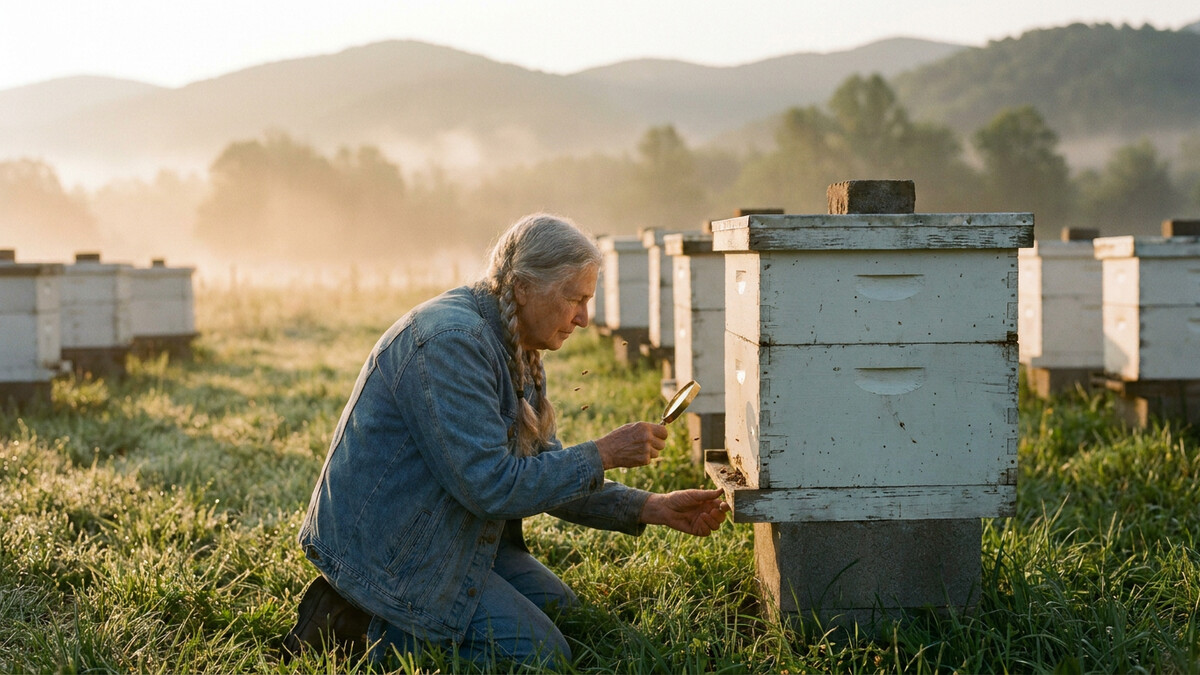
Ola Mae knelt down beside the hive in the grass, slowly, and caught a bee coming home on her finger, and held it close so the little girl could see.
On its back legs were two tiny packed balls of pollen, bright and startling blue.
"That's yours," she said. "That's your meadow."
Lily looked at it for a long time.
"It's safe now?" she whispered.
"It's safe now," Ola Mae said.