Ellie screamed. Or she tried to. It came out as a squeak.
She spun around. Mr. Locke was standing right behind her, tall as a tree in the dark, with the lantern light on one side of his face. He'd come around the tomato stakes without making a sound.
Ellie couldn't move. She couldn't run. She just stood there in her torn pajamas, staring up at him.
He looked down at her for a long moment.
Then he let go of her shoulder. He held up one finger, the way a teacher does. Wait.
He reached into the pocket of his overalls and took out a small spiral notepad and a carpenter's pencil. He wrote something, slowly, in big square letters, and held it out to her in the lantern light.
YOU TORE YOUR PAJAMAS ON MY FENCE. ARE YOU HURT?
Ellie stared at the notepad.
"No, sir," she whispered.
He nodded. He wrote again.
GOOD. YOUR FRIENDS IN THE PECAN TREE CAN COME DOWN NOW. I WON'T BITE.
They came down, eventually. Deshawn last.
Mr. Locke brought out a pitcher of sweet tea and five plastic cups and set them on an upturned bucket by the garden. He sat down on a wooden bench he'd obviously built himself, and the four kids sat on the ground in front of him in their pajamas, and he wrote on his notepad, one page at a time, in the lantern light.
He'd had cancer in his throat, four years ago. Right after his wife died.
The doctors had taken out his voice box to save his life. Now he breathed through the little hole in his neck.
THEY GAVE ME A MACHINE, he wrote. YOU HOLD IT TO YOUR THROAT AND IT TALKS FOR YOU. He made a face.
IT SOUNDS LIKE A ROBOT WITH A COLD. THE FIRST TIME I USED IT AT THE PIGGLY WIGGLY, A LITTLE GIRL CRIED.
He looked at the kids.
SO I QUIT TALKING.
Ellie's throat got tight. She thought about the cashier, and the exact change, and the way he'd smiled a little and walked out without a word.
"Why do you dig at night?" Priya asked in a small voice.
THE RADIATION, he wrote. IT DID SOMETHING TO ME. HEAT MAKES ME SICK NOW.
GEORGIA IN AUGUST, I CAN'T BE OUT IN THE DAY. He shrugged. SO I GARDEN WHEN IT'S COOL.
Deshawn pointed at the long burlap shape lying beside the trench.
"What's that?" he said.
Mr. Locke looked at it. Then he got up, slowly, and walked over, and pulled back the burlap.
It was roots. A long bundle of them, wrapped in wet newspaper. Dozens of little rooted cuttings, tied together with twine.
ROSES, he wrote. OLD ONES. LILLIAN'S MOTHER'S ROSES.
FROM HER HOMEPLACE IN TIFTON. He was quiet for a minute. Then he wrote one more page, very slowly.
MY WIFE ALWAYS WANTED A GARDEN BIG ENOUGH FOR THE FALL FESTIVAL GARDEN TOUR. SUNFLOWERS AND ZINNIAS AND HER MAMA'S ROSES. WE NEVER GOT TO IT.
I'M DOING IT NOW. FOR HER.
He held it out to the kids in the lantern light.
The fall festival was the third Saturday in October. It was nine weeks away.
He looked around at the long rows of red dirt, at the half-dug trench, at the burlap bundle of roses.
I'M NOT GOING TO MAKE IT, he wrote. I'M EIGHTY-SIX. I'M TOO SLOW.
Ellie went to the Okalee Public Library on Monday after school.
The librarian, Mrs. Hatcher, helped her find two books on American Sign Language. One had pictures. Ellie took them both home and practiced in her room in front of the mirror every night that week, until her fingers ached.
On Saturday morning, she walked down to the dead end of Pecan Street and stood at Mr. Locke's front gate. The same gate the kids dared each other to touch.
She opened it and walked right up the path.
Mr. Locke opened the door before she could knock. He looked down at her with his eyebrows up.
Ellie took a deep breath. Then she raised her hands, and slowly, carefully, the way the book showed, she signed: GOOD MORNING.
MY NAME IS E-L-L-I-E. CAN I HELP WITH THE GARDEN?
Mr. Locke didn't move.
Then his face changed. It crumpled, slowly, like a paper bag.
He put one big scarred hand over his eyes. When he took it away, he was smiling and crying at the same time.
He raised his own hands, slowly, a little clumsy. He'd been reading the same kind of book, Ellie realized later. He'd been practicing too, for four years, with only a mirror to sign to.
YES, he signed. Then, after a moment, a second word she had to look up when she got home.
PLEASE.
They worked every evening after that, from six o'clock until it got dark. When it was cool enough, Mr. Locke worked with them.
Ellie came first. Then Jackson.
Then Deshawn and Priya, and two boys from the next street over. Then some of their parents, who had lived on Pecan Street for years and had never once been inside Mr. Locke's gate.
They planted the sunflowers in long rows along the back fence. Mammoth Russians, the kind that grow ten feet tall.
They planted zinnias in every color, orange and pink and red and yellow, and marigolds along the edges. They set Lillian's mother's roses in the long trench Mr. Locke had dug, forty-one rooted cuttings from the old homeplace in Tifton, which he'd driven down to rescue that week before a developer bulldozed it.
Mr. Locke taught the kids to set a fence post straight with a level. He taught them to build a trellis.
He wrote on his notepad when he had to, and when he could, he signed, slow and careful, and Ellie translated for the others. By September, all the kids on Pecan Street could sign water, hand me that, good job, and too hot.
The Okalee Fall Festival was the third Saturday in October. There was a parade and a pecan pie contest and, for the first time, a stop on the garden tour at the dead end of Pecan Street.
The festival committee had put a little sign on Mr. Locke's front gate. It said: Lillian's Garden.
More than three hundred people came through that afternoon.
They walked between rows of sunflowers so tall they had to tip their heads back to see the faces. They walked past zinnias like a sunset and marigolds like coins. And at the far end of the garden, along the back fence, in a long row in the red Georgia dirt, Lillian's mother's roses had taken hold.
Most of them had only a few leaves. One of them, the one at the very end, had a single pink bloom.
Mr. Locke stood by that rose all afternoon, in a clean white shirt with a fresh square of gauze at his throat. He shook hands.
He nodded. He wrote on his notepad when people asked him questions.
And when the kids came by, he signed to them, and they signed back.
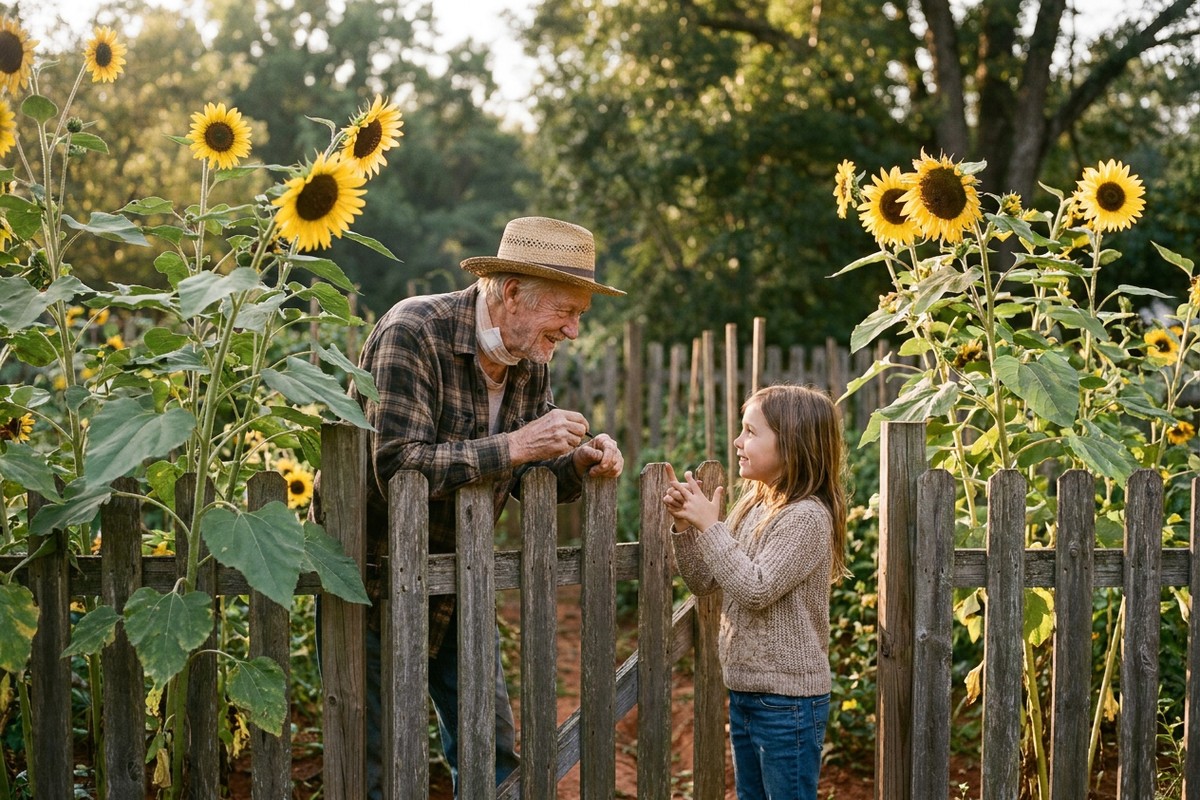
Late in the afternoon, when the crowd had thinned, Ellie found him at the front gate. The same gate the kids had dared each other to touch all summer.
She stood on the outside. He stood on the inside. The sunflowers were taller than both of them, nodding over the fence in the gold October light.
She raised her hands.
THANK YOU FOR LETTING US IN, she signed.
Mr. Locke looked at her for a long moment. Then he raised his big scarred hands, slowly, and signed back.
THANK YOU FOR CLIMBING THE FENCE.