Faye didn't argue through the door. She'd raised three boys of her own, and she knew better.
"All right," she said. "I'll go. But I left something in the bookmobile for you. The new Hank the Cowdog. Number seventy-something. It came in Monday, and I saved it."
There was silence on the other side of the door.
"I'll set it here on the porch," Faye said. "And I'll sit out in the bookmobile for a few minutes, warming up, before I drive back down. It's real cold out here, Wesley. My heater works good."
She went back to the bookmobile and sat in the driver's seat with the door open and the heater blowing.
It took four minutes.
Then the front door of the Hensley house opened, and a skinny boy in two sweatshirts and a toboggan hat came out onto the porch, looked at the empty spot where she hadn't actually set any book, and then looked at her.
He was crying. He was trying very hard not to.
"Miss Faye," he said. "I can't get the fire to go."
Inside, the house was as cold as the porch.
Ollie Hensley was sitting in his recliner by the dead woodstove under three quilts and an old Army blanket. He was seventy-eight, a retired coal miner, a big man gone thin.
The left side of his face drooped. When he saw Faye in the doorway, he tried to sit up straighter, and the left side of him didn't want to.
"Miss Combs," he said. His words came slow and a little thick. "I told the boy. Don't go bothering folks."
"Mr. Hensley," Faye said, "I'm not one bit bothered."
She looked at the woodstove. There were ashes, gray and cold, and two big unsplit rounds of oak on the hearth. Beside them was a hatchet, a boy's hatchet, and a pile of wood chips where somebody had been trying for a long time to split a round of oak that was too big for him.
It came out of Wesley while Faye got the fire going, crouched by the stove with kindling she'd brought in from the bookmobile.
Grandpa had a stroke three weeks ago. Wesley had found him on the kitchen floor and run a mile and a half down the hollow to the neighbor's to call. Grandpa had been in the hospital in Hazard for five days.
Then they'd sent him home. A nurse was supposed to come twice a week, but the snow had come, and she couldn't get up the road.
Wesley had been taking care of him by himself.
He'd made the meals out of the cookbook. He'd done Grandpa's pills out of the little plastic box with the days on it. He'd read the first aid book and the stroke book so he'd know what to watch for.
Last night, the split wood ran out.
"I couldn't split it," Wesley said. "I tried. The pieces are too big. And I was scared if I went and told somebody, they'd come and take Grandpa to a nursing home. And take me somewhere else." He wiped his face with his sleeve. "That's what happened to a boy at my school. So I wrote the note. So you'd stop coming. So people wouldn't notice."
He looked at his grandfather.
"I signed it for him," Wesley said. "I'm sorry, Grandpa."
Ollie's eyes were wet. He didn't say anything.
The fire caught. Faye fed it slowly, the way her mother had taught her, small wood first. Then she sat back on her heels and took out her phone.
She knew every family on her route. She'd been carrying their books for twenty-nine years. She knew who had a log splitter and who had a four-wheel drive and who was a nurse, and she knew which of them would come up a snowy hollow for Ollie Hensley without asking a single question.
Her cousin Darlene was a home health nurse in Hazard. Faye called her first.
Then the Free Will Baptist preacher in the next hollow over, who had a tractor with a blade. Then Junior Sizemore at the mouth of Laurel Fork, who had a splitter and two strong teenage sons.
Then she sat down beside Ollie's recliner.
"Mr. Hensley," she said quietly, "doesn't Wesley have an aunt? In Lexington? I remember her name on a Christmas box. Teresa."
Ollie looked at her a long moment. Then he nodded, slowly.
"We'll call her too," Faye said. "Not to take anybody anywhere. Just so she knows. A boy shouldn't carry this all by himself, and neither should you."
By three o'clock that afternoon, the preacher had bladed the hollow road all the way to the house. Junior Sizemore and his boys had split a cord of oak and stacked it on the porch. Darlene had come up in her four-wheel drive and checked Ollie over and said, firmly, that he was doing better than he had any right to, and that the boy had done everything right.
Wesley's Aunt Teresa called back from Lexington at four. She was coming Saturday, she said.
For a few weeks, at least. Longer if they needed her.
Faye drove the bookmobile back down the hollow at dusk. Her route was three hours behind. She didn't care.
The next Thursday, the snow was mostly gone.
When the bookmobile pulled up to the wide spot at the mouth of Laurel Fork, Wesley was waiting. He ran to meet it before the door was even open, the way he always had.
But he wasn't alone.
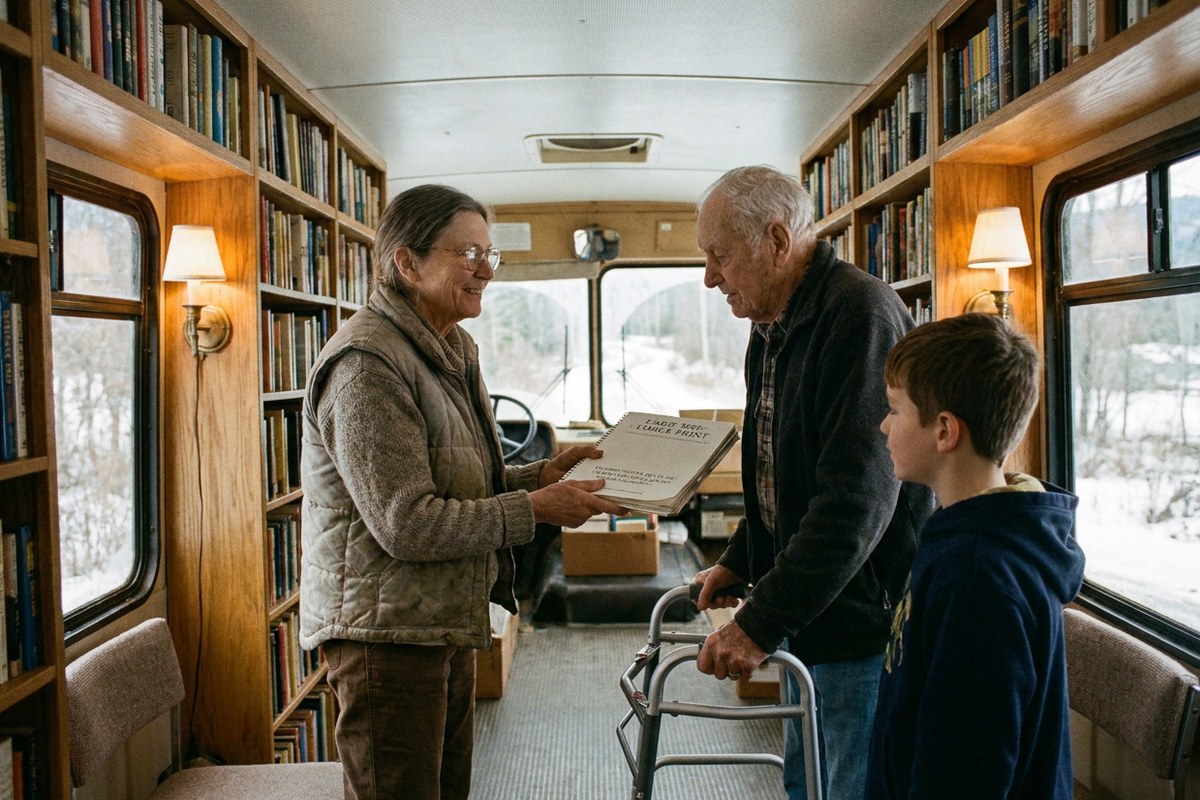
Behind him, at the end of the gravel road, sat his Aunt Teresa's car. And beside the car, leaning on a walker, in his good coat, with the left side of his face still drooping, stood Ollie Hensley.
He came up the steps of the bookmobile very slowly, one at a time, with Wesley behind him and Teresa holding his elbow. He stood in the narrow aisle between the shelves and looked around like a man in a church.
"Miss Combs," he said. "I'd like a book."
"What kind of book, Mr. Hensley?"
Ollie looked at Wesley. Then back at her.
"One that teaches a man his letters," he said. "I'd like to sign my own name."
Faye found him one on the bottom shelf, a big, plain reader with large print. Then she sat down in the driver's seat, opened her spiral log to a fresh page, and wrote it down in pencil.
O. Hensley. Learning to read.