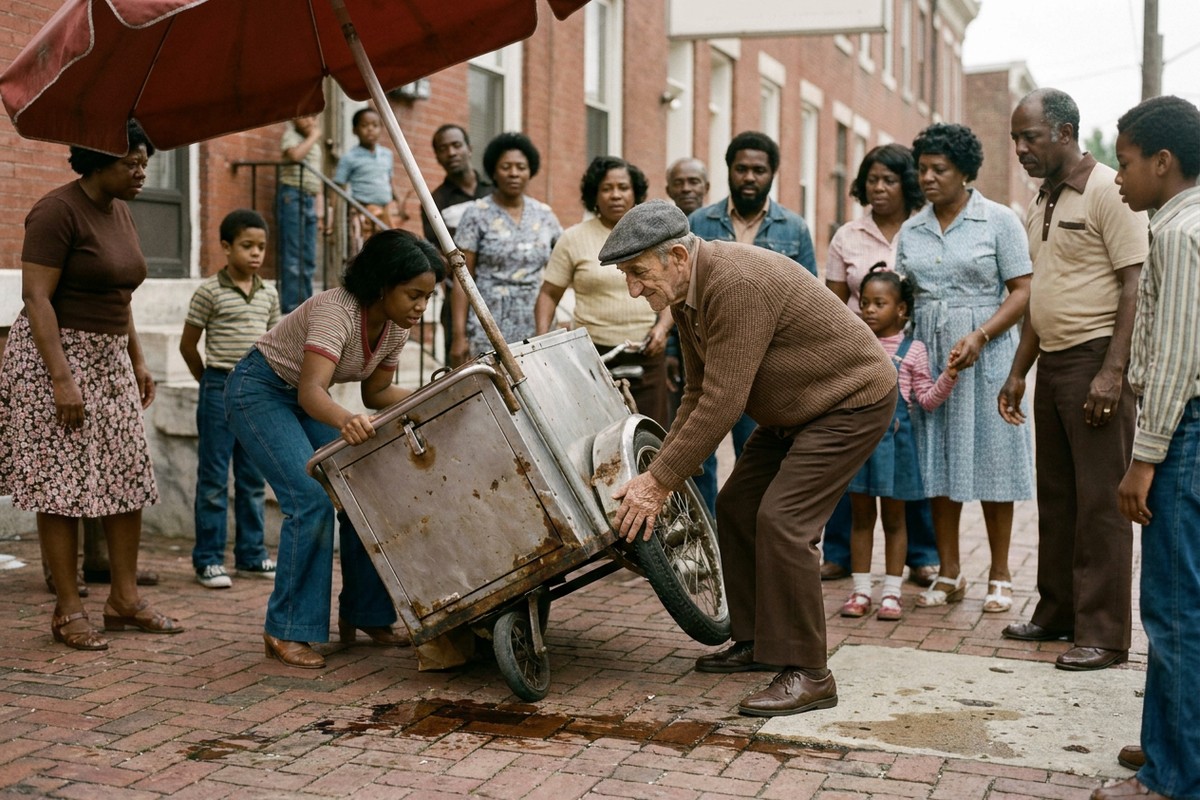
Sal walked over the spilled coffee and stood between Troy Mahaffey and the girl.
He didn't put up his hands. He didn't make a fist. He just stopped, about two feet in front of Troy, with Tessa behind him, and planted his feet on the wet sidewalk the way he'd been taught to plant them in a gym on Eastern Avenue in 1968.
Weight even. Knees soft. Shoulders down.
And he didn't move.
"Troy," he said. His voice was low and steady, almost gentle, the way you'd talk to a dog you weren't sure about. "You're going to want to go home now."
Troy laughed. His two friends laughed with him. "Or what?"
"Or nothing," Sal said. "I'm not going to hit you, son. I'm just going to stand here."
That confused Troy. Sal could see it.
Troy had come for a fight. He'd come with two friends to make sure he won it. He'd figured the old boxer would swing, and then Troy would get to knock down a seventy-four-year-old man in a cardigan on a Saturday morning in front of the whole avenue, and call it self-defense.
But the old man wasn't swinging. He was just standing there in the coffee, looking at him.
"Get out of my way, Pop."
"No," Sal said.
Troy stepped forward until his chest was almost touching Sal's cap. He was breathing hard. Sal could smell last night's beer on him.
Sal didn't step back. He didn't lean forward either. He just stood exactly where he was, and kept his hands down at his sides, and kept looking up into Troy's eyes.
In 1971, Sal's trainer, an old Irishman named Mickey Doyle, had taught him that the man who moves first has already lost. Don't chase him.
Don't flinch. Make him come to you, and most of the time, he won't.
"You're not going to hit me, Troy," Sal said quietly. "And I'm not going to hit you. So we're going to stand here a while."
They stood there.
It took about a minute for the avenue to notice. Then it noticed all at once.
Augie came out of his barbershop first, still holding his clippers, with a customer behind him in a cape and half a haircut. They crossed the street and stood beside Sal on his left.
Neither of them said anything. They just stood there.
Then Mrs. Dombrowski came down her front steps in her housecoat and slippers. She was eighty-three years old and four foot eleven. She walked across Eastern Avenue without looking for traffic, and she took her place on Sal's right, and she folded her arms.
Then Mr. Hernández came out of the bakery on the next block, in his white apron with flour up to his elbows, and his two grown sons behind him. Then a woman pushing a stroller, who stopped, and set the brake, and stood there. Then a family coming back from the Saturday market with bags of tomatoes.
They didn't shout. They didn't threaten anybody. They just came, one at a time and two at a time, and stood on the sidewalk around Sal Benedetto and the overturned coffee cart, quiet, the way the old man was quiet.
In three minutes, there were thirty people on that corner. In five, there were more than fifty.
And a teenage boy on a bicycle at the edge of the crowd was holding up his phone, filming the whole thing.
Troy looked around.
His two friends had already started backing away. One of them said, "Man, let's go," and the other one was already halfway down Conkling Street. Troy stood alone on the wet sidewalk in a circle of fifty silent neighbors, with an old man in front of him who still hadn't moved an inch.
His face was red. Then it was something else.
"This is stupid," he said. "You people are crazy."
The crowd didn't answer him. Mrs. Dombrowski just tilted her head, the way she did at the butcher when the scale looked wrong.
Troy backed up one step. Then two. Then he turned around and walked away down Eastern Avenue, fast, with his head down, and the crowd opened up to let him through and closed again behind him.
The police came twenty minutes later. This time it was different. This time there were fifty witnesses, and a video from four angles, and an overturned cart with a broken umbrella and a busted cash box.
Troy Mahaffey was arrested that afternoon at his apartment two miles away. The charges were destruction of property, and harassment, and a few other things the officer read off a list. A judge ordered him to stay away from Tessa Moreno and from the corner of Eastern and Conkling.
The video went around the neighborhood by suppertime. By Monday, it had been watched two hundred thousand times.
But before any of that, there was the sidewalk.
When Troy was gone, Mr. Hernández's sons got down and started picking up the quarters. Augie and his half-haircut customer took one end of the coffee cart. Sal took the other.
"Tessa," he said. "Give us a hand, honey."
She took the middle. Her hands were shaking. The three of them lifted the cart off its side together and set it back up on its wheels, and somebody rolled the steel thermoses back over, and Mrs. Dombrowski went home and came back with a mop.
Tessa stood there looking at the broken red umbrella. She was crying a little, and she was angry about crying.
"Why didn't you hit him?" she asked Sal, very quietly, when the crowd had thinned out. "Augie said you could have. With one punch."
Sal took off his cap. He turned it around in his hands a few times.
"I could have," he said. "That's the problem."
He told her about 1973. About a summer night outside the Venetian Lounge, two years after the Golden Gloves, when a drunk man shoved Sal's kid brother Joey into a parked car.
Sal had hit him once. Just once, a right hand, the way Mickey Doyle had taught him.
The man fell straight back and hit his head on the curb.
"His name was Dennis Keefe," Sal said. "He was in a coma at Hopkins for nine days. I sat in that waiting room every one of them. He woke up, thank God. But he was never quite right after that. He couldn't go back to his job at the shipyard." Sal put his cap back on. "I went to see him every Christmas until he died in 2002. I never got in a ring again. Never made a fist again, not at a man."
Tessa didn't say anything for a while.
"One punch," Sal said. "That's all it takes, honey. That's the thing they don't tell you about being able to hit hard. Anybody can swing. The hard part is standing there and not doing it."
He looked at the corner, at the neighbors still drifting back to their stoops and shops, at Augie's customer finally going back to get the other half of his haircut.
"Besides," he said. "I didn't need to hit him. I had Mrs. Dombrowski."
Tessa laughed through her tears. She wiped her face with the back of her hand.
On Monday morning at six-fifteen, she was back on the corner with a new red umbrella. Augie had bought it. The line was twenty people long, the longest it had ever been, and it went all the way past the newsstand to the barbershop door.
The first cup she poured was for Sal. On the side, in Sharpie, she'd written: For the Champ. Still undefeated.