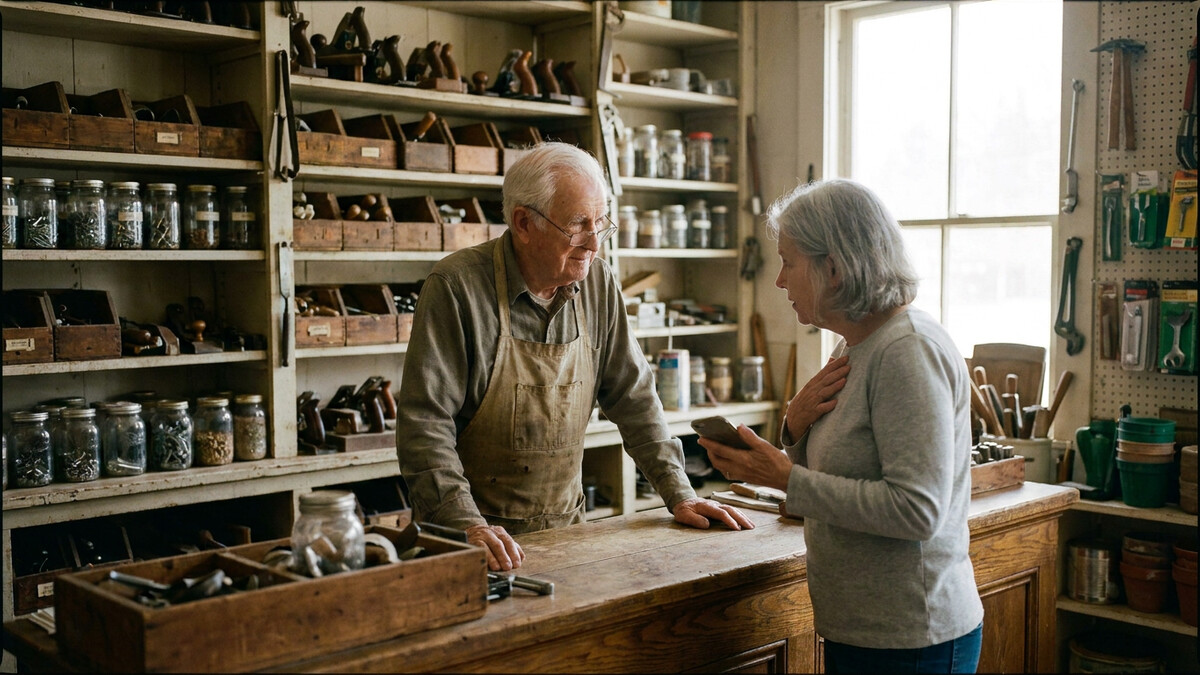
Merle Gaddis had run the hardware store on the square in Osage Bend, Missouri, for fifty-five years, and he had never once refused to sell a customer anything until the Tuesday morning Lorene Biggs came to his counter shaking and asked for twenty gift cards at a hundred dollars apiece.
"Lorene," he said. "What on earth for?"
"Just ring them up, Merle." She had her checkbook out. Her hands would not hold it still. "Please. I'm in a hurry."
Merle looked at her. Then he looked at the cell phone in her other hand, pressed against her chest, with the screen lit up. A call was still connected. Twenty-two minutes.
"Who's on the phone, Lorene?"
She did not answer.
Merle was seventy-seven. He bought Gaddis Hardware from his father in 1971, the year he married Ruthie, and had worked behind the same oak counter ever since. He could tell you what size washer fit what faucet in every house in town. He still kept charge accounts for the old customers on index cards in a wooden box under the register, because the old customers liked it that way.
Ruthie had died in 2020. Lorene Biggs had been her best friend for sixty years.
Lorene was eighty-one. She was a careful, proper woman who had taught piano to half the children in Osage Bend and never in her life bought anything she did not need. In all the years Merle had known her, she had never bought a gift card.
"Lorene," he said gently. "Put the phone on the counter for me."
"I can't. He said not to hang up."
"Who said?"
Lorene's eyes filled.
"The lawyer," she whispered. "For Kyle."
Kyle was her grandson. Merle knew him. A big, good-natured boy of twenty-four who had stocked shelves at the store in high school and broken more light bulbs than any employee in Gaddis Hardware history.
According to the lawyer on the phone, Kyle had been arrested in Mexico. A car accident. A woman was hurt. The police were holding him until somebody posted bail. The lawyer said the court only took payment in gift cards, because of the international banking laws. The lawyer said it had to be today. The lawyer said Kyle was too ashamed to call his parents and had begged him to call Grandma instead.
And the lawyer had said, very firmly, that if Lorene told anybody, the judge would add a charge for interfering, and Kyle would go to a Mexican prison for ten years.
"I talked to him, Merle," Lorene said. "To Kyle. He got on the phone for a minute. He was crying. He said, Grandma, please, it's me, please help me."
"Did it sound like him?"
"He was crying," Lorene said. "His nose was all stuffed up. He said he broke it in the accident." She pressed the phone harder against her chest. "Merle, please. Just sell me the cards."
Merle had seen this before. Not in his store. In the newspaper, and on the television, and once, two years ago, at the Methodist church supper, when Bud Holloway stood up and told the whole fellowship hall how he had lost eleven thousand dollars to a man who said he was his nephew.
Merle had sat in the fellowship hall that night and thought, that won't happen in my town. Not to my people.
It was happening at his counter.
"Lorene," he said. "Honey, this is a scam."
"No. No, Merle, you didn't hear him."
"Courts don't take gift cards," Merle said. "Not here, not in Mexico, not on the moon. Gift cards are for birthdays. The only people who want bail in gift cards are crooks, because once you read them the numbers, the money's gone, and the police can't trace it."
Lorene stared at him.
Then, from the phone pressed against her chest, Merle heard a man's voice. Faint. Sharp. Urgent.
Mrs. Biggs. Mrs. Biggs, are you there? Is someone with you? Remember what I told you. If you talk to anyone, Kyle goes to prison.
Lorene's face crumpled.
She did not buy the gift cards.
But she did not believe him, either.
She put her checkbook back in her purse. She said, in a thin, tight voice, "Thank you, Merle. I'll take care of it myself." And she walked out of Gaddis Hardware with the phone against her ear, the bell over the door jangling behind her.
Merle watched her through the front window. She crossed the square toward the First Osage Bank, walking faster than he had seen an eighty-one-year-old woman walk.
He knew the bank. He knew the tellers. If she asked for a large withdrawal, they were supposed to ask questions.
But Lorene had been banking there since 1962. They would not want to embarrass her. And she would tell them whatever the man on the phone told her to tell them.
Merle called the bank anyway. He got the manager, a young woman named Tara, who was polite and worried.
"Mr. Gaddis, I can't discuss a customer's account," she said. "But I can tell you that if someone in her situation wanted to withdraw cash, and told us it was for a new roof, and showed us her ID, we would have to give it to her. It's her money."
"How much cash, Tara?"
"I really can't say."
"Tara."
A long pause.
"More than you'd think," Tara said finally, very quietly. "And she said a man from the roofing company was coming to her house to pick it up at four o'clock."
Merle looked at the clock over the paint counter. It was ten past two.
He called the sheriff's office. The dispatcher said a deputy would try to swing by, but they had a wreck on Highway 54 and the sheriff was in Jefferson City.
He drove to Lorene's house on Elm Street. She would not come to the door. Through the front window, he could see her sitting in her late husband's recliner with the phone against her ear and a bank envelope in her lap, thick as a paperback book.
He knocked for five minutes.
She did not look up.
Merle stood on her front porch in the cold and felt more helpless than he had in fifty-five years behind a counter. He had always been able to fix things. A leaky faucet. A broken screen door. A furnace that would not light. He knew where every part in Osage Bend was kept.
He could not fix this.
And then, standing on the porch with his hands in his coat pockets, he thought of the wooden box under his register. The charge account cards. Fifty years of them, on yellowed index cards, in his own handwriting.
Every one with a name. An address. And, on the back, a phone number for family, in case of emergency.
He had written them all himself.
He was already running for his truck when a car he did not recognize turned onto Elm Street, slowed, and pulled up to the curb in front of Lorene's house.
It was ten minutes to four.