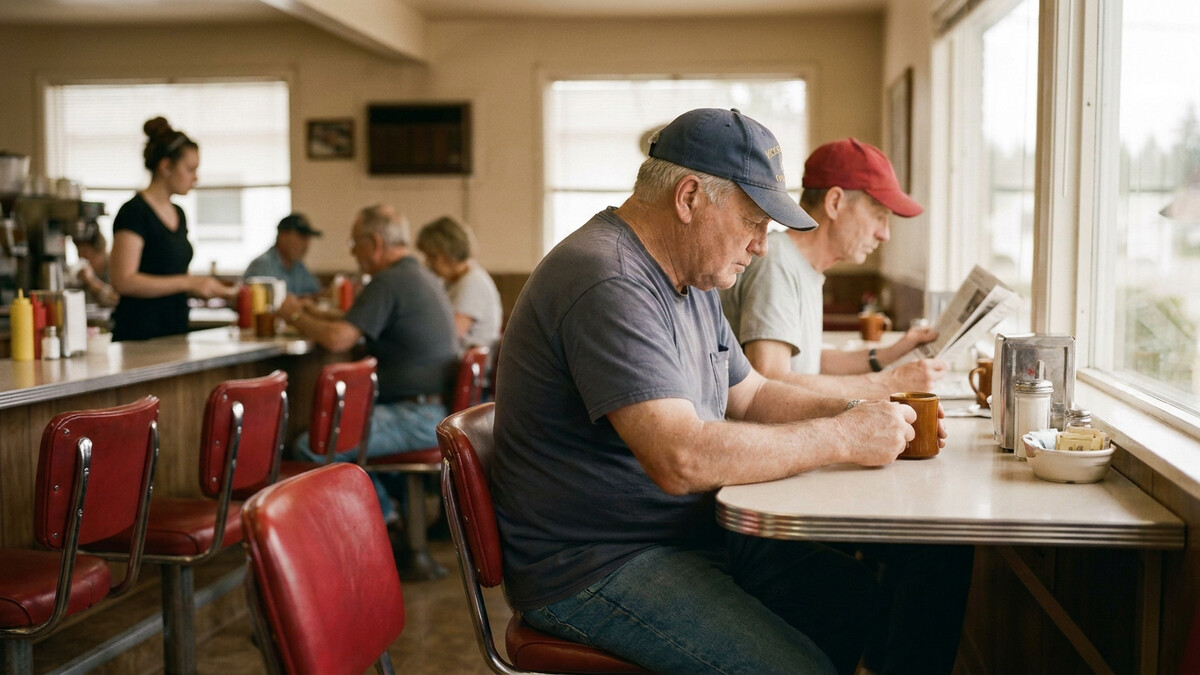
Dewey Lamb had raised his brother's son for fourteen years, and on the Tuesday before the Panthers' first playoff game in a decade, his brother walked into Dot's Corner Diner, sat down at the counter two stools away, and ordered the same thing Cody always ordered.
Two eggs scrambled hard. Wheat toast. Chocolate milk.
Dewey set down his coffee cup very carefully.
"Hello, Dewey," Rick Lamb said, without turning his head.
"Rick," Dewey said.
Behind the counter, Dot Kessler stopped with the coffeepot in midair, looked at the two of them, and quietly went to refill somebody else's cup.
Dewey was sixty-four. He had grown up in Pine Hollow, the oldest of two boys, and left at eighteen for the Navy. He had spent twenty-two years as a cook on aircraft carriers and destroyers, feeding five thousand sailors three times a day, and retired as a chief petty officer in 2010 with a bad back and no family to speak of.
Then, in 2012, his little brother Rick had gone to prison.
Burglary. A string of break-ins at farm supply stores in three counties, to pay for pills. Rick was twenty-seven. His girlfriend had already left. His son, Cody, was three years old, sitting alone in a Zanesville apartment with a social worker when Dewey got the call.
Dewey had driven up from Norfolk, Virginia, in eleven hours straight.
He had never once regretted it.
Cody was seventeen now. He was six foot two, a senior, the Panthers' starting center, and the kindest boy Dewey had ever known. He had grown up in the little white house on Feed Mill Road, with Dewey cooking his breakfast every morning at six and checking his homework every night at nine.
Dewey had told him the truth about his father, a little at a time, as he got old enough. That Rick had been sick. That the sickness was pills. That he had done wrong things and was paying for them. That he wrote letters from prison, and Cody could read them whenever he wanted.
Cody had read three or four over the years. Then he stopped.
"I don't want to hate him, Uncle Dewey," he said once, at fourteen. "I just don't know him."
"I got out in June," Rick said at Dot's counter, still not looking at him. "Did four years in the state prison, then the rest at a halfway house in Columbus. I've been clean eight years. I've got a job now. Driving a cattle truck for an outfit in Zanesville."
"Good for you, Rick," Dewey said. He meant it. He did not know how to say it like he meant it.
"I want to see him, Dewey."
"He's at school."
"I know he's at school." Rick finally turned on the stool and looked at him. He was forty-one and looked fifty. Thin. Gray at the temples. His hands, wrapped around Dot's coffee cup, were shaking a little. "I want to come to the game Friday. And after he graduates, I want him to come live with me. In Zanesville. I've got a two-bedroom. I've been saving."
Dewey did not say anything for a long time.
"He's not a truck you left in a parking lot, Rick," he said finally. "You don't just come back and pick him up."
Rick's face went red. He put money on the counter and walked out.
That afternoon, Dewey drove out to Clay Hollister's place.
He did not know Clay well. Not many people did. Clay was seventy-two, a retired saddle bronc rider from Wyoming who ran thirty Angus cows on eighty acres off Route 9 and limped from a wreck in Cheyenne in 1983. He sat in the back row at the sale barn every Thursday and said almost nothing.
But Ray Dunbar, the auctioneer, had once told Dewey that Clay Hollister could read a man by how he walked, the same way he read a bronc in the chute. And Dewey had seen Rick's cattle truck at the sale barn twice that fall.
Clay was in his barn, working on a gate hinge. Dewey told him the whole story.
Clay listened without looking up from the hinge.
"Your brother," he said, when Dewey finished. "Tall fella. Red cap. Drives for Muskingum Livestock Hauling. Unloads in the back pens on Thursdays."
"That's him."
Clay put down his wrench.
"He's been coming to the sale barn every Thursday since August," he said. "Unloads his load. Then he sits in the truck for an hour and watches the parking lot."
"Why?"
"Because your boy works the gate at the sale barn on Thursdays after school," Clay said. "For Bev Truitt. Moving cattle through the back alley."
Dewey stared at him.
"That man's been sitting in his truck every week for three months," Clay said quietly, "watching his son move cattle. He never once got out."
Dewey went home and thought about that for a long time.
He cooked supper. Meatloaf, mashed potatoes, green beans, the way Cody liked it before a game week. He set the table for two.
Cody came in at six-thirty from practice, sweaty and starving, and dropped his bag by the door.
"Smells good, Uncle Dewey."
Dewey did not answer right away. He was standing at the stove with his back to the door, and he was on the phone with Clay, who had called back to tell him one more thing.
He did not hear Cody come in.
"Clay, I'm not saying he's a bad man," Dewey was saying. "I'm saying I don't want him near that boy. Not yet. Maybe not ever. I've had him fourteen years. Rick had him three. That's my boy. Not his."
Behind him, the kitchen had gone very quiet.
Dewey turned around.
Cody was standing in the doorway, still in his practice jersey. His face was white.
"He's here?" Cody said. "My dad's here? In town?"
"Cody."
"And you weren't going to tell me." The boy's voice cracked. "You were going to decide. For me. Like I'm three."
"Son, listen to me."
"I'm not your son," Cody said.
He picked up his truck keys off the hook by the door, the keys to the old Ranger Dewey had bought him at sixteen, and walked out into the November dark.
Dewey heard the engine start. He heard the tires on the gravel. He stood at the kitchen window with the phone still in his hand and Clay's voice saying his name, and watched the taillights turn north on Feed Mill Road.
North. Toward Zanesville.