Clarence didn't waste any more time on the sign.
A mile-and-a-half train at fifty miles an hour takes about a mile to stop, sometimes more. He'd stopped them himself, plenty of times, and he knew the feel of it in his body: the long slow shove of all that weight behind you, the brakes taking hold car by car.
If the engineer saw trouble at the crossing, it was already too late.
The engineer needed to see it a mile out.
"Ma'am," he told the dispatcher, "tell the railroad the train is the eastbound approaching Grange Road right now. Tell them I'm going out to flag it."
He didn't wait for her answer. He put the phone in his pocket and ran for the truck.
The farm lane ran along the north side of the tracks, straight west across his own field. Clarence had driven it every day for fifty years. He drove it now with the headlights off so the engineer wouldn't mistake them for anything, and he drove it by memory, by the feel of the ruts under the tires and the line of fence posts going by his left elbow in the snow.
The headlight on the main line grew brighter.
At the end of his field, a little over a mile from the crossing, he stopped the truck and got out. He grabbed the grip bag, climbed through the fence, and slid down the bank to the tracks.
The wind hit him like a wall. Snow stung his face. He could feel the rail humming under his boots.
He took out a fusee, pulled the cap, and struck it on the end the way he'd done a thousand times. It flared red, hissing, so bright it lit the snow pink for fifty feet around him. He jammed it upright in the ballast between the rails.
He lit a second one and planted it beside the first.
Then he took out the old lantern, switched it on, stepped to the side of the tracks, and began swinging it in a slow, wide arc, back and forth, straight across the rails.
A light swung across the track means stop. It had meant stop since before Clarence was born. Every engineer in America knew it.
The headlight bore down on him out of the snow, huge now, and the horn blew.
Clarence kept swinging.
He heard the brakes go on before he saw it.
It was a sound he'd never forgotten. An emergency application, the air dumping all at once, a long iron scream running back through a mile and a half of train. The headlight kept coming.
The cars kept coming. The whole earth shook under his boots.
Clarence stepped back down the bank and kept swinging the lantern.
The locomotives went past him at a walk, then a crawl, close enough that he could feel the heat off the engines. Sparks were coming off the wheels. The second locomotive passed him, then the first few cars of containers.
Then, with a long groan and a last hiss of air, the train stopped.
Clarence turned and looked east down the tracks. A quarter mile past the front of the train, through the blowing snow, he could just see the red taillights of the bus.
The conductor came down off the lead engine with a radio in one hand and a lantern of his own in the other. He was in his fifties, with a gray beard frozen white.
"Dispatcher said Grange Road," he shouted over the wind. "We were already slowing for it. And then we saw your fusees."
"Bus on the crossing," Clarence shouted back. "Thirty-one people. All off and clear."
The conductor looked at the old man in the snow with the lantern, and then at the fusees still burning red between the rails.
"Who are you?" he said.
"Clarence Holt. I ran this line thirty-eight years."
The conductor stared at him. "Holt? You were the engineer on the old grain train out of Council Bluffs? My dad was your conductor. Gil Ramos."
"Gil was the best conductor I ever had," Clarence said. "He couldn't play cards worth a nickel."
The conductor laughed, a big surprised laugh that the wind tore away.
It took the county until after two in the morning to get a wrecker out through the snow and drag the bus off the crossing.
The train crew couldn't leave their train. But Clarence could leave his porch light on.
He drove the grandmother and the littlest kids up to the house first, and then he went back for the others, three trips in his old pickup. By midnight there were thirty-two strangers in his farmhouse, and every one of them was warm.
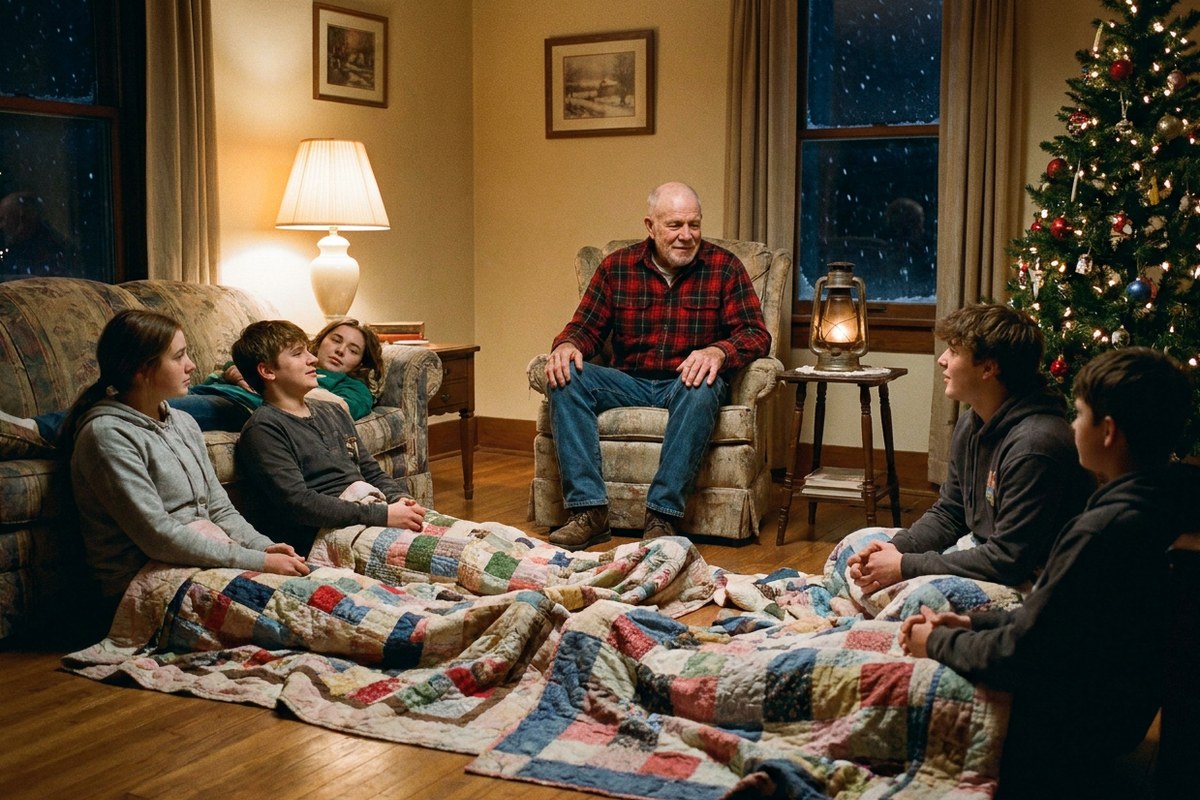
The chaperones found the spare quilts in the hall closet where Doris had always kept them. The teenagers made a pallet on the living room floor. Clarence put on the big percolator and found two boxes of Christmas cookies his neighbor had dropped off, and when those ran out, the grandmother made pancakes in his kitchen and told him his cast-iron skillet was a disgrace.
At midnight, the youth pastor asked if anybody minded if they sang. The room went quiet, and then the grandmother started the first verse herself.
Clarence sat in his recliner and listened to thirty teenagers sing "Silent Night" in his living room. He hadn't had a Christmas Eve like it since Doris died. He hadn't had one like it ever, really.
The girl in the pink ski hat sat on the floor by his chair.
"Were you scared?" she asked him. "Out there on the tracks?"
Clarence thought about it honestly.
"I was scared I'd forgotten something," he said. "Turned out I hadn't."
At a quarter to three, the wrecker cleared the crossing.
Clarence was still awake. He heard the train start up again, the long pull of the locomotives taking up the slack, the cars clanking into motion one by one. He went to the kitchen window to watch.
The train came past his house slow in the dark, a mile and a half of lights and steel. As the lead engine passed the end of his lane, the horn sounded.
Not the crossing signal. Two short, sharp blasts, the way a crew says thank you to a man standing by the tracks.
Clarence lifted the old lantern from the kitchen table, switched it on, and held it up in the window until the last car had gone by.