Nell did not call anybody.
She did not call the sheriff. She did not call Karen in Tyler. She did not get in her own truck and go after him, though she thought about it for a long time, standing in the cold kitchen with her hand on the empty table.
She knew where he was going. The casinos were across the state line in Louisiana, an hour and a half east. Open all night.
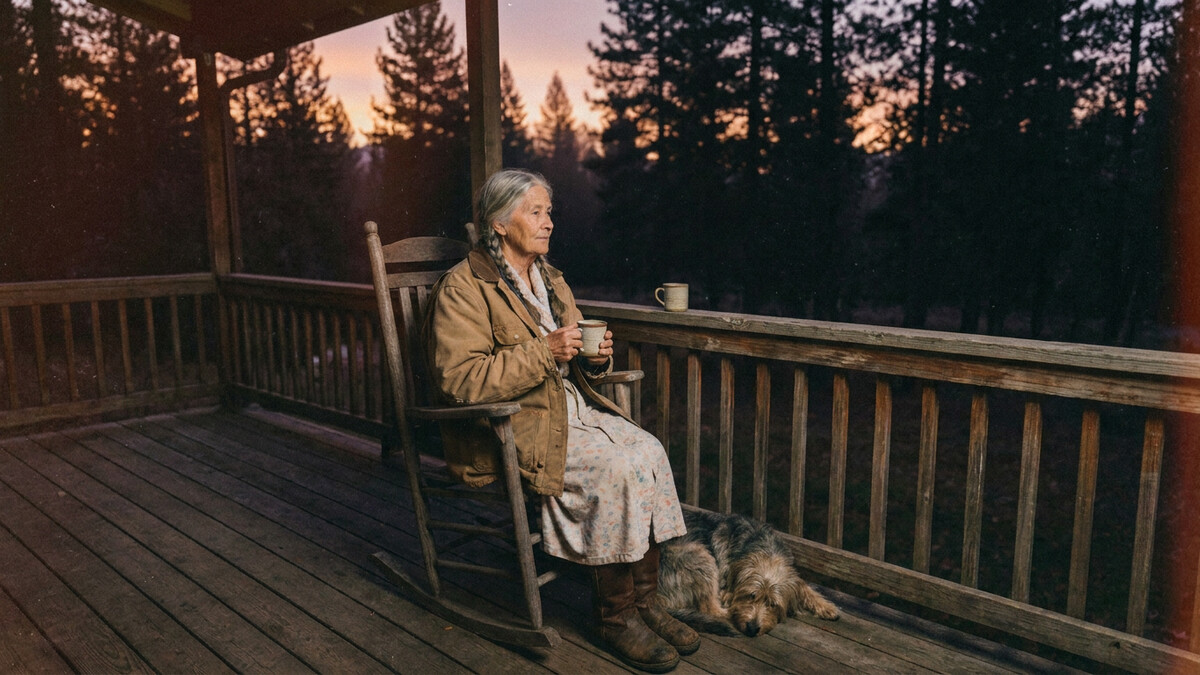
She put on a pot of coffee. She put on J.D.'s old barn coat over her robe. She took two cups out to the front porch and set one of them on the railing, and she sat down in the rocking chair with the other one and Rowdy at her feet.
And she waited.
She had waited like this before. In 1984.
J.D. had been drinking for ten years by then. Not falling-down drunk. Just every night, and harder every year. That spring, he had taken the grocery money out of the coffee can on the kitchen shelf and driven to a honky-tonk in Shreveport, and Nell had sat on this same porch until dawn with a cup of coffee, because she did not know if the man who came home would be her husband or a stranger.
He had come home at five. Sober. He had sat in his truck in the yard for an hour before he got out. Then he walked up the steps and put the coffee can money back on the kitchen shelf, every dollar, and sat down on the porch beside her.
"I sat in the parking lot all night," he said. "I couldn't go in. I kept thinking about you sitting here."
He never drank again. Not one drop. For the rest of his life.
Nell had never told her children that story.
At three, she was still waiting. At four, the coffee in the second cup on the railing had gone cold. She went in and made a fresh pot and poured a new one.
Rowdy slept. The pines sighed in the wind. Off to the east, a long way off, a train blew for a crossing.
At a quarter to five, she heard a truck on the county road.
It slowed down. It turned in at the cattle guard. Its headlights swept across the pasture and the barn and the porch, and came to a stop in the yard.
Jimmy's silver pickup.
He did not get out.
He sat in the truck with the engine off and the headlights off. Nell could see the shape of him behind the cracked windshield. Not moving.
She did not get up. She sat in the rocking chair with her coffee and waited, the way she had waited for his father forty-two years before.
At a quarter past five, the truck door opened.
Jimmy walked up the porch steps slowly, like an old man. He had the envelope in his hand. He set it on the porch railing beside the cold cup of coffee.
Then he sat down on the top step, with his back to her, and put his face in his hands.
"I drove to Shreveport," he said. His voice was muffled. "I sat in the parking lot for three hours. I had the envelope in my hand. Twelve hundred dollars. I kept thinking, I'll turn it into five thousand. I'll come back with your money and mine and you'll never know."
Nell did not say anything.
"I couldn't go in," Jimmy said. "Every time I put my hand on the door handle, I saw you. Sitting here. Waiting. I don't know how I knew you'd be sitting here. I just knew."
He turned around on the step. His face was wet.
"Mama, I'm sick," he said. "I've been sick for two years. I can't stop. I don't know how."
Nell set down her coffee.
She reached over and put her hand on her son's head, the way she had when he was six and had a fever.
"I know you're sick, son," she said. "Your daddy was sick too."
Jimmy looked up at her.
And sitting on the porch at five in the morning, in J.D.'s old barn coat, Nell Pritchett told her son the story of the coffee can.
He was quiet for a long time after she finished.
"Daddy did that?" he said finally. "Daddy drank?"
"For ten years," Nell said. "And then he sat in a parking lot all night and couldn't go in. Just like you." She handed him the fresh cup of coffee. "So I knew you'd come back, Jimmy. I didn't know when. But I knew you'd come back. You're his son."
Jimmy held the coffee in both hands and cried like a little boy.
That Tuesday night, Nell drove him to a meeting in the basement of the First Methodist Church in Caddo Springs. A group for people with a gambling problem. It met every week, at seven. She sat in the truck in the parking lot with Rowdy until it was over, and when Jimmy came out, he did not say anything, and she did not ask.
He went back the next Tuesday. And the next.
At the end of the month, Nell wrote him a check for five thousand dollars, as she had promised. He looked at it for a long time.
Then he tore it in half.
"I'd like to stay another month," he said. "If that's all right. And I'd like you to keep my phone at night. In your room. Until I don't need you to."
He stayed through the winter.
In February, with Karen's husband, who was a CPA, he made a plan to pay off the thirty-one thousand dollars, a little at a time, from a job driving a feed truck for the co-op in Center. He gave up the apartment in Houston. He moved into the old hired man's trailer behind the barn and fixed the roof himself.
And every morning at five-thirty, he fed the cows.
On the first Saturday in March, Nell came out on the porch at daylight with two cups of coffee and found her son already in the yard, loading round bales onto the tractor in the gray light, with Rowdy running circles around his boots.
She set one cup on the porch railing for him, the way she always did now.
Then she sat down in the rocking chair, took a sip of her own, and watched him work. He moved like his father. Slow and steady, not wasting a step.
When he looked up and saw her, he lifted one gloved hand.
Nell lifted her cup back.