Loretta read the notice standing in her doorway. Then she opened the screen door.
"Come in, Mr. Cagle," she said. "Sit down. I'd like to show you something before you file anything."
He hesitated.
"It'll take fifteen minutes," Loretta said. "If I'm wrong, you can file it on your way home, and I'll pay every penny."
She'd covered the kitchen table with paper.
There was a sketch of her house, drawn to scale on graph paper, with every wall measured to the inch. She and the neighbor's boy, Jamal, had done it Friday evening with Cliff's old hundred-foot tape. Fifty-two feet by thirty, with a small ell on the back, and a foot of overhang all the way around.
"Seventeen hundred and forty-eight square feet on the ground," she said. "Counting the overhang."
Beside it was a piece of notebook paper with a drawing of a triangle.
"I got Jamal up on the stepladder at the gable end with a carpenter's level," Loretta said, "and I measured straight up from it, twelve inches out. Six inches of rise. That's your six-twelve pitch. The factor for a six-twelve is one point one one eight. You know that. It's printed in every roofing book in Alabama."
Travis didn't say anything.
"Seventeen forty-eight times one point one one eight is nineteen hundred and fifty-four square feet of roof," Loretta said. "Nineteen and a half squares. Add ten percent for waste, which is generous on a plain gable roof, and you get twenty-one and a half. Starter and ridge cap are in that."
She slid a second sheet across the table.
"This is the receipt for my tear-off in 2004. One layer, down to the deck. Gulf Coast Builders did it. I wrote the check myself."
And a third.
"Six sheets of decking came off my roof. I sat on that porch and counted them. Six went back on. I counted them in the dumpster too, Saturday evening, after your crew left. Six old sheets, all rotten on one corner."
Travis looked at the papers. His face had gone a dull red under the sunburn.
"And there's one more thing," Loretta said.
She picked up the phone on the wall.
"I called Baldwin Building Supply yesterday," she said. "I kept the books for Gulf Coast for thirty years, Mr. Cagle, and Gulf Coast bought from Baldwin the whole time. Bobby Toomer still runs the counter. He was kind enough to tell me what was on the delivery ticket for this address."
She didn't dial. She just held the phone.
"Twenty-two squares of shingles," Loretta said. "Six sheets of decking. Do you want me to call him back so you can hear him say it?"
Travis sat very still at her kitchen table for a long moment.
Then he put his face in his hands.
It came out the way those things usually do, in pieces.
He'd been in business eleven years. Last fall, he'd done a big job for a developer over in Daphne, forty thousand dollars of roofs on new houses, and the developer had gone bankrupt and never paid him. Travis had five men on payroll.
Two of them had babies. The storm had brought him more work than he'd had in years, and he'd been padding every invoice he wrote since, trying to dig out of the hole.
"Most people don't check," he said, not looking at her. "They just pay it. They're old, and they're scared, and they want the roof done."
"I'm old," Loretta said. "I'm not scared. And I check."
He laughed, and it came out more like a sob.
"I'm not proud of it," he said. "I want you to know that. My daddy'd skin me."
Loretta looked at him for a while. He was forty-five and sunburned and exhausted, and he had a Bible verse on the back of his business card, and she believed that he wasn't proud of it.
"Here's what we're going to do," she said.
She wrote him a check that afternoon for ninety-eight hundred dollars, the price he'd quoted her on her porch. Not a dollar more. He tore up the notice of intent in front of her.
"How many other invoices did you pad, Mr. Cagle?" she asked.
He told her. Nine.
"You're going to go back to every one of those nine houses," Loretta said. "With a corrected bill and a refund for the difference. You can pay it back out of what you're owed from that developer in Daphne."
"He's bankrupt. I'll never see that money."
"Did you file a lien on those houses?"
Travis stared at her. "A lien?"
"When a builder doesn't pay a contractor in Alabama, the contractor can file a lien on the property for what he's owed. There are deadlines for it. Strict ones." She took off her reading glasses. "When did you finish that job?"
"November."
"Then you may still have time. Bring me every scrap of paper you have on it. Contracts, invoices, delivery tickets. Monday morning. I'll look at your books."
He looked at her like he couldn't decide if she was serious.
"I'm seventy-three, Mr. Cagle," Loretta said. "I don't have time to say things I don't mean."
On Monday morning, the white pickup pulled into her driveway at eight o'clock sharp.
Travis Cagle came up the porch steps carrying a cardboard box, the kind that copy paper comes in. It was stuffed full of receipts and invoices and crumpled delivery tickets, eleven years of them, in no order at all.
Loretta took one look at it and went to get more coffee.
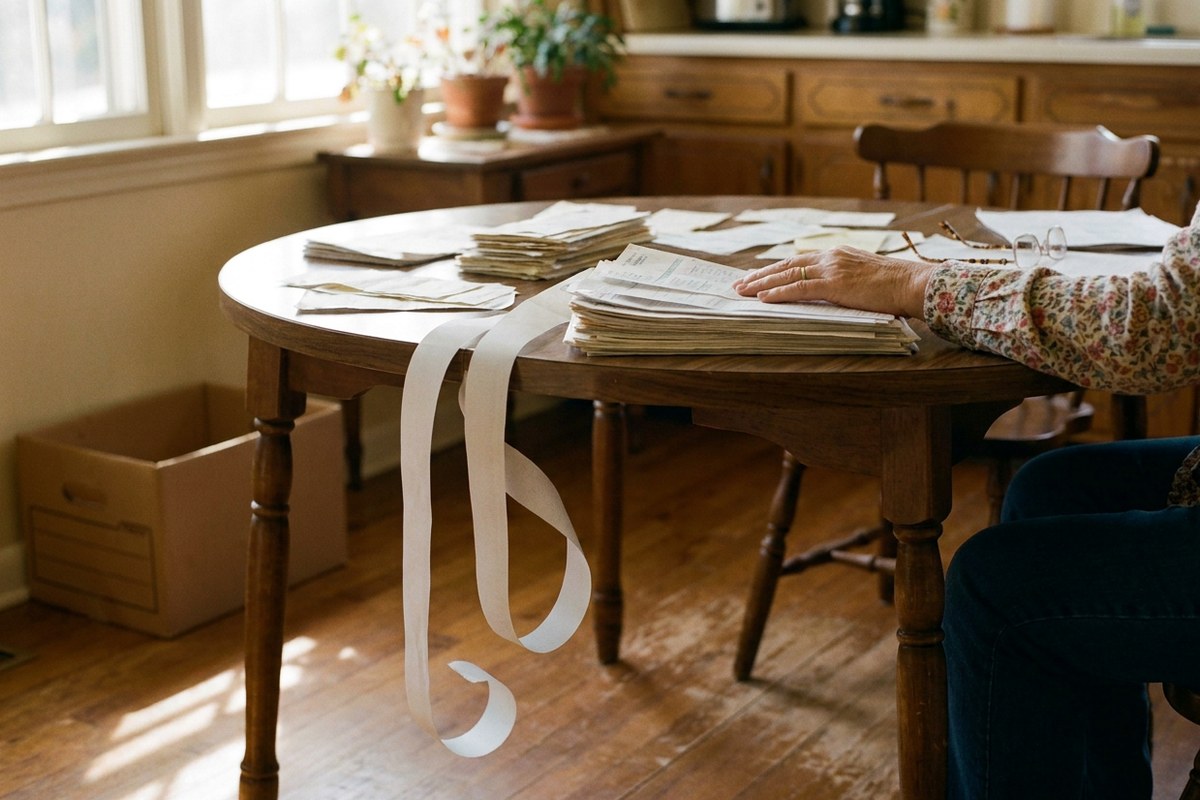
By noon, the box was empty, the kitchen table was covered in neat stacks, and a long curl of white adding machine tape hung off the edge of the table almost to the floor.