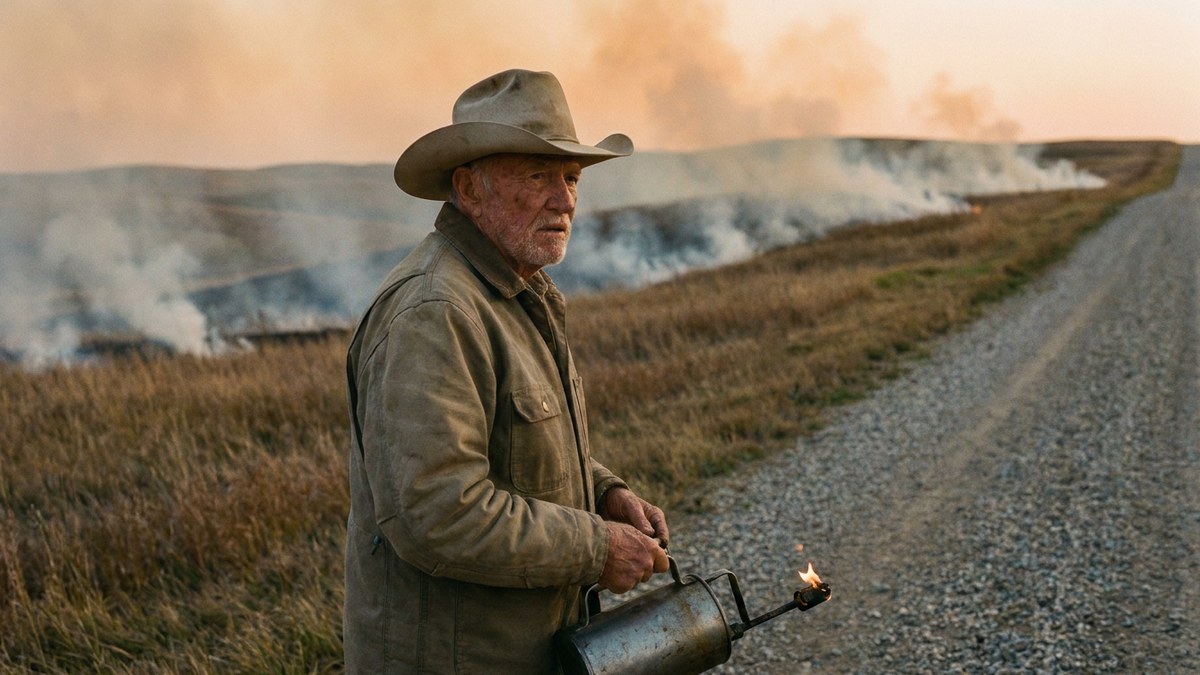
Lyle Ferris and Amos Kettering had built the same fence three times and torn it down twice, and in forty years neither one had said a word to the other.
The fence ran a mile and a half along Cottonwood Creek, where the Nebraska Sandhills rolled away in long brown swells toward the sky. Lyle could see Amos's windmill from his kitchen window. Every morning for forty years, he'd looked at that windmill over his coffee and pretended it wasn't there.
On the last Thursday in October, the wind came up out of the southwest at forty miles an hour, and Lyle smelled smoke.
He was seventy-seven. His knees hurt on stairs and in cold weather and whenever his grandson Cody tried to get him to go for a walk. They had never once hurt in a prairie fire.
He went out on the porch. Over the ridge to the southwest, a brown column of smoke was leaning hard toward the northeast.
Toward him. Toward Amos.
Lyle went back inside and called the Thatcher Valley Volunteer Fire Department. Then he called Cody, who was in town at the feed store, and told him to come home on the county road and not the shortcut.
"How big?" Cody asked.
"Big enough. A line came down in the wind, out by the Holt place, I'd guess. It's moving."
The grass that fall was the worst Lyle had seen in years. A wet spring had grown it tall and thick, little bluestem and prairie sandreed waist high in the low places.
Then August had turned off the rain like a faucet. By October, the whole country was standing there cured and dry, waiting for a spark.
Lyle had seen fire in that grass before. He'd seen it outrun a pickup.
He knew it didn't burn like a campfire. It ran ahead of the wind in a line, laid over the tops of the grass, and threw burning bits of stem a hundred yards ahead of itself to start new fires.
He hooked the old disk to the tractor and started cutting a firebreak around his yard. The disk turned the sod over in a black-and-tan strip ten feet wide.
It wouldn't stop a head fire. But it would give a man something to stand on.
By the time he'd circled the house and the bale yard, the smoke had covered half the sky. The sun turned orange, then the color of a penny.
The first grass rig came down the county road with its lights going. Then another, and a water tender behind it.
Dana Hurd was the fire chief. She was forty-four and had run the Thatcher Valley department for eleven years, and she drove her pickup straight into Lyle's yard and rolled down the window.
"It's moving fast, Lyle. It's going to come right down between you and Amos."
"I know it."
"I want to put a backfire off the county road," she said. "Burn the grass between the road and the head fire before it gets here. Black it out so the main fire's got nothing to eat. Road's the only break we've got for a mile."
"It is."
"Problem is, the wind's squirrelly along that ridge. My crew doesn't know this ground."
She looked at him. "You do."
Lyle had known that ground since 1956. He knew how the wind came down off that ridge and curled back on itself in the draw by the creek. He knew where it would push a fire and where it would let it lay down.
He'd lit a backfire off that same road once before.
"I'll show you," he said.
The trouble was where the backfire had to go.
The county road ran north and south between the two places. To stop the fire before it reached either house, the black line had to start on the road and burn back west into Amos Kettering's south pasture. Into Amos's grass, on Amos's land.
Amos was already at the road when they got there. He was seventy-nine and thin as a fence post, in a canvas coat with a shovel in his hand. His grandson-in-law had the water tank on the back of a flatbed.
He watched Dana's pickup pull up. He watched Lyle climb out of the passenger side with a drip torch in his hand.
Amos's face closed up like a fist.
"Amos," Dana said. "We need to backfire off this road. Into your south pasture. Lyle knows how the wind runs on this ridge, and he's going to walk my crew through it."
"No."
"Amos, we've got maybe ten minutes."
"No." Amos didn't look at Dana. He was looking at Lyle. "Not him. Not with fire. Not on my place. Not again."
Lyle knew that look. He'd last seen it on October 9, 1986, in that same road, with smoke still rising off the black ground and Amos's haystacks burning down to nothing behind him.
You burned me out to save your own house, Amos had said that day.
And Lyle, who had been thirty-seven and proud and so tired he could barely stand, had said, Believe whatever you want.
Amos had believed it for forty years.
Now the smoke was over the ridge. Lyle could hear it. A low roar like a train coming, and under it the sharp crackle of the grass going up.
The fire came over the hill in a line of orange a quarter mile wide, laid flat by the wind, coming straight down at the road.
Dana said, "Amos."
Amos stepped between Lyle and the pasture and planted his shovel in the dirt.