Everett sat back down behind his desk, slowly.
"For me," he said.
"Two things." Annie held up two fingers, the way a nurse does when she's giving instructions. "The first one's good news. The second one, you're not going to like. Which do you want first?"
"I've been a doctor for fifty-seven years, Annie. Give me the bad news first."
"No," she said. "Good news first. You need it."
She unzipped her parka. Under it, she was wearing a pair of navy blue scrubs. And clipped to the pocket was a hospital badge with her photograph on it, and her name, and two letters after her name.
M.D.
Everett stared at it.
She told him the whole thing, sitting on his exam table with her boots swinging.
She'd been an emergency room nurse in Boston for twenty-eight years. She'd loved it. She'd also been watching doctors for twenty-eight years, and somewhere around year twenty, she'd started thinking she could do what they did.
At forty-nine, after her kids were grown, she'd applied to medical school. Her husband thought she'd lost her mind.
"I told them about you," Annie said. "In my essay. About a twenty-seven-year-old doctor with a flashlight in his teeth, delivering a baby on a kitchen table in a blizzard. My mother told me that story every birthday of my life." She smiled. "They let me in."
She'd graduated at fifty-three. She'd started her residency in family medicine at fifty-four. She was finishing it in June, at fifty-seven, the oldest resident in her program by twenty years.
"I signed the papers with your lawyer in March," she said. "I asked him not to tell you. I wanted to tell you myself." She took a breath. "I'm taking over your practice, Dr. Lowe. If you'll let me. I start in July."
Everett didn't say anything. He couldn't.
He looked out the window at the lobster boats rocking on their moorings. Six years of ads in journals. Six years of calling medical schools.
And the answer had been sitting on his kitchen table in 1970, screaming louder than the storm.
"Annie," he said finally. His voice broke right in half. "Annie Gagnon."
"It's Dr. Ross now," she said, and her eyes were wet. "But you can call me Annie."
When he could talk again, he wiped his eyes with his handkerchief and folded it.
"All right," he said. "What's the bad news?"
Annie's face changed. It went careful and gentle. A doctor's face.
"I was home at Christmas," she said. "For Midnight Mass at St. Bernard's. You were three pews in front of me. You held the hymnal up for 'O Holy Night,' and it was shaking, Dr. Lowe. Both hands." She paused. "I watched you all through Mass. You had trouble with the communion cup."
Everett didn't answer.
"How long?" she asked.
"A year," he said. "Maybe more. Just in the mornings." He looked down at his hands on the desk. They were very still right now. "It's the coffee."
"It's not the coffee," Annie said. "And you know it's not, because you're a better doctor than that." She took a folded paper out of her parka pocket and set it on his desk. "You have an appointment with a neurologist at the medical center in Portland. Tuesday at ten. She's very good. I trained with her."
Everett looked at the paper. He didn't pick it up.
"Annie," he said, "I've been taking care of this town for fifty-seven years. I can make my own appointments."
"You haven't, though," she said quietly. "Have you?"
He didn't answer.
"You've taken care of this whole town for fifty-seven years," Annie said. "You sat up all night with my grandmother when she was dying. You came to our house at three in the morning when my brother had croup. You delivered me on a kitchen table with a flashlight in your mouth." She reached over and put her hand on top of his. "Let somebody take care of you for once. I'll drive you to Portland on Tuesday. Joanne's coming too. She already said so."
Everett looked at the nurse's hand on his. Strong.
Steady. He'd held it when it was the size of a walnut.
He picked up the paper.
"Tuesday at ten," he said.
It was essential tremor. Not Parkinson's.
The neurologist was as good as promised. She gave him a prescription and a lecture about coffee, and told him he'd likely have the tremor the rest of his life, and that it wouldn't kill him.
"You can't do surgery with it," she said. "But you can certainly enjoy your retirement."
"I'm not good at retirement," Everett said.
"Learn," said Annie, from the chair in the corner.
The town found out about the new doctor the next week. In a town of eleven hundred people at the end of a peninsula, news travels faster than weather.
Then Joanne had an idea. She sat down at the front desk with the old paper delivery log, the one they'd kept from 1970 to 1994, and a phone, and a list.
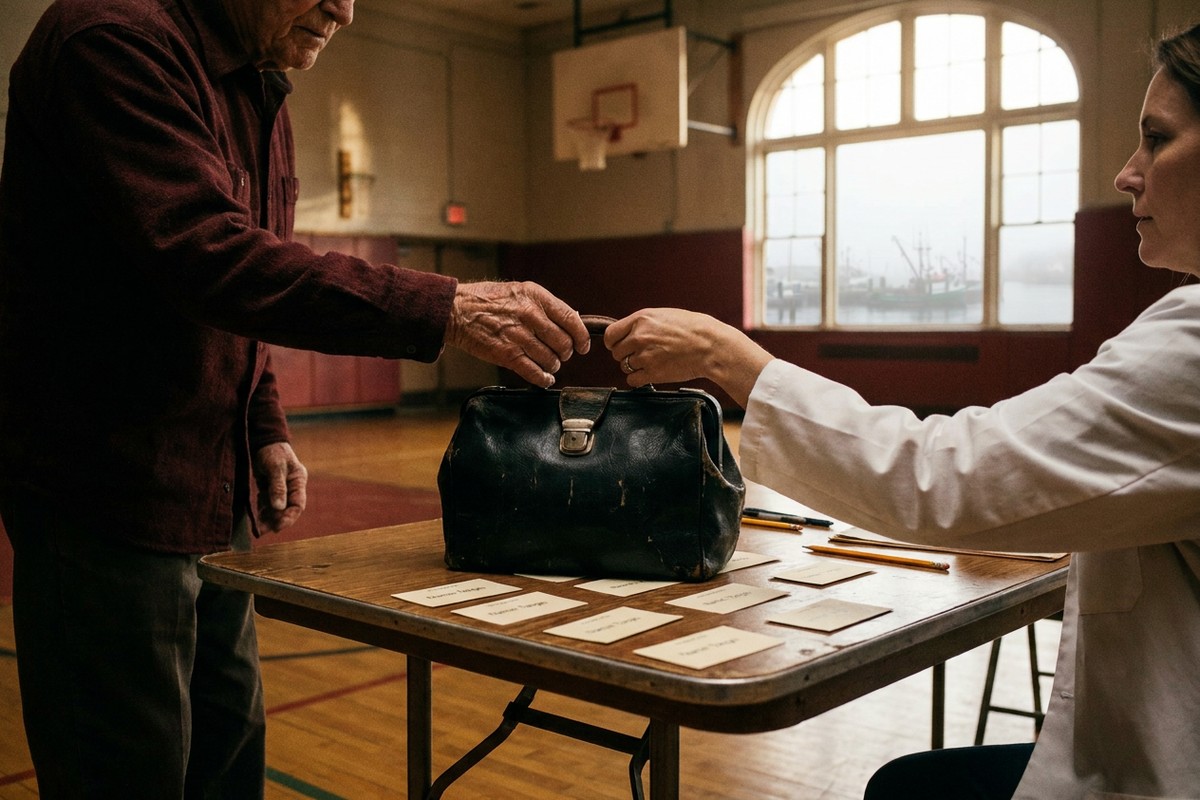
The party was on a Saturday in June, in the gym at Port Ellery High School.
They'd planned it for two hundred people. They had to open the bleachers. By two o'clock in the afternoon, the gym was packed to the walls, and the line went out the door and across the parking lot.
At the door, each one got a paper name tag. On each one, Joanne had written a name and a date. Annie Gagnon, February 9, 1970, was the first one.
After her came lobstermen and teachers and nurses and a state senator. A young mother holding a baby of her own, whose name tag said 1993, with the baby's tag underneath that said Granddaughter of a Lowe baby.
The tags said the same thing at the top, in Joanne's big printing. I'm a Lowe Baby.
Seven hundred and twelve of them came, out of seven hundred and forty-one. Joanne counted. The rest had died, or couldn't travel, and a few sent letters.
Everett sat in a folding chair at the front of the gym with Lorraine beside him, and they came up to him one by one. They shook his hand. They hugged him.
They told him what their mothers had told them. You came in a blizzard.
You came at Easter. You came in the middle of the Super Bowl, and Dad never forgave the Patriots.
He couldn't speak most of the afternoon. He didn't need to.
At the end of the day, when the gym had emptied out and the bleachers were full of paper cups and name tags, Annie came and found him. She was holding something.
It was his black bag. The old leather doctor's bag he'd carried since 1970, worn soft at the corners, the brass clasp rubbed shiny by fifty-seven years of his thumb.
Everett took it from her. He held it in his lap for a long time.
Then he opened it. Inside, on top of everything else, where it had been since 1970, was an old steel flashlight.
He took out the flashlight and put it in his own coat pocket. Then he closed the bag, and snapped the brass clasp shut, and held it out across the folding table to the woman in the white coat.
"Dr. Ross," he said. "Your patients are waiting."
Annie took the bag in both hands, the way you'd take a newborn. She didn't say anything at all.
Outside the gym windows, the harbor had gone gold. Port Ellery had a doctor.