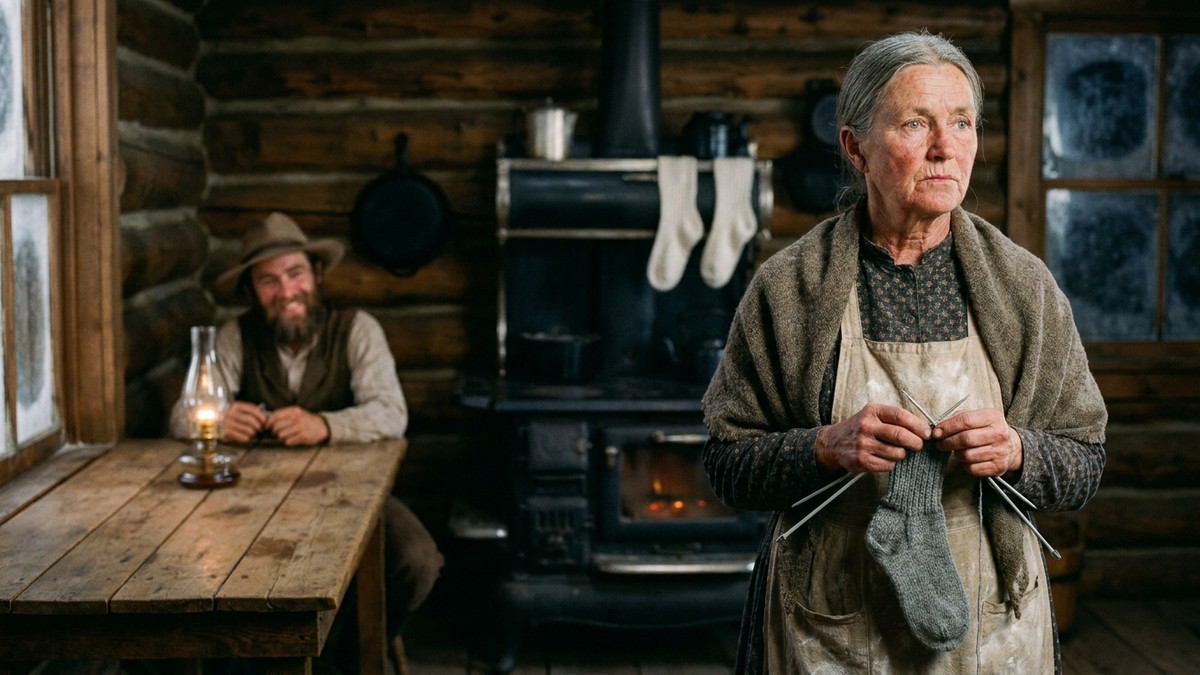
Part 2
It was Rafe Mercer, and Billy Coe was holding him up.
Ida got them inside and the door shut. The wind kept pushing at it like it wanted the room back. Both men were white with snow from hat to stirrup, and Rafe's eyelashes had frozen together in little points.
"Where's Cal?" Ida said.
Billy's teeth were knocking so hard she could hear them. Nell put a cup of coffee in his hands and held her own hands around his until he could grip it.
"Lower ford," he said. "Coming back. His gray went through the ice."
"How deep?"
"To Cal's knees. Horse came out lame." He drank. "We made the old Antelope cabin, eight miles out. Cal got a fire going. Said take the two good horses, bring the bobsled at first light." Billy swallowed. "He said tell the cook to keep the coffee on."
Ida looked at the thermometer. The red had gone down into the bulb and stayed there.
Eight miles. Wet to the knees. Cotton socks, and boots a size too small.
Dutch was already pulling on his coat.
"We go now," he said. "Four of us, the sled, the bay team."
"You go at first light," Ida said.
Every man in the room turned.
"Ma'am, he's sitting in a cabin with wet feet."
"And you'll be sitting in a drift with dead horses if you go now. You can't see the barn, Dutch. You won't see the ford."
She heard how hard her voice was. She did not soften it. If she was wrong, a man would lose his feet because an old woman had told the boys to wait, and she knew it, and she said it anyway.
Dutch held her eyes. Then he took his coat back off.
"First light," he said.
They did not sleep. Nobody pretended to.
Ida finished the last two socks herself, for Rafe and Billy, with her knuckles burning. Nell held the lamp close. The fire popped and the kettle ticked on the stove, and at four in the morning there were forty-four socks on the rail.
At five she dressed them.
Two pairs of wool on every man, the thin pair under, the thick pair over. Then she sent them out one at a time to stand in the water trough by the door, boots and all, and stand in the wind until the water froze on the leather in a hard clear shell.
Billy stared at her. "That's foolishness."
"It's Montana," Ida said. "An old cattleman on the Musselshell showed Dan. The ice keeps the wind out of the seams."
She burned a handful of matches and rubbed the black under each man's eyes against the glare. Last, she wrapped a butcher knife in a flour sack and put it in Dutch's hand with a pair of Dan's old buffalo overshoes.
"His boots won't come off," she said. "Don't pull. Cut them."
At first light the wind dropped to a long, low moan, and the sled went out into it.
The morning took about a week.
She made biscuits because her hands had to do something. She made too many. Toby lay on a cot by the wall with his foot wrapped, watching her.
"Mrs. Rourke," he said. "Would you show me the heel?"
She brought him the needles. His fingers were clumsy and he dropped two stitches, and she showed him how to pick them up with the point.
"I laughed loudest," Toby said, without looking up.
"You did."
He worked another stitch. "I'd like to learn it right, then."
At two in the afternoon, Nell said, "There," and put her hand flat on the cold window glass.
A dark shape was coming up out of the white. The bay team, heads down. The sled behind them. Four men walking beside it.
And a fifth man lying in it, under every robe on the ranch.
They carried Cal Brewster into the cook shack and set him in the chair by the table, away from the stove.
His face was gray. His mustache was a block of ice. His boots had been cut off and lay in the sled, split down both sides like peapods. His feet were bundled in a saddle blanket, tied with a pigging string.
Ida knelt. Her knees cracked on the planks.
She untied the string. She folded back the blanket.
Gray wool. One thread of blue around the top of each cuff.
She put her hand on his foot. It was cold. It was not hard. Under the wool, she felt him move his toes.
Nobody in the room said anything.
Ida held on to his foot a little longer than she needed to. Then she got up, slow, one hand on the table, and poured him a cup of coffee.
Cal held it in both hands a while before he drank.
"They were in my saddlebag," he said. "I went in for the coffee sack and there they were. I took off the cotton and put those on by the fire and wrapped up in the blanket and didn't move." He looked at the cup. "I'd have tried to walk out, if my feet had been wet. I'd have tried for the ranch."
"I know," Ida said.
"Why the blue?"
"Dan's color. He ran a blue thread in his own socks so nobody on the trail would walk off with them." She wiped her hands on her apron. "I put it on the man I figured would go out after the boys. I figured that would be you."
Cal turned the cup a quarter turn on the table.
Then he reached up, slow, and took off his hat in her kitchen, and held it on his knee.
The doctor came on Monday and said Cal Brewster would keep all ten toes.
When the trail opened in March, Cal sent the first freight wagon to Miles City for wool. He paid for every skein out of his own wages and did not tell anyone. Nell found out from the bill.
In April they rode the range and counted what was left. Fewer than half the Lodgepole cattle had lived to see the grass. Every one of the eleven men had.
On a night in late April, Ida came in from the cellar and found the foreman at the long table with a pair of needles in his big hands and a sock that looked like a feed sack.
Toby sat beside him with his foot up on a box.
"No," Toby said. "You go under first. Under, then around."
"I went under."
"You went around."
Ida did not help. She hung the wash on the stove rail and went back to her biscuits.
Over the stove, twenty-two pairs of gray wool socks steamed in the heat. Ida counted the holes.
There weren't any.