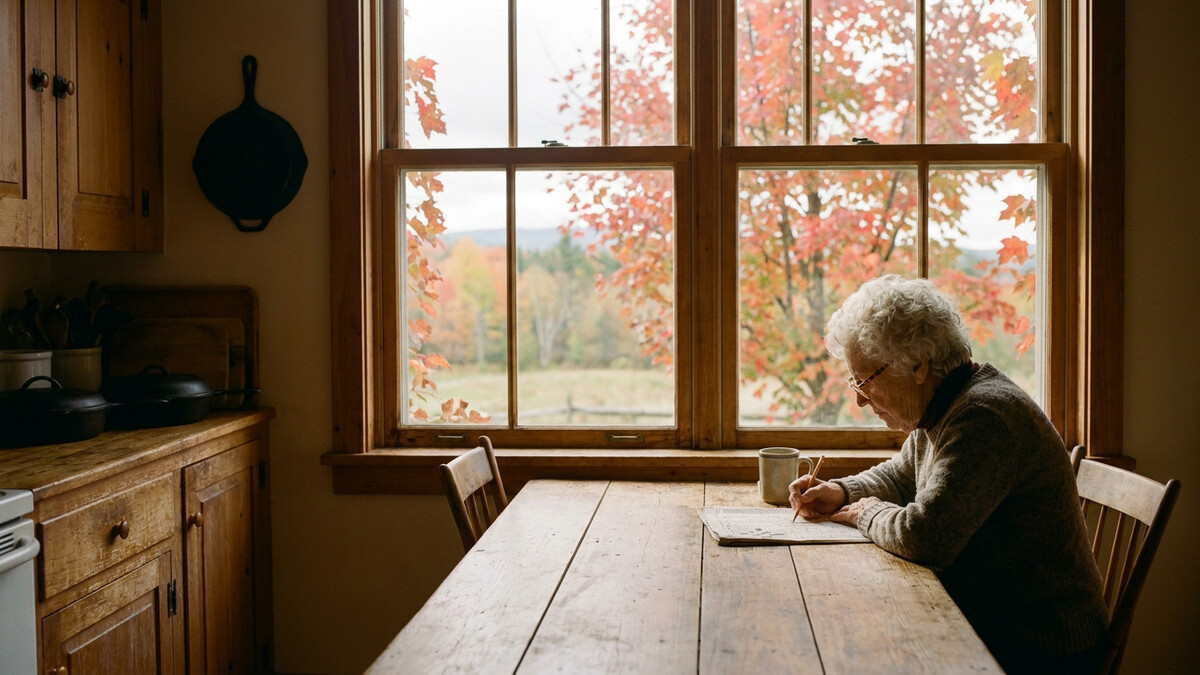
For four weeks in a row, the crossword puzzle in the Ashby Valley Courier had little circles in some of the squares, and Winnie Lavoie was the only person in North Ashby, Vermont, who knew that Elmer Gaudette never used circles unless he had something to say.
She noticed it on a Thursday morning in October, at her kitchen table, with a pencil and a cup of tea.
She had done the Courier crossword every Thursday for fifty-five years. For most of those years, she had also set it in type herself.
Twelve circled squares, scattered across the grid. She filled them in. Then she wrote the circled letters on the margin of the page, in order, left to right, top to bottom.
I AM NOT SICK.
Winnie put down her pencil.
She was seventy-eight. She had gone to work at the Courier in 1966, at eighteen, running the Linotype machine in the back room, the big clattering one that cast every line of the paper in hot lead. When the paper switched to computers in 1994, she had learned those too. She had retired in 2010.
For thirty-nine of those years, the crossword had come to her desk every Monday morning in a brown envelope, in pencil, on graph paper, from the same man.
Elmer Gaudette had been a dairy farmer up on Gaudette Hill Road. He had started making the Courier crossword in 1971, because he said the old one was too easy. He had made one every week since. Over two thousand of them.
He was eighty-eight now. He lived alone on the farm. His wife had died in 2015, and he had sold the cows, but he had never missed a crossword.
And in all those years, he had used circled squares exactly once a year. For the Christmas puzzle. A special message in the circles. MERRY CHRISTMAS ASHBY VALLEY. That sort of thing.
He always called Winnie to tell her when he was going to do it, so she would know how to set it.
It was not Christmas. And he had not called.
She got out the three papers before it. She kept them in a stack by the woodstove for kindling.
They had circles too. She had been in a hurry and had not looked closely. She looked now.
The puzzle from three weeks ago had eleven circles. She filled them in, and wrote down the letters.
NO PHONE NO CAR.
The puzzle from two weeks ago had fifteen.
NEPHEW SELLING FARM.
She went back to this week's puzzle. Below the first message, there was a second row of circles she had missed.
FRIDAY TEN AM HELP.
Winnie sat at her kitchen table for a long time, with four newspapers spread out in front of her and her tea going cold.
Then she picked up the phone.
She called the Courier first. The new editor was a young man named Colin, from New Jersey, who had bought the paper two years ago and was trying very hard.
"The circles?" he said. "Mr. Gaudette's been sending them. I figured it was a theme. Is something wrong with the puzzle?"
"How does he send it, Colin?"
"Same as always. Brown envelope, every Monday. Although," Colin paused, "it's a different handwriting on the envelope lately. Not his. The puzzle inside is his, but somebody else addresses the envelope."
"Have you talked to him? On the phone?"
"I tried in September. A man answered. Said he was Mr. Gaudette's nephew, and Mr. Gaudette was resting."
Winnie knew about the nephew.
His name was Trevor Gaudette, Elmer's late brother's boy, forty-five, from Connecticut. He had moved up to the farm in July, after Elmer had a fall in the barn. The ladies at church had said what a good nephew he was, giving up his job to look after his uncle.
She had not seen Elmer at church since August.
She had not seen him at the post office, or at the general store, or at the diner on Main Street where he ate pie every Wednesday. She had thought he was just getting old. They were all getting old.
NO PHONE NO CAR.
She called the county sheriff's office. A deputy listened politely and said they would do a wellness check.
He called her back that afternoon.
"Mrs. Lavoie, I went up there," he said. "The nephew let me in. Mr. Gaudette was in his recliner. He looked fine. A little thin. He said he was fine."
"Did you talk to him alone?"
The deputy paused. "The nephew was in the room. He showed me a power of attorney. All signed and notarized. He said his uncle gets confused, and he's handling the sale of the farm. A developer from Massachusetts. It closes Friday morning."
"At ten o'clock," Winnie said.
There was a silence on the line.
"How did you know that, ma'am?"
"Elmer told me," Winnie said. "In the crossword."
The deputy did not know what to say to that. Winnie could hear it.
"Ma'am," he said finally, "he's an adult. He told me he was fine. The paperwork's legal. If he wants to stop the sale, he can say so. But he has to be the one to say it."
Winnie hung up. She stood at her kitchen window and looked up at Gaudette Hill, where the maples were turning red and gold.
He has to be the one to say it.
Elmer could not say anything. He had no phone. No car. A nephew in every room. The only words that left that farmhouse were in a brown envelope every Monday, addressed in somebody else's handwriting.
And the only words that went into it came on Thursday.
In the newspaper.
Winnie looked at the stack of Couriers by the woodstove. She looked at the clock. It was two-fifteen on Thursday afternoon.
Next week's paper did not come out for seven days. The closing was Friday. Tomorrow.
Unless the paper came out early.
She picked up the phone again, and when the young editor answered, she said, "Colin. How fast can you print a special edition?"