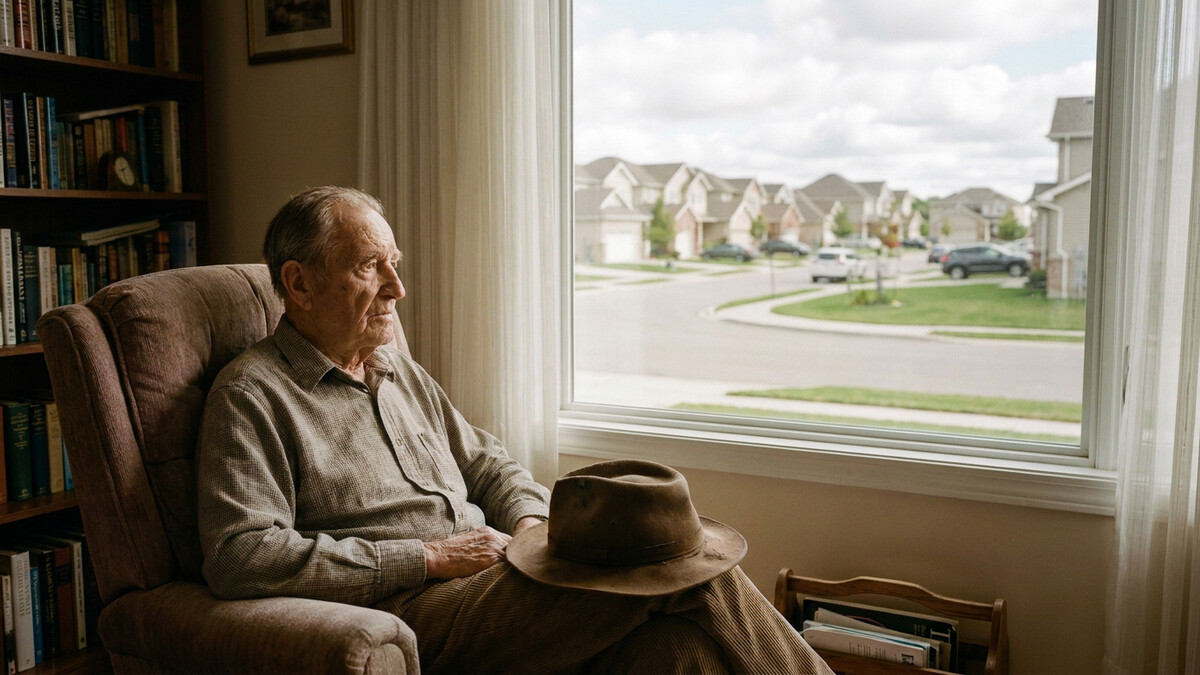
Three weeks after Odell Puckett's daughter moved him from his farm in Kentucky to her house in the suburbs of Columbus, Ohio, his old dog, Daisy, slipped through an open gate and disappeared, and Odell stopped eating.
He did not do it on purpose. He was eighty-six. He just was not hungry anymore.
He sat in the recliner by the window in his daughter's guest room every morning, looking out at the neat green lawn and the neat beige houses and the neat cul-de-sac, with his hat in his lap. He waited for a black-and-white border collie to come trotting around the corner with her ears up.
She did not come.
Odell had farmed a hundred and twelve acres of hill land outside Sorghum Creek, Kentucky, for sixty-four years. Tobacco and beef cattle at first, then just cattle, then just a few cows and a big garden after his wife, Velda, died in 2018. He had never lived anywhere else. He had never wanted to.
Then, in August, he had fallen off the porch steps carrying a bucket of feed and broken his hip.
His daughter, Brenda, had driven down from Columbus to the hospital in Somerset. She sat by his bed and held his hand and cried, and then she wiped her eyes and said the thing she had obviously been practicing for a long time.
"Daddy, you can't live out there alone anymore. I can't be four hours away wondering if you're lying in the yard. You're coming to live with us."
He had argued. Of course he had argued. But he was eighty-six with a pin in his hip, and Brenda was fifty-eight and a nurse and just as stubborn as he was.
She put the farm up for sale in September. A young couple from Lexington made an offer. Closing was the first Friday in November.
Odell had brought three things to Columbus. His good hat. His Bible. And Daisy.
Daisy was ten. She had been born in the hay barn on the farm, the runt of a litter of six, and Odell had picked her out because she was the only one who walked straight up to him and sat on his boot.
She had worked cattle with him every day of her life. She knew every gate and every fence and every cow by name. She slept on the porch in summer and in the kitchen by the woodstove in winter. She had found Odell in the yard the day he broke his hip and barked until the mail carrier stopped.
In Columbus, she had nothing to do.
She lay in Brenda's backyard on the clipped grass behind the white vinyl fence and watched the gate. She would not eat much. She would not come in at night unless Odell came out and got her. When the neighbors' children ran by on the sidewalk, she did not even lift her head.
"She's just adjusting, Daddy," Brenda said. "Like you."
Odell did not answer.
On the second Saturday in October, the lawn service came to mow Brenda's yard. A young man left the side gate open while he went back to the truck for the leaf blower.
When Odell came out at noon to sit with Daisy, the gate was open and the yard was empty.
They looked for her everywhere. Brenda and her husband, Ron, drove the streets of the subdivision for two days. They put up signs on every telephone pole. They called the animal shelters and the county dog warden. Brenda posted her picture on every lost-dog page on the computer. A woman thought she saw a black-and-white dog crossing a road near a shopping center on Sunday night. Then nothing.
Odell sat by the window and waited.
After a week, Brenda gently said maybe someone had taken her in. A nice family. Maybe she was happy somewhere.
Odell looked at his daughter for a long time.
"That dog's never been happy anywhere but one place in her life," he said. "And it isn't here."
By the third week, he was barely eating. A few bites of supper. Coffee in the morning. Brenda took him to the doctor, who said his heart and lungs were fine for eighty-six, and asked him gently if he was sad.
"I'm homesick," Odell said. "That's all. They don't make a pill for that."
Brenda drove him home from the doctor in silence.
That night, she stood in the doorway of the guest room and watched her father sitting in the recliner in the dark, looking out the window at the empty yard. He had his Bible in his lap, open, but he was not reading it.
She went to bed and cried, very quietly, so Ron would not hear.
The phone rang at six-thirty in the morning on the first Tuesday in November.
Brenda answered it in the kitchen, half asleep, with the coffeepot gurgling.
It was a voice she had known her whole life. Velma Combs, eighty-one, who lived across the road from the farm in Sorghum Creek and had been her mother's best friend.
"Brenda, honey," Velma said. "Is your daddy up yet?"
"Not yet, Miss Velma. Is something wrong?"
"No, honey. Nothing's wrong." Velma's voice was shaking. "I just went out to get my paper, and I looked across the road like I always do. And Brenda, there's a dog on your daddy's porch."
Brenda set down her coffee cup.
"A black-and-white dog," Velma said. "Lying right in front of the door. Skinny as a rail. Her feet are all torn up. But it's her, Brenda. It's Daisy. She's lying on the porch with her nose against the door, waiting for him to let her in."
Brenda put her hand over her mouth.
Behind her, she heard a sound.
She turned around. Her father was standing in the kitchen doorway in his pajamas, holding on to the door frame. He had heard every word.
"Two hundred miles," Odell said quietly. "She walked two hundred miles."
Then his face changed, and he looked at Brenda with an expression she had never seen on him before, not even at her mother's funeral.
"Brenda," he said. "When do the new people close on the farm?"
Brenda swallowed.
"Friday, Daddy," she said. "Three days. And they told me they don't want a dog."