Nora held the flashlight beam steady on the center burlap sack. In her father's neat block letters, the tag read:
*Cleaned Turkey Red winter wheat. Sixty-one-pound test weight. Forty acres at sixty pounds to the acre. Set the Deere flute lever to notch three and check the south forty with the brass probe before you give up on me.*
White vapor rose with her breath in the cold barn while sleet hissed against the metal roof.
Nora shone the light across the red tractor. The battery cables were clean and tight, and grease fittings on the three-point hitch gleamed with fresh amber grease.
Her father had greased those bearings two weeks before his heart stopped. Everything in the shed was lined up and ready.
After sliding the barn door shut, Nora carried the flashlight back through the wind to the basement stairs.
Kneeling before the silent furnace, she read the tag wired to the gas valve. In her father's block letters: *Hold pilot button down 45 seconds. Tap flame sensor with dry rag before lighting.*
Once she wiped the sensor clean and held the button, the burner whooshed to life, filling the basement with warm air.
At six-thirty Wednesday morning, thirty-six hours before the ground froze, Nora stood on the gravel lane in her father's heavy canvas chore coat, holding his brass soil thermometer.
On the north ridge beside the county road, the wind-scoured soil was dry and hard. Her thermometer registered thirty-eight degrees at two inches, exactly as her father's ledger recorded.
Down the slope on the south forty, the dark silt loam lay sheltered behind the red cedars her father had planted.
Pushing the brass thermometer four inches into the earth, she waited three minutes. The red needle settled at forty-six degrees. The subirrigated ground held moisture and warmth.
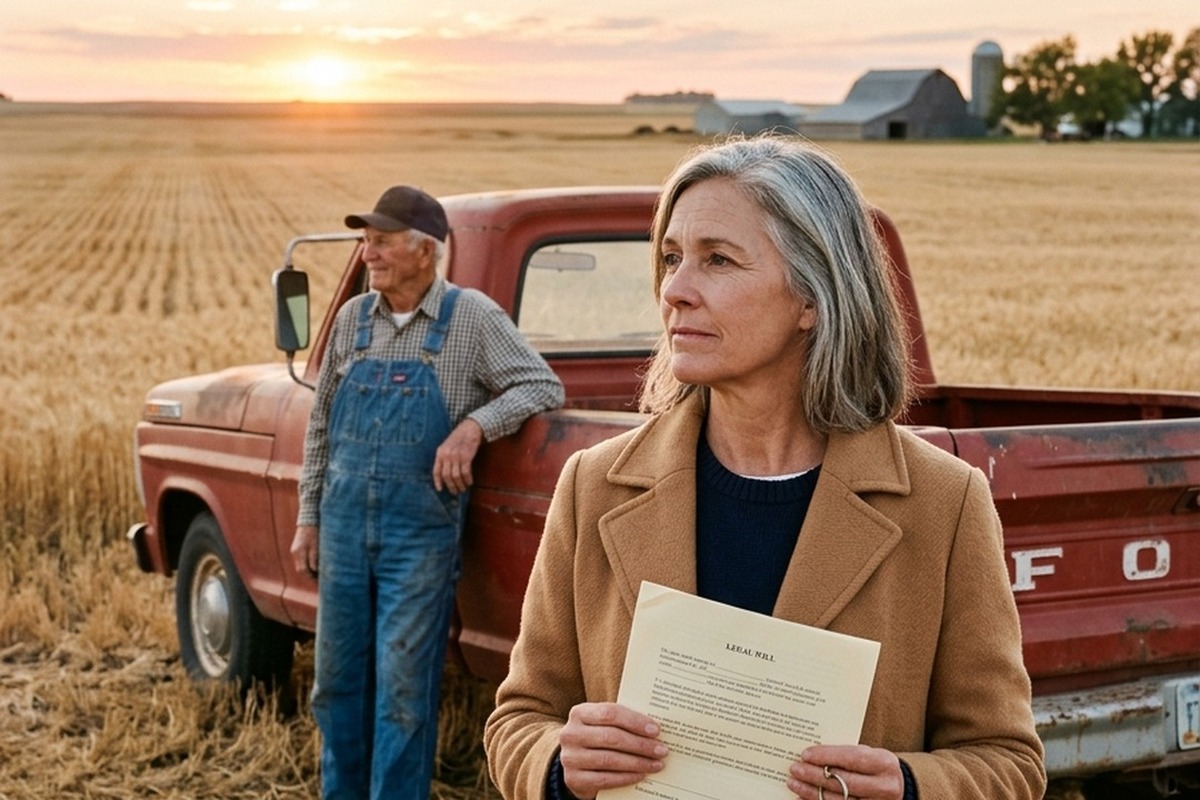
At seven o'clock, Otis Finch's red pickup turned in at the gate. He stepped out in a sheepskin coat and looked at the brass thermometer in her hand.
"The codicil says I have to plant the crop myself, Otis," Nora said, wiping the loam onto her sleeve. "Arthur said if a custom crew drills it, the foundation takes the title."
"The will says your hands have to steer the tractor and load the seed box," Otis said, adjusting his cap. "It doesn't say an old neighbor can't show you where the clutch catches."
Otis showed her how to dump amber kernels across the wooden baffle of the drill box, check that steel delivery tubes weren't plugged, and sight down the hood emblem toward the section telephone pole to keep rows straight.
Her palms blistered through leather gloves, but when dust rose behind the press wheels, the smell of turned earth rose with it: dark, cold, and rich with rain.
At eight o'clock Wednesday night, under the yellow tractor headlights with sleet stinging the glass, Nora finished the final pass on the south forty.
Otis walked out into the headlight beam, knelt on one knee, and uncovered three amber kernels resting snug in damp fifty-two-degree soil two inches down.
On Friday morning, instead of driving to the airport, Nora walked into the county clerk's office in Minden, paid the probate recording fee, and filed her official notice of residence. Then she called Denver to arrange moving her belongings east.
The Turkey Red wheat sprouted into green rows before the Thanksgiving freeze, exactly as the mudroom ledger promised.
On a cold Saturday in mid-February, Day 124 of her year, the tractor battery drained during a blizzard. Nora reached into the glove box beneath the seat for the operator's manual and felt something stiff wrapped in canvas.
Beneath the manual lay a blue vinyl bank pouch.
Unzipping the blue vinyl bank pouch on the passenger seat, she found two faded parking receipts from the 17th Street garage in downtown Denver, four blocks from her old accounting office.
The first was stamped October 18, 2019; the second was stamped October 19, 2021.
Clipped to the tickets was an unmailed envelope addressed to her Denver apartment.
*Dear Nora,* the pencil lines read. *I drove out to Denver to see your high-rise office. I sat in the truck on 17th Street and watched you walk out with people in suits. You looked smart, with a nice coat. I looked at my greasy work boots and faded jacket, and I knew if I walked up, I would make you look backward in front of your friends. I wanted to tell you the farm was paid off, but a father ought not pull his daughter down. I came back home and put Turkey Red in the bin. If you ever come back, you will see why I stayed.*
Behind her, Otis Finch's boots crunched in the doorway snow as he brought the Saturday mail. Seeing the two yellow parking receipts in her fingers, he took off his cap.
"He drove four hundred and eighty miles each way twice, Nora," Otis said gently. "He didn't stop for a motel. He told me he wanted to make sure his girl had made it in the world, and that if you ever got tired of running on concrete, the ground here was waiting for you. That will wasn't a trap, honey. It was an excuse to keep you still long enough to breathe."
Nora pressed the letter flat against her coat. A sparrow hopped across the threshold, pecking at spilled wheat kernels on the concrete.
In April, the south forty turned emerald green behind the cedar windbreak. In June, stalks rose waist-high, rippling under prairie wind. In August, Nora and Otis harvested sixty-four bushels to the acre and paid off her father's operating line with money to spare.
On October 15, 2025, at eleven-thirty in the morning, Day 365 ended.
Arthur Lindquist and Otis Finch sat at the kitchen table as Arthur signed the Executor's Deed vesting unrestricted title in Nora Ellen Sorensen.
Ten minutes after noon, Brad Vance's silver SUV stopped beside the back porch.
Stepping out with a blue leather folder, Brad walked to the bottom step as Nora came out onto the porch with Otis and Arthur behind her.
"The one-year restriction expired at noon, Nora," Brad said, holding out a typed purchase contract. "Prairie Horizon is offering one million, two hundred and twenty thousand dollars today. Cash wire by five o'clock."
Looking past his shoulder at the cedar windbreak and the freshly disked loam of the south forty, where thirty new sacks of Turkey Red seed waited in the barn, Nora shook her head.
"The farm isn't for sale, Brad," she said evenly. "Not today, and not next fall."
Brad lowered the folder an inch, the brisk polish slipping from his face.
"My grandfather farmed eighty acres six miles west of here until the bank took it in eighty-two," Brad said, his voice flat and defensive. "I know what land does to people. It wears you down until you have nothing left."
"It only breaks your heart if you leave before the spring green-up," Nora said, not unkindly. "Drive safe going back to town."
Brad nodded once, climbed into his SUV, and backed down the lane for the last time.
When the dust settled on Road 34, Nora walked down the lane with her father's claw hammer, knocked the white realtor sign off its wooden stake, and carried the post behind the barn. Across the south forty, the ground lay dark and quiet, waiting for the winter freeze.