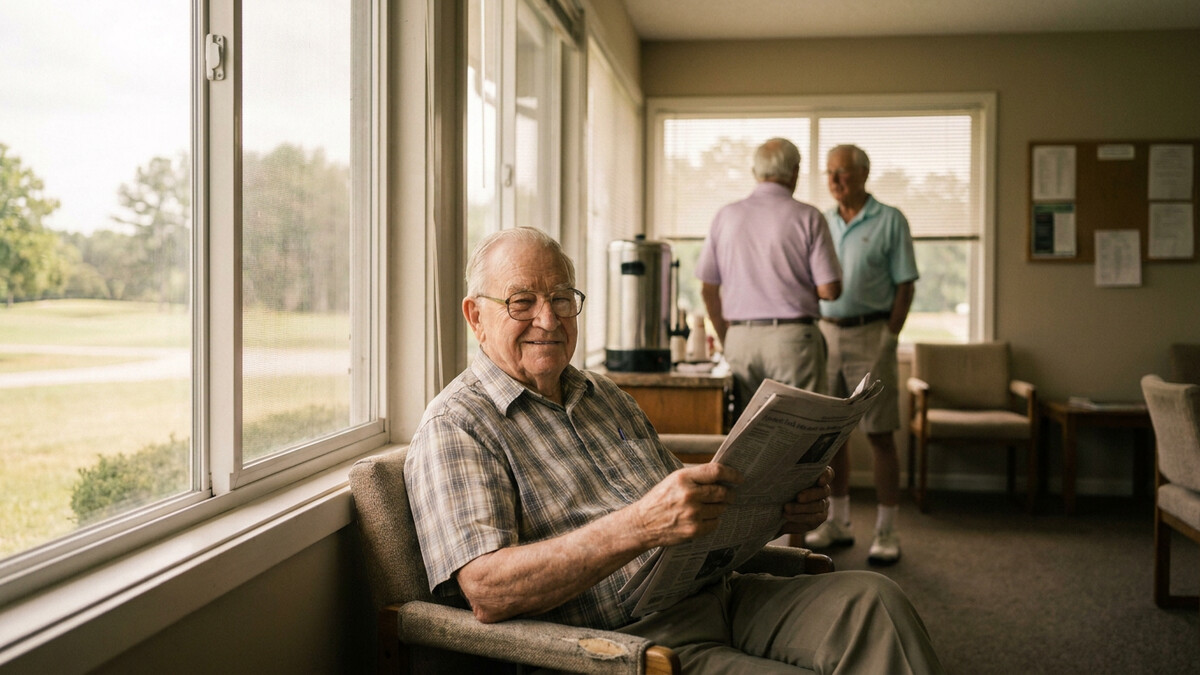
Morris did not answer right away.
He had stood next to a punch press for forty-three years. He had learned that a man who flinches at a loud noise loses a finger. He did not flinch.
"What?" he said, loudly. "Larry? What did you say?"
Larry Bonner looked at him for a long moment. His smile stayed in place. His eyes went over Morris's ears, his face, his hands.
Then he laughed and patted Morris on the shoulder.
"Never mind, old-timer," he said. He turned to the bridge table. "Ladies. See you at the luncheon tomorrow. Chicken salad and a very exciting announcement."
He walked away toward the door.
Morris did not breathe until he heard it close.
Bea Gutierrez was staring at him.
"Morris," she said, very quietly. "Did you just pretend not to hear him?"
Morris sat down in the empty fourth chair at the bridge table.
"Bea," he said. "I can hear every word you're saying. I've heard every word in that clubhouse since Tuesday morning. And I need you to listen to me for five minutes, the way you'd listen to a teacher who came to your office with something important."
Bea looked at him for a long moment.
Then she put down the cards.
"Ladies," she said to the table. "Bridge is canceled. Go home." She turned back to Morris. "You have five minutes. Go."
He showed her the spiral notebook. Six pages, in a machinist's small, square printing. Dates. Times. Every word.
Bea read every page. Twice. Then she took off her reading glasses.
"The drawings," she said slowly. "For the walking path. I thought they looked too fancy. I thought, where's the money really coming from for all this?"
"From you," Morris said. "From four hundred people at a thousand dollars each. That's what the chicken salad's for."
Bea was quiet for a moment.
"The police won't do anything until somebody writes a check," she said.
"That's what they told me."
"Then we need somebody to write one," Bea said.
The next morning, Bea Gutierrez made eleven phone calls. Morris sat at her kitchen table and listened to every one of them, which he would have found very strange a week ago.
She did not tell people what was going on. She did not need to. She had been a high school principal for twenty years. She simply told people what time to be in the clubhouse, where to sit, and not to sign anything until she said so.
At ten, she called her nephew, who was a detective with the county sheriff's office in Bartow.
At eleven-thirty, the Friday luncheon began.
The clubhouse was full. A hundred and twenty residents, the biggest luncheon of the year. Chicken salad on croissants. Fruit cups. Iced tea. Larry Bonner stood at the front with a microphone and a projector, showing pictures of a beautiful lakeside walking path with benches, and Doug Kincaid stood by a table at the side with a stack of sign-up forms and a metal cash box.
Morris sat in his usual chair by the window, with his newspaper up.
Bea Gutierrez sat at the front table in the middle, in a pink blouse, with her purse in her lap.
"So who wants to be first?" Larry said, smiling. "Who wants to help make Palmetto Shores the best retirement community in Florida?"
Bea raised her hand.
"I'd like to be first, Larry," she said sweetly.
She walked up to Doug Kincaid's table and wrote a check for one thousand dollars, made out to the Palmetto Shores Community Improvement Fund, and handed it to him, and signed the sign-up form.
Doug smiled and put the check in the cash box.
Then, at the back of the room, a quiet man in a sport coat who had been eating chicken salad at the last table stood up.
"Mr. Bonner," he said. "Mr. Kincaid. My name is Detective Ramon Gutierrez, with the county sheriff's office. I'd like to ask you some questions about this fund."
It was not dramatic. Morris had expected it to be dramatic. It was not.
Larry Bonner kept smiling for about ten seconds. Then he stopped. Doug Kincaid sat down hard in the folding chair behind the sign-up table and put his hands flat on the table.
The detective took them both outside to talk. A sheriff's car pulled up in the parking lot ten minutes later. And by the end of the afternoon, the residents of Palmetto Shores knew three things they had not known at breakfast.
There was no development partner. There was no walking path. And Doug Kincaid's real name was Doug Prewitt, and he and Larry Bonner were wanted in Georgia for doing exactly the same thing at a retirement community outside Savannah, where they had collected two hundred and eleven thousand dollars before they disappeared.
Bea Gutierrez got her check back that afternoon. It had never been cashed.
On Saturday morning, Morris walked into the clubhouse at nine o'clock, the way he always did, and sat down in his chair by the window.
He did not pick up a newspaper.
People came over. A lot of them. Women he had lived next to for eleven years and never spoken to. Men from the golf course. The lady from the activities office.
They shook his hand. They thanked him. Some of them hugged him.
And one of them, a tall man from the pickleball group named Ed Dobbs, stood in front of his chair with his cap in his hands and said, "Morris, I'm sorry. I'm the one who started calling you Deaf Morris. Years ago. I thought you couldn't hear it."
"I couldn't," Morris said. "Not then."
"Can you now?"
Morris thought about it.
"Every word," he said.
That Thursday night, Bea Gutierrez came by his chair at seven o'clock.
"Morris," she said. "We're short a fourth at bridge. Do you play?"
"I used to," Morris said. "With Ruth. A long time ago."
"Then come on."
He sat down at the corner table, across from Bea, with two other women he had known by sight for eleven years and by name for three days.
Bea dealt the cards. Then she looked at him over the top of her hand, with a small smile.
"One more thing, Morris," she said, very softly, almost under her breath. "If you ever hear me cheating, you keep it to yourself."
Morris smiled for the first time in a long time.
"What?" he said loudly.