The groom asked Marvin Toles to leave the front row empty on the left side, and Marvin asked him why.
They were sitting at the long table in the kitchen of Station 4 in Mill Ford, Virginia, on a Tuesday night in early June. Ryan Garza was thirty-one, broad through the shoulders, with a firefighter's haircut and a firefighter's habit of sitting with his back to the wall.
His fiancée, Jess Albright, sat beside him with a legal pad full of wedding notes. She was an emergency room nurse, and she ran the wedding the way she ran a trauma bay.
Marvin was seventy-two. He'd been the fire chief in Mill Ford for twenty-four years, until he retired in 2022 with two bad knees and a box of plaques he kept in the garage. These days he married people.
A dozen weddings a year, give or take, at the river park and the old brick churches and once, memorably, in the bed of a pickup truck. He got the papers from the circuit court that let him do it, and he never charged a dime. He asked couples to put twenty dollars in the jar for the burn unit in Richmond instead.
He'd been the one who hired Ryan Garza, eight years ago. He'd watched Ryan grow into the best firefighter in the county.
"Front row, left side," Marvin said. "That's usually the groom's family."
"I know what it's usually for, Chief." Ryan turned his coffee cup a quarter turn on the table. "My mom passed in 2019. My grandparents are gone. That row is for my dad."
"And your dad's not coming."
"No, sir."
Jess put her hand on Ryan's arm and didn't say anything. She'd heard this before.
"Then why keep it empty?" Marvin asked. "Put your crew in it. Put Jess's aunts in it. Seems like a lonely thing to look at while you're saying your vows."
Ryan was quiet for a while. When he answered, he didn't look up from his cup.
"Because it's his," he said. "I'm not giving his seat to somebody else."
Marvin knew most of the story already. The county was small and firehouses talked.
Ryan's father was Tom Garza, a retired Marine gunnery sergeant, twenty-two years in the Corps, two tours in places Tom didn't talk about. He lived alone now in a little house on a ridge road west of town, with a flagpole in the yard and a lawn cut so straight it looked like he'd done it with a ruler.
Ryan had joined the Marines himself at eighteen. He'd served his four years, done them well, and come home.
He didn't reenlist. He went to the fire academy instead.
Tom Garza had called it quitting.
They'd fought about it for years, the slow, cold way fathers and sons fight, with long silences between the words. Then Ryan's mother got sick, and died, and at the house after the funeral the two of them said things in the kitchen that couldn't be unsaid. Ryan walked out the back door.
That was six years ago. They hadn't spoken since.
"I sent him an invitation," Ryan said. "Jess made me. Wrote his name on the envelope myself."
"He answer it?"
"Card came back in the mail. He checked the box that says regretfully declines." Ryan smiled without any humor in it. "He didn't even write a note. Twenty-two years in the Marine Corps, and he couldn't find one word."
"Ryan," Jess said quietly.
"I'm fine." He wasn't. "Chief, I'm not asking you to fix it. I'm asking you to leave a row empty and marry us. Can you do that?"
Marvin looked at him for a long time. He'd been reading men's faces across a fire scene for forty years. He knew what a man looked like when he'd given up on something, and this wasn't it.
"I can do that," he said.
He meant to leave it alone. He told himself so on the drive home, and again the next morning, and again on Thursday when he wrote out the ceremony at his kitchen table in pencil.
It wasn't his business. A man doesn't walk into another family's kitchen and start moving the furniture.
But Marvin's own father had been a Navy man. Chief Petty Officer Earl Toles, thirty years at sea, hard as a deck plate. The two of them hadn't spoken for four years once, over something Marvin couldn't even remember now.
He'd meant to call. He'd been sure there was time.
His father died on a Sunday in 1988, and Marvin had found out from his aunt.
The wedding was set for two o'clock Saturday afternoon at St. Paul's, the old brick Lutheran church on Main Street. The rehearsal was Friday at five.
Marvin walked the wedding party through it twice. He showed the groomsmen where to stand and told the flower girl she could throw the petals as hard as she wanted.
And every time he turned to face the pews, there it was. Front row, left side. A white ribbon tied across the end, and the whole oak bench empty.
After the rehearsal dinner, when the groomsmen had gone to the bar on Water Street, Jess found Marvin in the church parking lot.
"He watches the clip," she said.
Marvin turned around. "What clip?"
"The fire on Route 11. Two years ago." Jess had her arms crossed against the evening cool. "When Ryan brought that little boy down the ladder. The Harrisonburg station put the helmet camera video online, and it went everywhere. A woman from the VFW told my aunt she was at Tom's house last fall to drop off a casserole, and he had it playing on the TV. On repeat. Like he'd been watching it all day."
She looked at the church.
"I don't know if that means anything," she said. "Ryan won't hear it. But you knew him before. I thought somebody should know."
Marvin drove home and sat in his truck in the driveway for a long time with the engine off.
Then he started it again.
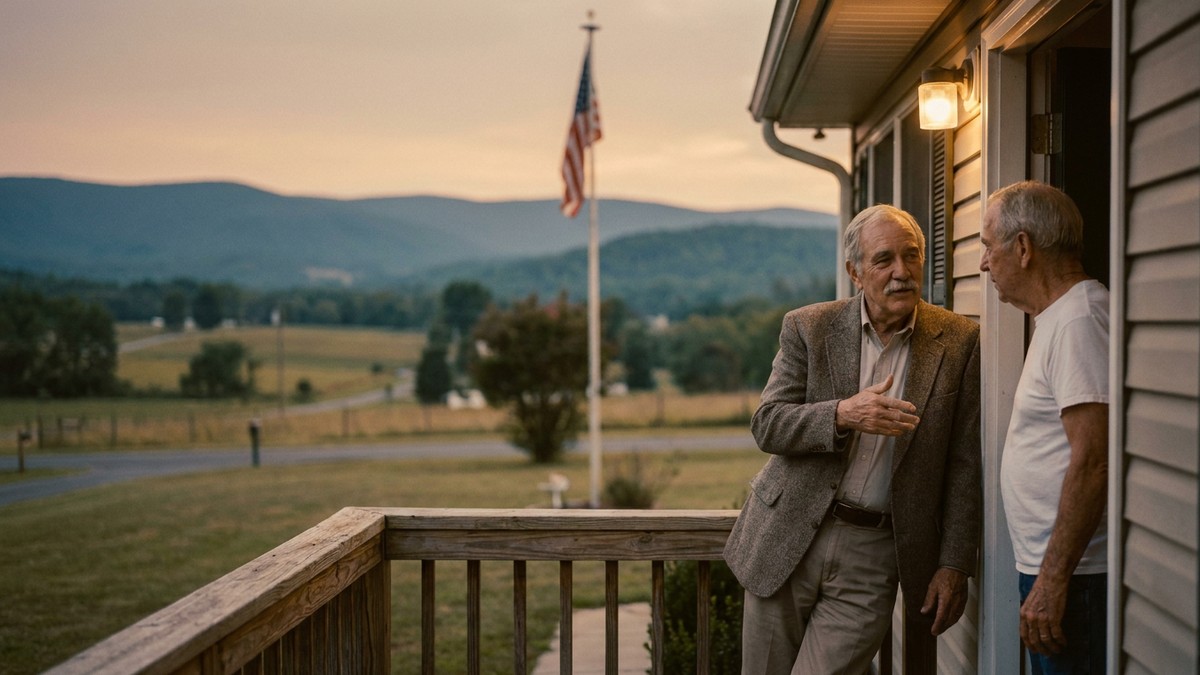
The ridge road was dark by the time he got there. Tom Garza's porch light was on.
The flag had been taken down for the night, the way it was supposed to be, and the rope was tied off tight on the cleat. Marvin climbed the four porch steps on his bad knees and knocked on the door, hard, the way he used to knock on doors at two in the morning when a house was on fire.
The door opened. Tom Garza filled it. He was seventy, gray, still straight as a rifle barrel, in a white T-shirt with his reading glasses pushed up on his head.
He looked at Marvin. He knew exactly who he was.
"I know why you're here, Chief," he said. "You've got one minute."