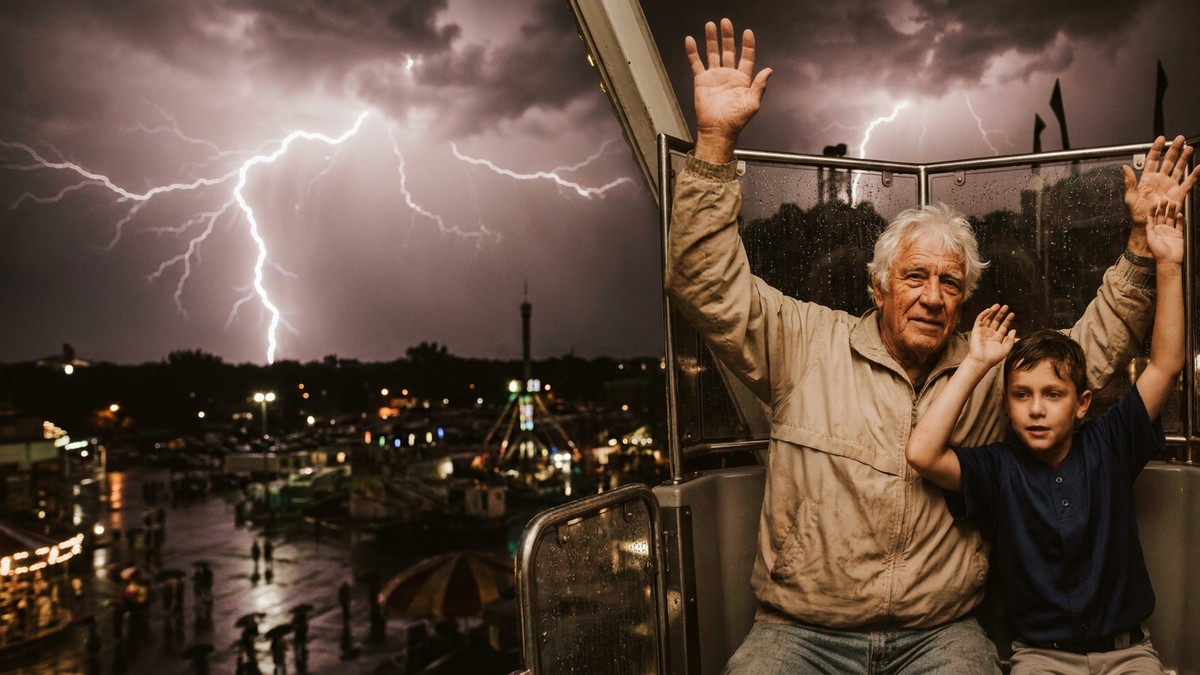
Aldo Ferrante had proposed to his wife at the top of the Ferris wheel at the Minnesota State Fair in 1966, and he'd ridden it alone every Labor Day since she died.
It wasn't the same wheel anymore. The old one was long gone. The new one was bigger, with enclosed gondolas instead of open swinging seats.
But it stood in the same corner of the fairgrounds, near the same lemonade stand, under the same wide Minnesota sky. That was close enough.
He'd buy one ticket. He'd ride it once, at dusk, on the last night of the fair. He'd sit in a gondola by himself and look out over the lights and the crowds and the Midway, and he'd talk to Angela for one full turn of the wheel.
Then he'd go home.
Aldo was seventy-nine. He'd been the band director at Cedar Lake High School, in the suburbs north of St. Paul, for thirty-eight years.
Marching band, concert band, jazz band, pep band. He'd taught more than three thousand teenagers to read music, and to stand up straight, and to come in on the downbeat.
He'd taken the Cedar Lake marching band to the State Fair parade twenty-two times.
Angela had sewn the uniforms. She'd driven the equipment truck.
She'd fed the drumline. They'd been married fifty-three years when she died, in March of 2019, after a long illness, at home, with Aldo holding her hand and the radio playing Puccini.
This was his eighth Labor Day alone on the wheel.
It had been hot all day, sticky and close, the way it gets in Minnesota at the end of summer. In the afternoon, clouds had started stacking up in the west, tall and white on top and dark underneath. By seven o'clock, the sky over the fairgrounds was a strange yellow-green, and the air had gone very still.
Aldo got in line for the wheel anyway. He'd ridden it in the rain before.
There was a boy in line ahead of him, by himself. Ten, maybe.
Skinny, with a buzz cut and a Twins jersey down to his knees. He kept turning around and looking back at the crowd on the Midway, up on his toes.
"You lose somebody, son?" Aldo asked.
The boy looked up at him. "My mom. She went to get lemonade. She said wait right here. I've been waiting a really long time."
Aldo looked around. The Midway was packed. A hundred thousand people, easy, on the last night of the fair.
"Well, the lemonade line's about forty minutes on Labor Day," he said. "She'll be back. You want to stand with me till she comes?"
The boy nodded.
The line moved. When they reached the front, the ride operator, a teenager with a headset, looked at the two of them and waved them both into the same gondola. "Two," she said. "Go on, go on."
"Oh, he isn't with me," Aldo started.
The gondola door clicked shut behind them. The boy looked at him with wide eyes.
"I've never been on one," he said.
"Well," Aldo said, sitting down across from him. "You picked a good one. What's your name?"
"Leo."
"I'm Aldo. You'll like it, Leo. You can see the whole world from the top."
They were three-quarters of the way up when the wind hit.
It came all at once out of the west, hard, with a roar like a train. The gondola swung.
Dust and paper cups flew across the Midway below. The lights on the rides flickered.
Then the first lightning cracked across the sky, white and enormous, so close that Aldo felt it in his teeth.
And every light at the State Fair went out.
The wheel stopped. Their gondola stopped with it, at the very top, a hundred and fifty feet in the air, swinging gently in the wind.
Below them, the whole fairgrounds had gone dark. A hundred thousand people. A great roar of voices came up from the crowd, and then car alarms, and then, far away, sirens.
Leo grabbed the edge of his seat with both hands.
"What happened?" he said. "What happened? Are we falling?"
"No, son. We're not falling. The power's out, that's all. They'll get it going."
The rain came then. Sideways, in sheets, pounding on the roof of the gondola like drums. Another bolt of lightning, and then another, and the thunder came right on top of it, so loud the plastic windows rattled.
Leo started to cry.
"I want my mom," he said. "I want my mom. Where's my mom?"
Twenty minutes went by. Then thirty.
Aldo could see lights moving down on the ground now. Flashlights.
The red and white flashers of a fire truck pulling up beside the wheel. A man with a bullhorn was shouting something up at them that the wind tore away.
Then he saw the fire truck's ladder begin to rise. It went up and up, slowly, swaying, toward the gondolas.
It stopped about halfway. The wind was too strong. The ladder swung in a long, frightening arc, and the firefighters pulled it back down.
The gondola rocked hard. Leo screamed.
And then he stood up. Before Aldo could stop him, he grabbed the handle of the gondola door with both hands and started yanking on it.
"I want to get out," he sobbed. "I want to get out. I have to find my mom. Let me out."
The door was locked. But he kept pulling, and the gondola was swinging wildly now, a hundred and fifty feet over the dark fairgrounds, with the rain pouring down and the lightning cracking all around them.