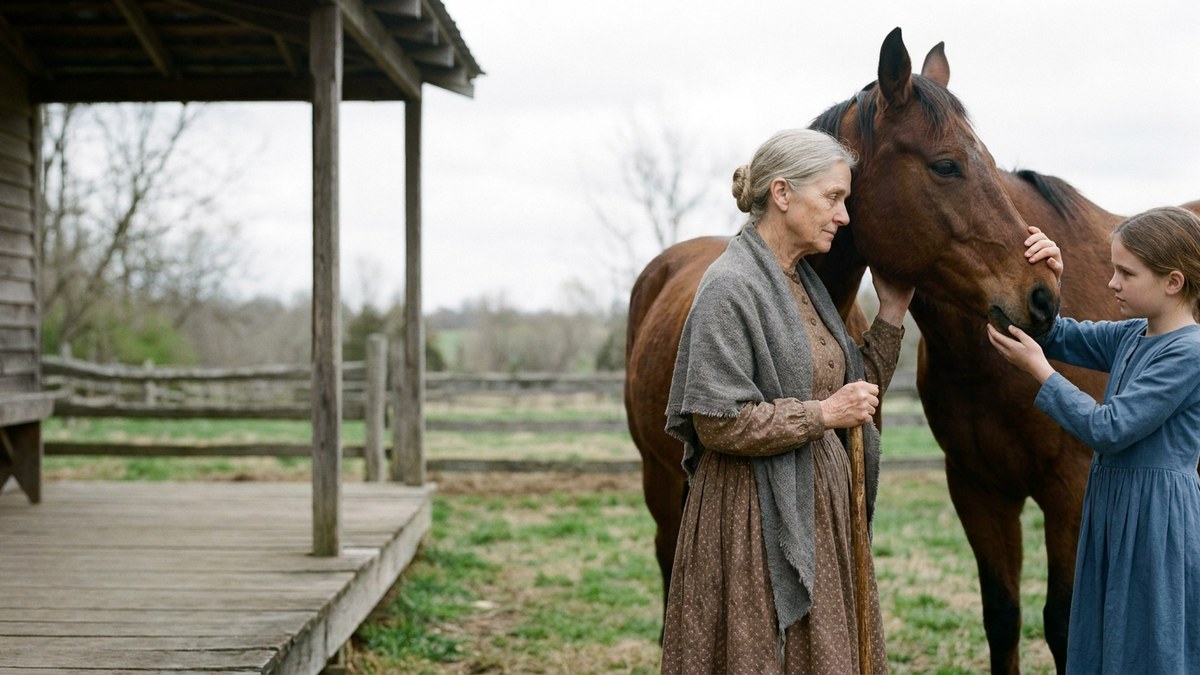
Hester stood very still in the middle of the sale ring.
She could feel the barn waiting. She could hear somebody's boot scrape, and a horse shift in a back stall, and Royal Pike breathing easy, like a man who has already counted his money.
For a moment she wished she had stayed home.
Then she remembered what Jacob used to tell young traders who got cocky with her. "She doesn't look at a mouth. She reads it."
"Josie," Hester said. "Hold the lantern close. Then look at the edge of one cup. Not the hollow. The edge."
Josie took the lantern from Ike Lessard and held it close to the mare's lip.
"A real cup has a rim," Hester said, loud enough for the rail to hear. "A thin ring of hard white enamel, all the way around the hollow, like the rim of a coffee cup. The tooth grows that way. Nobody can put it there."
Josie leaned in until her nose nearly touched the mare's lip.
"There's no rim," she said. "It's just a hole. It's black inside, like somebody burned it. And it's too round."
Two farmers leaned over the rail. Then three.
"Lord," said Amos Duff. "She's right. Look at that. There's no ring."
"A man with a file and a hot iron can make a hollow in an old tooth," Hester said. "Dig it out and blacken it. The old traders called it bishoping. It looks like a cup to anybody who counts. It doesn't look like a cup to anybody who reads."
Royal Pike was not smiling now.
"Ma'am," he said. "That's one old woman's word, and she can't see her own hand."
"Then don't take my word," Hester said. "Mr. Lessard, is your red mare in the barn? The one you bought from the Coopers last spring?"
Ike Lessard said she was. Everybody in the county knew the red mare. She had been foaled at the Cooper place in the spring of 1869. She was five.
"Bring her out," Hester said. "Stand her next to this one, and open both mouths. Then let every man here look from the side."
Ike led the red mare in. Josie opened the bay's mouth again, and Ike opened the red mare's, and the men came off the rail and into the ring to look.
It was plain to everybody.
The red mare's front teeth met each other straight up and down, short and close, like the two covers of a shut book. The bay's teeth were long and yellow and slanted far forward, so they met like the two halves of a bird's beak.
No file could straighten that. No iron could shorten it.
"She's fifteen if she's a day," said Amos Duff. He looked at Pike. "Maybe more."
Nobody laughed this time.
Hester did not say anything more to the men along the rail. She had said enough. She turned toward the tall, soft blur that was Royal Pike and spoke low, so only he and Josie could hear.
"You were the Pike boy," she said. "From Boonville. You curried horses for Jacob and me in the summer of '46, when you were eleven. You asked me to show you how to read a mouth, and I did."
Pike stood there a long time.
"Yes, ma'am," he said finally.
"Where did you learn the rest of it?"
"Memphis," he said. "From a man who told me folks don't pay for the truth, Mrs. Vail. They pay for what they want to believe. And he wasn't wrong. Not once, in twenty years."
"He was wrong today," Hester said.
Pike paid it back in the sale ring. Eighty-five dollars, counted into Josie's hand, and five more because he had said he would, and a gentleman pays his bets.
Then Hester took thirty dollars of her own out of her purse and bought the bay mare from him. He took it without counting.
Ike Lessard told him to take his last two horses and go. Pike went. He did not argue. He stopped once at the door and looked back at Hester, as if he meant to say something more.
He didn't. He touched his hat brim and walked out into the April light.
Amos Duff came over and asked her, in front of everybody, who the man was. How she'd known him.
"An old trader," Hester said. "There used to be a lot of them."
She never told anyone more than that. Not Amos. Not Martha. Not even Josie, who asked her all the way home.
Cal was waiting on the porch when they came up the road. He had seen them from a long way off, the old woman and the girl walking, and the bay mare walking behind them on her rope.
Josie handed him the money without a word. Ninety dollars.
He looked at it. Then he looked at his grandmother.
"I didn't want to be wrong," he said. "Not in front of you."
"I know," Hester said. "I was wrong in front of your grandfather for thirty years. He never let me hear the end of it."
Cal almost laughed.
"What happens to her?" he asked, nodding at the bay.
"She's gentle," Hester said. "She's not fit to plow, and she's not worth eighty-five dollars. But she's worth thirty to a girl who's going to need a horse to learn on."
That night at the kitchen table, Hester asked Martha to bring her a pen and the back of the old bill of sale. She wrote slowly, by feel, in large uneven letters that ran uphill.
Sold to Josie Vail, by her grandmother, for one year of morning chores: one bay mare, fifteen years old, give or take, and sound.
Then she pushed the paper across the table to Josie.
"Sign it," she said. "You're the one who read her."
> What really happened: "Bishoping" was a real horse trader's fraud in the 1800s: a dishonest dealer filed down an old horse's front teeth and cut or burned false hollows, called cups, into them so the horse looked years younger. Experienced buyers caught it by looking for the ring of enamel that surrounds a natural cup and by the slant and length of an older horse's teeth. Period farm manuals and horse books warned buyers about the trick. Sources: Project Gutenberg (Horse Secrets, 1915); American Cowboy magazine.