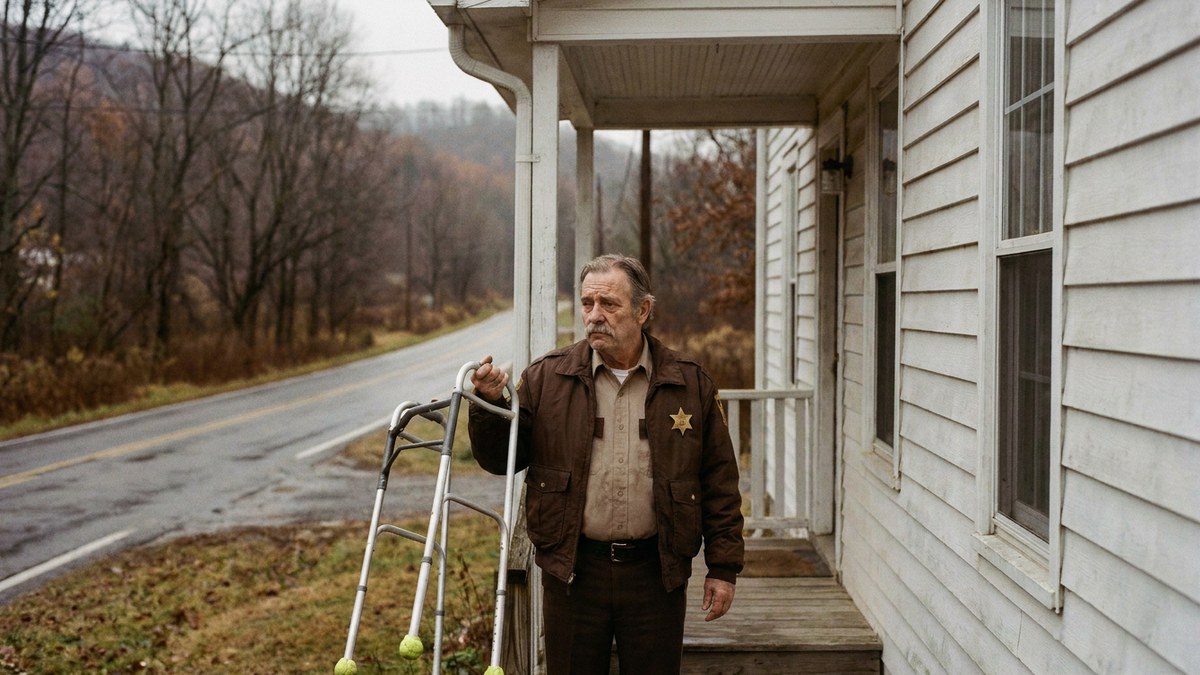
Floyd Eckert's chair at the Liars' Table was empty at 7:05, and Sheriff Earl Whitaker set down his coffee.
Floyd had not missed seven o'clock at Dot's in nine years. Earl knew that because Floyd had told him so, twice, both times while correcting Earl's arithmetic on something else.
"He sick?" Earl asked.
Dot Kessler looked at the empty chair and then at the clock over the pie case. "He'd have called. He calls if he's going to be two minutes late, hon. He called the day of his cataract surgery to tell me he'd be in at noon with a patch on."
At the round table by the window, the rest of the Liars' Table had gone quiet. Pete Yoder, eighty, was looking at his eggs. Gus was looking at Pete.
"Anybody seen him?" Earl asked.
None of them had. That was what worried him.
Floyd lived alone in a white frame house on Maple Street, three blocks from the diner. He'd carried the mail in Calder County for thirty-one years, and he still walked like a mail carrier, which is to say he walked the same route every morning, at the same speed, and you could set a watch by him.
These days he walked it with an aluminum walker with tennis balls on the front legs. He hated the walker. He used it anyway, because his daughter in Columbus had threatened to move him into Maple Grove if he didn't.
The walker was sitting on Floyd's front porch.
Earl stood at the bottom of the steps and looked at it for a long moment.
The door was locked. Earl had a key, because Floyd's daughter had given him one after the second fall. He let himself in and called Floyd's name.
The house was cold and neat. The bed was made. The coffee pot was washed and upside down in the drainer.
In the front hall, Floyd kept his canes in an old milk can by the door. Rose had painted it with roses back in the seventies. There had always been two canes in it, a plain one and the good one with the brass handle.
The good one was gone.
On the hook above the milk can, where Floyd hung his tie every night, there was no tie.
Earl went into the kitchen. The wall calendar was from the Calder Feed and Seed, with a picture of a red barn for November. Floyd marked it in pencil, like everything.
Dentist on the fourth. Daughter visiting on the twenty-second.
Today's square had one word in it, circled twice.
Rosie.
Under it, in smaller letters: 80.
Earl stood in Floyd Eckert's kitchen and did the math. Rose Eckert had died in the spring of 2021. Today she'd have been eighty years old.
"Rose is buried up at Hollow Creek Chapel," Ruth Ann Mercer told him on the phone. Ruth Ann knew where half the county was buried, and who'd paid for the stone. "That little cemetery on the hill above the creek, off Lutz Hollow Road. The church closed in '88, but the Eckerts kept their plots."
"Lutz Hollow's closed past the railroad tracks," Earl said. "The bridge washed out in July."
"I know it is," Ruth Ann said. "And Floyd knows it too."
Earl went back to the diner. He needed to think, and he thought better at Dot's.
"Last Tuesday," Dot said, before he'd even sat down. "Floyd asked me if they'd fixed that bridge on Lutz Hollow yet. I told him no. He said, 'Well, there's more than one way across a creek,' and I thought he was talking about politics."
At the window table, Pete Yoder cleared his throat.
"I gave him a ride," Pete said.
The whole diner turned around.
"This morning. Five-thirty. I was going out to sit in my tree stand by the old Lutz place, and he was standing at the end of his walk in that orange hat Rose made him wear every November."
Pete looked miserable. "He said his grandson was picking him up at the barricade. I didn't think anything about it. Floyd doesn't lie."
"He doesn't have a grandson," Dot said.
"Well, I know that now," Pete said.
Earl drove out Lutz Hollow Road in the Crown Victoria with June's picture on the dash. The morning was gray and raw. Bow season was open, and he passed two pickups parked in field lanes, their drivers off in the woods.
Past the railroad tracks, the road dropped into the hollow, and a county barricade blocked it. Road Closed. Bridge Out.
Earl parked and got out.
The gravel was wet from the night's rain. Beside the barricade, in the soft mud at the edge of the road, he found a print.
A round rubber cane tip, and beside it the toe of a good leather shoe, and then another. Step, step, tap.
Floyd had walked past the barricade.
Earl followed the prints down the road. Three hundred yards on, the road ended at the edge of Hollow Creek.
Where the bridge had been, there were two concrete abutments and nothing in between. The creek ran high and brown and fast from the rain, loud over the rocks.
The prints turned off the road onto a deer path along the bank. Earl followed them through the brush, calling Floyd's name.
The creek answered. Nothing else did.
Fifty yards along the path, Earl stopped.
Hanging from a sycamore branch out over the water was a necktie. Navy blue with little gold ducks on it. Floyd's good tie, the one he wore to church and the diner and funerals, tied in a hard knot around the branch, wet through and moving in the wind.
Below it, the bank was torn up, and the mud slid straight down into the fast brown water.