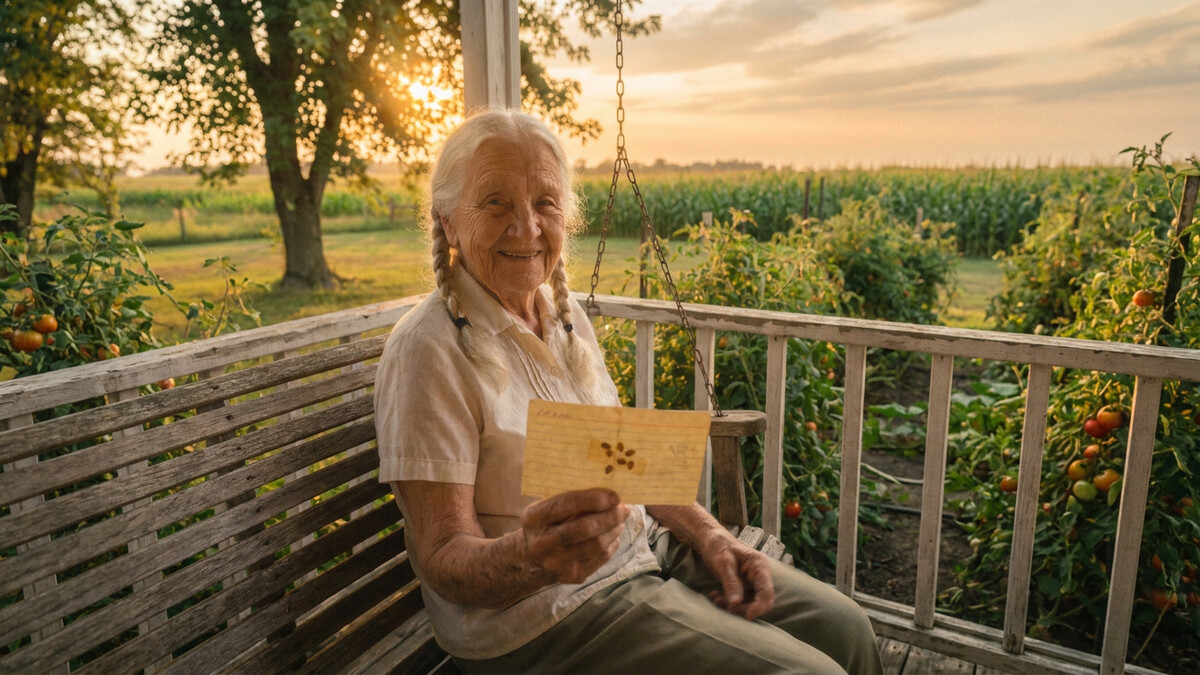
Bernadine read the letter four times on the porch swing. Then she went inside and called her son in from the field.
He came in the back door in his work boots, worried, because his mother never called him in from the field. He found her at the kitchen table with the letter in front of her and her reading glasses pushed up on her forehead, crying.
"Mom? What's wrong?"
She handed him the letter.
He read it standing up. Then he sat down.
"Grandpa never said anything," he said slowly. "Not one word. In my whole life."
"No," Bernadine said. "He never said anything to anybody."
That night, she could not sleep. She sat up in the kitchen with a cup of coffee and her father's old Army footlocker, which had sat in the corner of the attic since 1983, and which she had never opened.
She did not know what she was looking for. She just wanted to touch his things.
Inside, there was not much. His uniform, folded. His dog tags on a chain. A Bible. A small bundle of letters from her mother. A photograph of a dozen young men in helmets, grinning, in front of a stone wall somewhere in England.
And at the bottom, in a small black box, a medal she had never seen. A bronze star on a red, white, and blue ribbon.
There was a typed citation folded under it. She read it at the kitchen table at two in the morning.
For heroic achievement in action near St. Lô, France, on 15 July 1944. Sergeant Kucera, under heavy enemy fire, carried a wounded member of his squad approximately one mile to safety.
He had never told anybody. Not her mother. Not her. Not anybody.
He had just come home, and farmed, and grown corn, and sat on the porch in the evenings and watched her tomatoes grow.
She wrote back to Amanda Brewer Lacey the next morning. In longhand, on lined paper, the way she had written to Sallie eighty-three years ago.
Dear Amanda, I am her. I am ninety-two and I still have all of your grandmother's letters too. Forty-one of them. I didn't know about my father until yesterday. He never told us. I found his medal last night in the attic. I didn't know he had one.
I have grown the same tomatoes every summer of my life. My grandmother brought them from Bohemia. I always thought of them as hers.
I think now they belong to both our families.
Your friend, Bernadine Kucera.
Amanda called her a week later. Then again. They talked every Sunday afternoon in September and October. About tomatoes, mostly. About Sallie and Bernadine. About fathers who came home and did not talk.
In the second week of October, Amanda said, "Mrs. Kucera, I'd like to come see you. If you'll let me. I'd like to bring my son. And something else."
"What else?"
"You'll see," Amanda said.
They came on a Saturday, in a pickup truck with Tennessee plates. Amanda, a tall, freckled, friendly woman with a big laugh. Her son, Cole, who was thirty-four and a schoolteacher in Knoxville. And Cole's little boy, Wyatt, who was six.
They had driven eleven hundred miles.
In the bed of the truck, wrapped in burlap and packed in straw, was a wooden crate.
Bernadine stood on her porch with her cane and watched Cole lift it down.
"What on earth?" she said.
Amanda smiled and pried the lid off.
Inside, nested in the straw, were tomatoes. Two dozen of them. The last of the season. Big, lumpy, deep red tomatoes, exactly like the ones in the sunny corner of Bernadine's garden.
"Frank's Tomatoes," Amanda said. "From Dayton Springs. Eighty-one generations of them." She laughed. "Well. Eighty-one summers. I picked them Thursday."
Bernadine reached into the crate and picked one up.
She held it in her old hand. She turned it over. She smelled it, the way her grandmother had taught her, at the stem.
It smelled exactly like her grandmother's garden in 1943.
They sat at Bernadine's kitchen table all afternoon. Amanda brought out Sallie's bundle of letters. Bernadine brought out hers. They laid them side by side on the oilcloth, in order, by date, and read them out loud to each other, one from Nebraska and one from Tennessee, back and forth, for three hours, like a conversation between two little girls eighty years ago.
Do you have okra in Nebraska?
We do not have okra. What is okra?
My tomatoes are ripe already. Are yours?
Mine are not ripe but they are bigger than yours.
Wyatt, who was six, laughed until he had to lie down on the floor.
Then Bernadine got up, slowly, and went into the bedroom, and came back with the small black box from the footlocker.
She opened it on the table.
Amanda looked at the bronze star for a long time. She did not touch it.
"He carried my great-great-grandfather a mile," she said to Wyatt softly. "Under fire. That's why we're here. That's why Grandpa Clyde came home. That's why Grandma Sallie was born, and Mama, and me, and your daddy, and you."
Wyatt looked at the medal with very wide eyes.
"Did it hurt him?" he asked. "Carrying somebody that far?"
Bernadine thought about it.
"I expect it did," she said. "He had a bad back his whole life. I never knew why."
Before they left on Sunday morning, Bernadine took the Tennessee family out to her garden.
It was mid-October. The vines in the sunny corner were brown and finished. But there were still a few late tomatoes hanging on, small and green, and two red ones.
She picked the two red ones and gave one to Wyatt.
"You take this home," she said. "When you eat it, save the seeds. Dry them on a paper towel on the windowsill. Plant them in the spring." She looked at the boy. "These are my grandmother's tomatoes. And your great-great-grandmother's. And my father's."
Wyatt held the tomato in both hands, very carefully, as if it were an egg.
"What's it called?" he asked.
Bernadine looked at Amanda. Amanda looked at her.
"Babička's Red," Bernadine said. "And Frank's Tomato." She smiled. "It's both. It always was."
The next spring, Bernadine planted her tomatoes in the sunny corner, the way she had every spring for eighty-four years.
She planted two rows instead of one.
One row from her own seeds, saved from her grandmother's line. One row from six seeds that had come back to Nebraska in a padded envelope from Tennessee, taped to an index card.
On a wooden stake at the end of the second row, her great-grandson painted the name for her in white letters, because her hands were too shaky now.
FRANK'S.