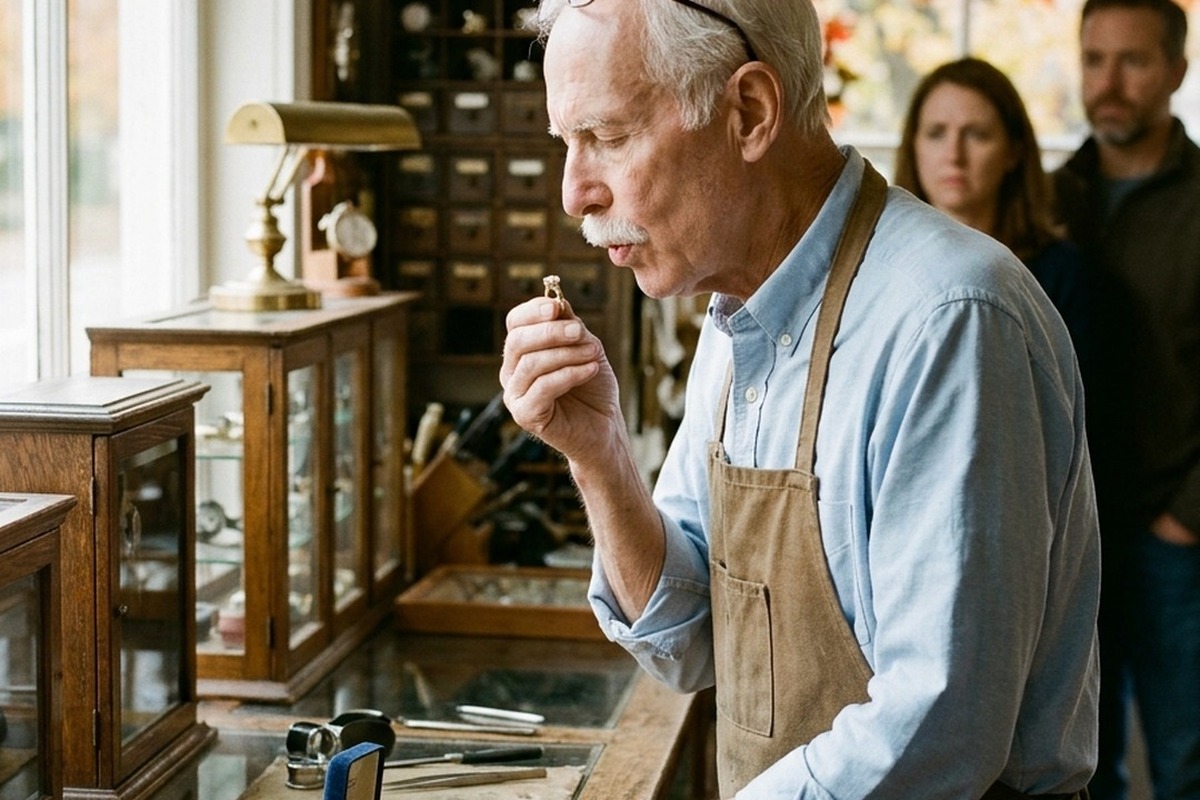
The man on the bench looked up for the first time. Abe could see the boy in him now, the narrow chin, the cowlick that had never been trained.
"You're Ellen's boy," Abe said. "Matthew."
"Matt." His voice was soft and a little hoarse. "Yes, sir."
"What year did you have your heart operation?"
Matt blinked. "Ninety-one. March. I was seven."
Denise put her pen down on the counter. Ron lowered the phone to his side, but did not put it away.
"What's that got to do with anything?" Ron said.
Abe opened the ledger. The pages were soft as cloth and smelled of the old cigar box it had lived beside for thirty years. He found the spring of 1991 by feel, not by sight, because the smudge in his eye ate the middle of every line.
"Denise," he said. "Your eyes are better than mine. Would you read the entry for March fourth?"
She hesitated. Then she came around the counter and bent over the book.
"M. Kessler," she read. "Purchased, one ring, round diamond, one point six carats. One bracelet, nineteen stones. One pair of earrings, half carat each." She stopped. "Paid, eleven thousand six hundred dollars. Cash. Copies made in glass at customer's request. Customer's settings retained." She looked up. "Customer's settings?"
"I took the stones out," Abe said. "I bought them from her at a fair price, and I set glass in her own gold so it would look the same on her hand. Same prongs. Same wear. I made the copies myself. Took me three weeks."
"That's not possible," Ron said. "The church paid for Matt's surgery. Mom said so. She said Saint Brendan's took up a collection."
"They did," Abe said. "Four hundred and some dollars. Your mother told me. She was very proud of that collection." He turned the ledger a little toward Ron. "Ellen had lost her job at the mill that winter. The insurance went with it. The bills came after."
Ron looked at the page a long time. Abe watched his jaw work.
"She never said a word," Ron said.
"She asked me not to," Abe said. "She said if her kids knew, Ellen would never forgive herself, and the rest of you would spend thirty years being careful around that boy. She didn't want him raised careful. So I told her I'd keep it and burn this book."
"Why didn't you?" Denise said.
Abe put his finger on the inside back cover, where a long sealed envelope was tucked into the pocket.
"Because she gave me this a few years later," he said. "Read the front."
Denise read it out loud. "Abe. If my kids ever fight over the glass, give them this. Don't you read it first, you nosy Swede."
Ron made a sound that was almost a laugh.
"I never opened it," Abe said. He held the envelope out past Denise and Ron toward the bench. "It's yours to read, Matt."
Matt stood up slowly. He took the envelope and opened it with his thumb, carefully, so the flap tore clean. There was one sheet inside, folded in thirds.
The clocks on the wall ticked out of step with each other. The radiator knocked twice.
"Dear Denise and Ronnie," Matt read.
He stopped. Swallowed. Started again.
"If you are reading this, you found out my diamonds aren't. I sold them for Matthew's heart. Don't you dare be sore at Abe. He gave me a better price than I deserved and made me look rich for thirty years."
Matt's thumb was pressing a crease into the corner of the paper.
"I wore the glass every Sunday," he read. "It was the best thing I ever bought. If you are fighting over it, quit. Give it to whoever needs it, and go have pie. Love, Mom."
He lowered the page.
Nobody moved. Out on Main Street, a truck went by with a loose tailgate, banging over the railroad crossing, and then it was gone.
Ron set his phone face down on the glass. He picked up the ring box, the bald velvet one with the bad hinge, and closed it with two fingers, very slowly, until the hinge caught.
Denise opened her folder, looked at it, and shut it again.
Matt folded the letter back into thirds. His hands had stopped shaking. He put it in the pocket of his cardigan and kept his hand there, over it.
"I used to ask her why she didn't wear her good ring anymore," he said. "When I was in high school. She'd say this one was good enough for me." He looked at the box. "I thought she meant I wasn't worth dressing up for."
Denise came around the counter and stood next to her nephew. She did not hug him. She straightened the collar of his cardigan where it had folded under, the way her mother used to, and left her hand on his shoulder.
Ron cleared his throat. "Mr. Lindqvist. I said something about the state police."
"You did," Abe said.
"I'd like to take that back."
"It's taken," Abe said.
Abe wrote the appraisal while they waited, with the big magnifier clipped over his bench lamp. Three pieces. Fourteen karat yellow gold settings. Glass stones, well cut, of good age. Total replacement value, four hundred and ten dollars.
At the bottom, he added one more line. Stones originally purchased by this shop, March 1991. Records available to the estate.
He signed it and handed it to Denise.
"Carl Brandt's going to ask questions," she said.
"Then he can come see me," Abe said. "I'm here till five."
Ron looked at the ledger entry again. "Eleven thousand six hundred. That's what I owe on the card. Near enough."
"Your mother had a bad roof in 1991 too," Abe said. "She kept a pot under it till '94."
Ron nodded once and set the ledger down.
They talked it out at the counter in lower voices while Abe went back to his mantel clock. He heard Denise say the house sale would cover the roof. He heard Ron say Sharon would want the earrings, and Denise say fine. He heard Matt say he didn't need anything, and both of them say at once that he was getting the ring.
The bell over the door rang as they left. Ron held it for his sister.
On Monday morning at twenty minutes to nine, the bell rang again.
Matt came in alone, in the same gray cardigan, carrying the blue velvet box. The radiator knocked. He set the box on the counter.
"I've got to be at Mr. Brandt's in twenty minutes," he said. "I wondered if you'd do one thing first."
He opened the box. Abe took out the ring and turned it to the light, and with the loupe in his good eye he found his own mark inside the band. AL, and the little star.
"Next to that," Matt said. "Could you put the date. March of '91."
Abe's hands were not what they had been. He set the ring in the clamp, picked up his finest graver, and took his time. 3. 91. Each line shallow and clean, small enough that nobody would ever see it who didn't know to look.
He handed it back.
Matt held the ring up close to his mouth, the way he had watched Abe do it, and breathed on the stone.
The fog came up gray and stayed. One. Two. Three. Four.
Neither of them reached to wipe it. They stood at the counter in the smell of clock oil and watched it hold, and Matt did not close the box until the stone was clear on its own.