Part 2
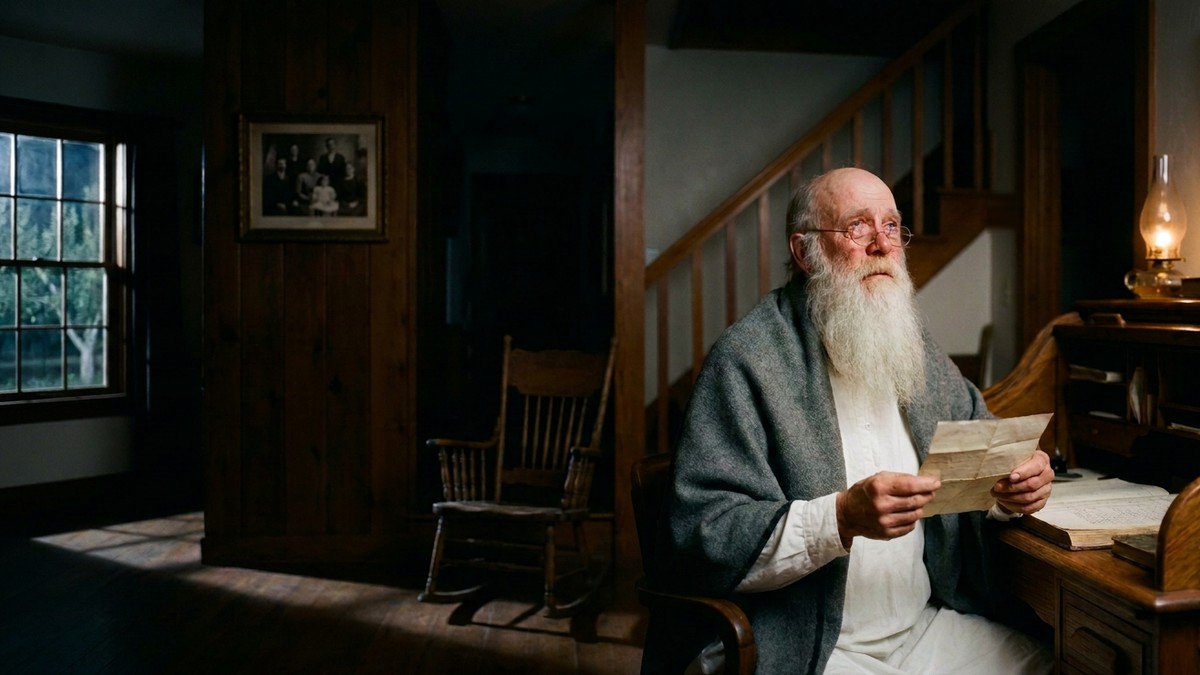
The letter from the Hudson's Bay Company was short and very polite, and it had kept Elias Penney awake for three months.
Sir, it said. In reply to yours of the 14th of July last, regarding a gold ring traded at Fort Boise in the autumn of 1843 for a sack of flour. The Company's journals for Fort Boise for that year record the transaction, and that the ring was forwarded to Fort Vancouver with the furs that winter, to be held against redemption, as was our custom with articles of personal value.
The Fort Vancouver account books for the year 1846 further record that the said ring was redeemed, on the 3rd of June of that year, for the sum of nine dollars in butter and eggs, delivered over two seasons. By a Mrs. Sabra Penney, of the Tualatin Plains.
We trust this information will be of use to you. Your obedient servant.
He had read it twenty times. He still did not understand it.
Sabra had bought back the ring. In 1846. With butter and eggs. Two seasons of butter and eggs, carried in a basket to the Company store at Fort Vancouver, twenty-five miles, on foot or by boat, with a baby on her hip.
Which meant she had known. All along. Since the Snake River. She had known he had traded it, and that he had lied to her. And she had said nothing at all, for fifty years.
And she had never worn it. Not once. He had never seen it.
Elias Penney sat in the dark front room with the letter in his hands and did not know whether to laugh or weep. He did neither. He put the letter in the pocket of his good black coat, which was hanging by the door, ready for the twentieth of May. And he went to Portland on the train the next week, and came home with a small box from a jeweler on First Street.
The twentieth of May, 1893, was clear and warm, with the orchards in blossom all over the valley.
The little white church in Forest Grove was so full that people stood in the doorway and outside the open windows. Nine children, thirty-four grandchildren, four great-grandchildren, and half the Willamette Valley. And in the front pew, eleven old men and women who had come over the trail in 1843 themselves, white-haired and bent, who had been young with Elias and Sabra on the Platte.
Elias stood at the front of the church in his good black coat. Sabra came up the aisle on the arm of their son John, in a gray silk dress, with a sprig of apple blossom in her white hair.
Reverend Atwell read the old service. They said their vows. Elias's voice shook only once.
Then the Reverend said, "And now, I believe, the ring."
The church went quiet.
Elias did not take out the jeweler's box. Not yet.
He turned, instead, to face the people in the pews. His family. His neighbors. The eleven old ones from the trail. And he spoke loudly, so that everyone could hear.
"I promised this woman a ring on the twentieth of May, 1843," he said. "In a tent in the rain, at Elm Grove, Missouri. My mother's ring. I told her I'd give it to her in Oregon, in a proper house." He took a breath. "And I never did. I told her it was lost in the Snake River. That was a lie. I traded it at Fort Boise, in the fall of '43, for a sack of flour, because she was sick with fever and carrying our John, and we had nothing left. And I was too ashamed to tell her. I've been too ashamed for fifty years."
There was a murmur in the church. John Penney, at the end of the front pew, had gone white.
Elias turned back to his wife. He took the jeweler's box out of his pocket, and opened it. Inside lay a new gold ring, bright and plain.
"I'm sorry, Sabra," he said. "It's not my mother's. But it's the best I could do."
Sabra Penney looked at the new ring in the box. Then she looked up at her husband, with her bright eyes swimming. And she began to laugh.
She laughed until she had to take out her handkerchief. Then she reached up, under the high gray silk collar of her dress, and drew out a thin black ribbon that hung around her neck.
On the end of it hung a heavy, plain, worn gold band.
"Oh, Elias," said Sabra. "You old fool. I saw you trade it."
He stared at her.
"I wasn't asleep in that wagon," she said. "I was lying in the back, burning up, and I watched you through the canvas, walking into Fort Boise with your mother's ring in your hand, and walking out with a sack of flour on your shoulder. And I knew what it cost you." She turned the ring on its ribbon in her fingers. "So I bought it back. It took me two summers of butter and eggs. And I've worn it next to my heart every day since the third of June, 1846."
"Why didn't you tell me?"
"Because I wanted you to tell me." Her voice shook. "I wanted to hear you say you'd traded your mother's ring to keep me alive. I've been waiting forty-seven years to hear you say it. And you finally did, didn't you? In front of the whole valley."
She untied the ribbon from around her neck and held out the old ring to him, and her left hand.
"Now put it on, Elias Penney," said Sabra. "Where it belongs. You promised me in Oregon. This is Oregon."
He put it on her finger. It fit, after fifty years, as if it had been made for her.
The new ring from Portland, she said afterward at the dinner, was much too fine to waste. So she put it on Elias's hand. And they both wore them, side by side, for the rest of their lives.
And when Sabra died, in 1901, she was buried with her mother-in-law's ring on her finger. In her Bible, the family found, folded small, a square of faded cotton flour sacking from Fort Boise, with the Company's mark on it, which she had kept for fifty-eight years.