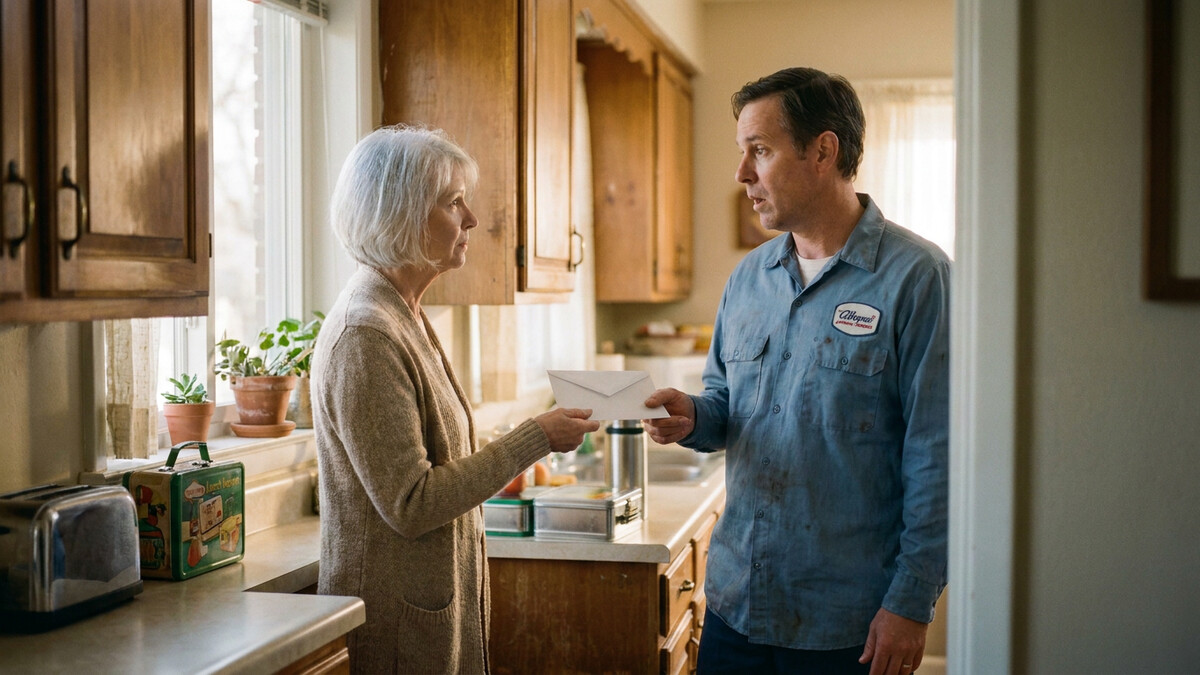
On the first Monday in November, Carol Jean Hensley handed her son an envelope at seven in the morning, the way she had handed him his lunch every school day for twelve years, and inside was a bill for six years of babysitting.
Mark opened it in the kitchen doorway with his car keys in his hand. He read it. Then he read it again.
"Mom," he said. "What is this?"
"It's a bill, honey," Carol Jean said. "Read the bottom."
The bottom said PAID IN FULL, in her neat schoolteacher's printing, with a little heart.
Above it was a number. One hundred and sixty-eight thousand dollars. Six years of full-time childcare for two children, at the going rate in Fairmont Hills, Ohio, which she had looked up at the library on Saturday.
And stapled to the back was a calendar for November and December, with every Wednesday circled in red.
"Starting this week," Carol Jean said, "I watch the kids Monday, Tuesday, Thursday, and Friday. Wednesdays are mine."
Mark stared at the calendar.
"What do you need Wednesdays for?"
"That's the part," his mother said, "that's none of your business."
Carol Jean was sixty-nine. For twenty-five years, from 1980 to 2005, she had run a licensed home daycare out of the little brick ranch house on Sycamore Lane. Miss Carol's. Six children at a time, the state limit, from six in the morning until six at night. She had changed more diapers than she could count and taught more children to tie their shoes than she could remember. She had raised Mark alongside them, after his father left.
When she retired, she thought she was done.
Then, six years ago, Mark's wife, Brittany, went back to work, and they asked if Grandma could help "just for a while."
Just for a while had turned into every weekday, seven to six, for six years. First the baby, Ellie, who was six now. Then Noah, who was three. Carol Jean drove to their house in the new subdivision every morning at a quarter to seven and left every night after the dishes.
She loved those children more than her own life. That was never the problem.
The problem had been building for a long time.
It was the way Brittany walked in at six and checked the kitchen to see what Carol Jean had fed them, like a health inspector. The way Mark forgot her birthday in March and remembered it in April. The way they had stopped saying thank you somewhere in the third year and never started again.
And it was the pot roast.
Two Sundays ago, Carol Jean had made her pot roast for the family, the way her mother had taught her, with carrots and onions and gravy. Noah would not eat it. Brittany got up and made him chicken nuggets from the freezer. Then she made Ellie some too. Then Mark said, "Mom, honestly, the kids don't really like that old-fashioned stuff."
Carol Jean had looked down at her pot roast.
Then, on the drive home, she had realized something that made her pull over on Route 4 and sit there for ten minutes with the engine running.
Not one person in that house had asked her one single question about her own life in six years.
Mark did not take the bill well.
He called her at lunch from his office.
"Mom, I don't understand. Are you mad at us?"
"No, honey."
"Then what's the bill for?"
"The bill is so you know what it's worth," Carol Jean said. "I'm not asking you for a dime. I'm asking you to know."
There was a silence on the line.
"Brittany's upset," Mark said. "She thinks you're trying to make her feel guilty."
"I'm sorry she feels that way. I'm not."
"And what are we supposed to do on Wednesdays? We both work."
"There's a daycare on Pike Road," Carol Jean said. "Little Sprouts. It has openings. I called."
The first Wednesday came. Carol Jean did not drive to the subdivision.
Instead, at nine o'clock, she drove to the community college in Springfield, parked in the visitor lot, and walked into a classroom for the first time since 1975.
The class was called Introduction to Watercolor. It met every Wednesday from nine to noon. She had wanted to paint since she was a girl, and she had never once in fifty years had three free hours in a row to do it.
She was the oldest person in the room by forty years. She did not care.
That afternoon, she ate lunch alone at a diner and read a library book for an hour. Then she went home and painted a very bad picture of a pear.
It was the best day she had had in six years.
The second Wednesday went worse for Mark and Brittany.
Little Sprouts called Brittany at work at ten-thirty. Noah had bitten another child. He had refused his nap, screamed for two hours, and asked for Mimi forty-one times, according to the teacher, who was counting. Ellie had come home with a note saying she was "disruptive during circle time," because she had tried to teach the other kids a song Mimi taught her.
Brittany called Carol Jean that night. Her voice was tight.
"Carol Jean, I know you need a break. I respect that. But you could have given us more notice. You've got the kids so attached to you that they can't function anywhere else."
Carol Jean was quiet for a moment.
"That's called being loved, Brittany," she said. "It takes a while to replace."
There was a long pause on the line.
Then Brittany said something Carol Jean would remember for a long time.
"Mark and I have talked about it," she said. "If this is how it's going to be, maybe it's time the kids went to Little Sprouts full time. All five days. Maybe it would be better for the kids if you just took a step back."
Carol Jean sat down slowly at her kitchen table.
"A step back," she said.
"From the kids. For a while," Brittany said. "Until you're feeling more like yourself."
And then she hung up, and Carol Jean sat alone in the little brick house on Sycamore Lane, holding a dead phone, looking at a very bad painting of a pear.