The listing said 1978 Ford F-100, runs good, some rust, dent in tailgate, $2,000, and the first man who called asked if the dent was still there.
Brayden Nash thought it was a strange question.
"Yes, sir," he said. "It's still there. It's a pretty good dent. You can see it in the third picture."
"I saw it," the man said. His voice was careful. "Is the truck still in Osage Landing?"
"Yes, sir. At my grandpa's place."
"Don't sell it to anybody else," the man said. "I'll be there in four hours."
Brayden was nineteen. He'd been living with his grandfather since August, when he'd dropped out of the community college in Jefferson City because he couldn't make his car payment and pay tuition at the same time.
He worked at the lumberyard in town, loading trucks. He wasn't sure what he wanted to do yet.
His grandfather was Orville Nash, eighty-one, a retired river barge mechanic who'd lived in the same white house on the bluff above the Missouri River since 1969.
Two weeks ago, Orville had slipped on the ice going out to the mailbox and broken his hip.
He'd had surgery in Columbia. He was in a rehab hospital there now, learning to walk with a walker and cussing the physical therapist in a mild, steady way that the physical therapist said she found refreshing.
The doctor had told Brayden, privately, that his grandpa would walk again, but probably not without a cane, and probably not well enough to drive a stick shift truck.
The truck had sat in the barn since the accident.
It was a two-tone F-100, faded blue over white, with a four-speed on the floor and a bench seat patched with duct tape. Orville had bought it new in the spring of 1978 for about five thousand dollars, cash, which was most of what he'd saved in ten years on the river. He'd changed the oil every three thousand miles for forty-eight years and written each one down in a little spiral notebook in the glove box.
There was a deep dent in the middle of the tailgate, big enough to set a basketball in. Orville had never fixed it.
"Why not?" Brayden had asked him once, when he was a kid.
"Because it's mine," Orville had said, and that was the end of it.
The hospital bills had started coming in the mail the week after the surgery. Brayden opened them because Grandpa had asked him to bring in the mail, and then he'd sat at the kitchen table and looked at the numbers for a long time.
Medicare paid most of it. What it didn't pay was still more than Brayden made at the lumberyard in two months.
Brayden had done the math the way he did everything, quickly and a little bit wrong. Grandpa couldn't drive the truck anymore. The truck was just sitting there.
Two thousand dollars would cover the rehab copay and some of the rest. And Grandpa wouldn't have to worry about it.
He'd listed it on a Sunday night without asking, sitting on the porch steps with his phone.
He'd meant to tell Grandpa on Monday. Then on Tuesday. He hadn't yet.
The man who'd called pulled into the yard at four in the afternoon in a gray Chevy pickup with Kansas City plates.
He was about forty-five, heavyset, in a canvas jacket and a seed company cap. He got out and stood in the yard for a moment looking at the barn. He didn't look at the house at all.
"Sam Whitfield," he said, and shook Brayden's hand.
Brayden opened the barn door. Sam walked in slowly and stopped behind the F-100.
He stood there looking at the dent in the tailgate for a long time. Then he reached out and laid his hand flat in the middle of it, like he was measuring it.
Brayden waited. It was getting uncomfortable.
"You want to hear it run?" he asked finally.
"No," Sam said. "I know it runs."
He turned around. His eyes were wet. He wiped them with the back of his wrist, quickly, like a man who isn't used to it.
"I'll give you four thousand dollars," he said. "Cash. I've got it in the truck."
Brayden stared at him. "It's listed for two."
"I know what it's listed for."
"Mister, why?"
Sam didn't answer that. He looked at the truck again.
"One condition," he said. "I want to give the money to your grandfather myself. In person. I want to shake his hand."
The rehab hospital in Columbia was forty minutes away. Brayden drove. Sam followed in his gray Chevy.
Brayden spent the whole drive feeling sick. He hadn't told Grandpa. He'd have to tell him now, in front of a stranger, and he could already see his grandfather's face.
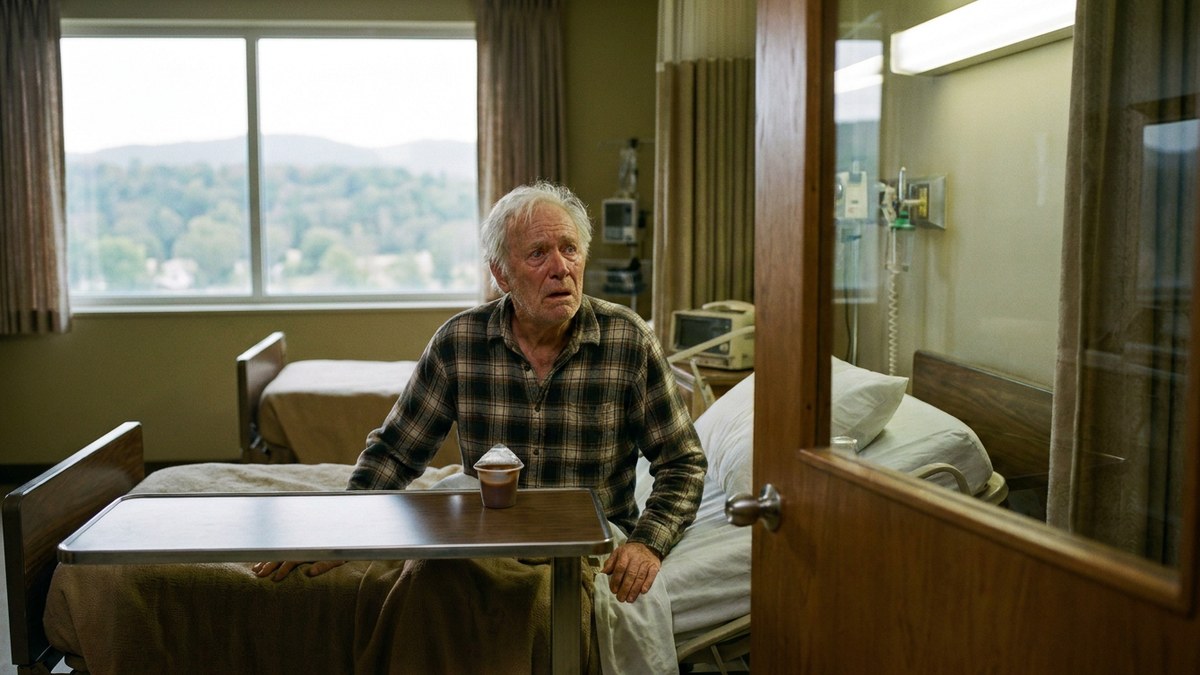
Orville was sitting up in bed in room 214 with the TV on and a pudding cup on his tray. He was in a good mood. He saw Brayden in the doorway and smiled.
Then Sam Whitfield stepped into the room behind him with his seed cap in his hands.
Orville looked at Sam. He looked for a long, long moment.
Brayden watched his grandfather's face change. The smile went away. Something else came into it, something Brayden had never seen there before, and couldn't name.
Orville set down the pudding cup.
"Brayden," he said quietly. "What did you do?"