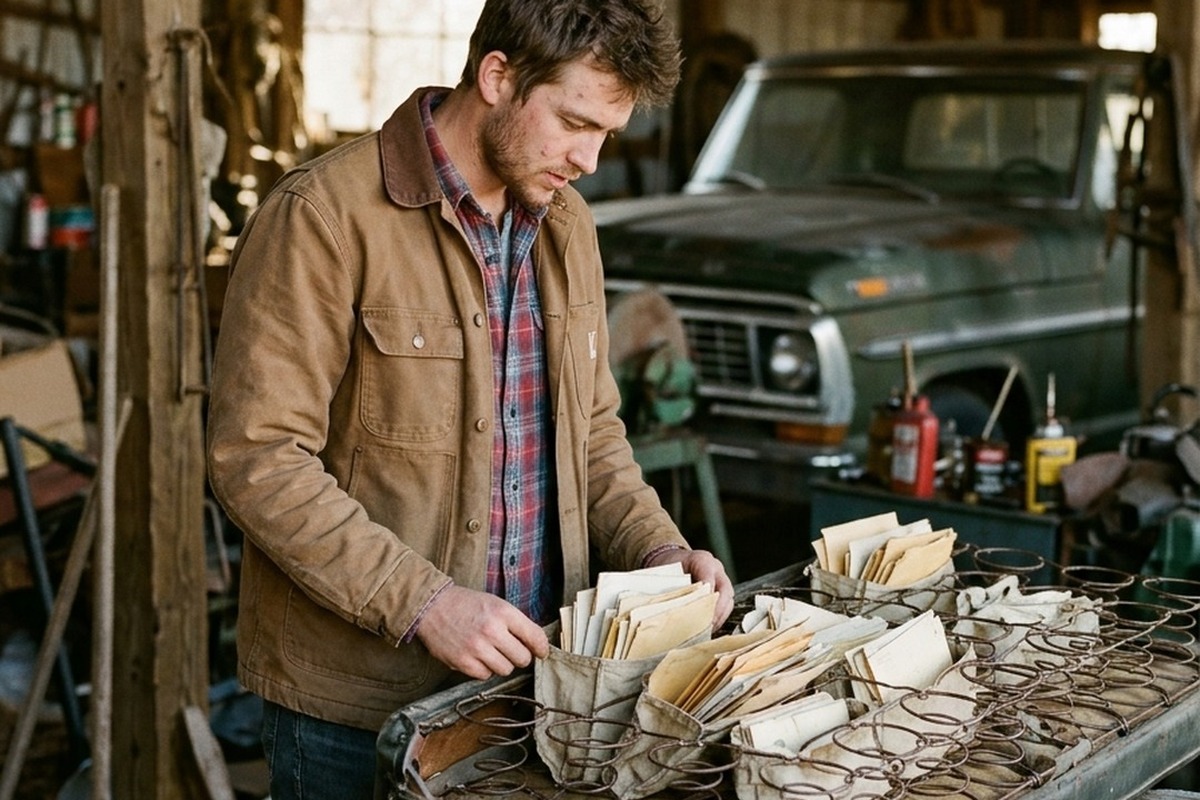
"What have you got wired under there?" Brad asked, stepping into the shed bay.
Wyatt kept his right hand resting on the rusted steel frame of the upside-down bench seat.
Brad craned his neck over the zig-zag coil springs and stared at the oiled canvas mail pouches lashed between the coils with greased wire. Through the open flap of the top pouch, the engraved borders and Treasury seals on the thick cream envelopes caught the light.
"Trudy!" Brad shouted toward the doorway. "Get out of the car and get in here!"
Trudy hurried across the gravel in her ankle boots, holding her coat closed against the wind. When she saw the heavy canvas pouches wired beneath the foam and burlap, her breath caught.
"Those are bank envelopes," Trudy whispered. "Dozens of them."
Brad reached for the open canvas pouch. "Step back from the sawhorses, Wyatt. Anything hidden inside the truck belongs to the residuary estate, which means it gets split between me and Trudy."
Wyatt set his calloused palm flat over the canvas flap before Brad could touch it.
"Step back, Uncle Brad," Wyatt said quietly. "Nobody touches a wire on this seat until Leland Pike gets here."
"Your title covers a nine-hundred-dollar farm truck, not cash assets," Brad snapped, his face flushing red. "I'm co-executor on this property, and I'll call the sheriff."
"Save your call," Wyatt said evenly. "Leland Pike is turning up the lane right now."
Outside on the gravel, a dark sedan stopped beside Clyde Harker's trailer. At eleven-forty, twenty minutes before the noon gate lock, seventy-four-year-old Leland Pike walked into the machine shed carrying his leather briefcase to sign off on the shed inventory.
"Leland, thank goodness," Trudy said, meeting him at the doorway. "Dad hid bank envelopes inside the springs of that pickup, and Wyatt is trying to keep them from the residuary estate."
Leland looked at the upside-down bench seat on the sawhorses and gave a calm nod. He set his briefcase on an empty steel oil drum and snapped the brass latches open.
"Wyatt isn't taking anything from the estate, Trudy," Leland said. "Your father brought that bench seat to the alley behind my office in the spring of 2019 so I could record every serial number before he bolted it back into the cab."
Brad stared at the lawyer. "You knew those pouches were under there?"
"I drafted the clause," Leland replied, lifting the certified copy of the will from his briefcase. "Listen to Article Five again, Brad. Vernon left Wyatt 'my 1972 Ford F-100, together with all tools, springs, and contents attached to or contained within its cab,' itemized on the Schedule B codicil in my vault."
"A vehicle bequest can't override probate on bearer funds," Brad argued.
"They aren't bearer funds," Leland said. He nodded to Wyatt. "Clip the wire on that first pouch, son."
Wyatt pulled the hog-ring pliers from his jacket pocket, snipped the greased wire holding the top canvas pouch to the coil spring, and handed it to Leland.
Leland slid out the bundle of cream envelopes and spread them across the oil drum. Inside were forty-two Series E and Series EE United States Savings Bonds purchased at Citizens State Bank every July from 1972 to 2014.
"Every July after wheat harvest for forty-two years, your father walked into Citizens State Bank and put his wheat money and road-department pension savings into thirty-year bonds," Leland said, tapping the top bond. "And look at the registration line typed across every single certificate."
Brad leaned over the drum and read the typed line aloud in a hollow voice.
"Vernon L. Mercer POD Wyatt R. Mercer," Brad said.
"Payable on Death to Wyatt R. Mercer," Leland confirmed. "Under federal Treasury regulations, Payable on Death bonds pass directly to the named beneficiary outside probate. Matured and compounded from 1972 to 2014, their redemption value comes to two hundred and forty-eight thousand, six hundred dollars."
That was nearly seven times the thirty-six-thousand-dollar checking account Brad and Trudy had split the morning before.
In the quiet bay, Wyatt reached into the last canvas pouch, where a worn 1972 Citizens State Bank passbook sat beside a tin of white grease. Inside the passbook lay a folded sheet of lined paper written in Vernon's carpenter's pencil.
Wyatt unfolded the note and read it aloud.
*If you have this seat upside down on the sawhorses, Wyatt, you finally used that nine-sixteenths socket,* the note read. *I started buying these bonds the summer Brad was born in July of '72. After the grass fire of '78 scorched the porch, I wired them inside oiled mail pouches under the Ford seat where I sat every day, figuring a man keeps his best work under him.*
Wyatt steadied his voice and read the second paragraph.
*For forty-five years I meant for these to be split with Brad and Trudy. Then by 2019, Brad and Trudy hadn't visited Colby in six years, while you spent every winter weekend splitting my stove wood and keeping the house warm. That spring I went to the bank and changed the beneficiary on the bonds to the one who showed up.*
Trudy looked down at her gloves, turned without a word, and walked back to her car.
Brad stayed beside the pickup's primer-spotted front fender. He leaned against the faded green steel his father had washed after fifty wheat harvests, and the stiffness went out of his shoulders.
"I drove out here in '18 and watched him rebuild a carburetor with you for three hours without asking me to hand him a wrench once, Wyatt," Brad said, his voice quiet and flat in the cold shed. "I figured he didn't need a son who worked at a desk."
Wyatt looked at his uncle without a trace of gloating.
Tucked into the back flap of the 1972 passbook were two early one-thousand-dollar bonds Vernon had left in their original registration from July 1972 and October 1975, clipped with a short pencil note: *Bought the weeks Brad and Trudy were born. Hand them over if they remember where they started.*
Wyatt slid those two original birth-year bonds out of the sleeve and held them out to his uncle so he and Trudy would have what their father bought the weeks they came into the world.
"Grandpa bought these the weeks you and Aunt Trudy were born," Wyatt said quietly. "He kept your names on both of them, and they belong to you."
Brad stared down at the July 1972 issue date, took the two envelopes in both hands, and gave Wyatt a slow nod before walking to his car.
At twelve noon, Clyde Harker hauled the old harrow disks out the gate, and Leland Pike followed Brad and Trudy down the gravel road.
Alone in the quiet machine shed, Wyatt set the canvas pouches inside his tool bag and took the hog-ring pliers out of his jacket pocket.
He spread the fresh burlap and foam over the bench seat frame, stretched the new green vinyl tight, and crimped new steel rings onto the springs the way Vernon had taught him.
When every coil sat firm, Wyatt bolted the seat back down into the cab with his nine-sixteenths socket, climbed behind the wheel, and drove the old green Ford out the gate toward the elevator.