Elwood Rasmussen's sons loaded every cow on the ranch onto three cattle trucks two weeks after his funeral, and they did not ask his widow, Hattie, because as far as they knew, she did not own a single one.
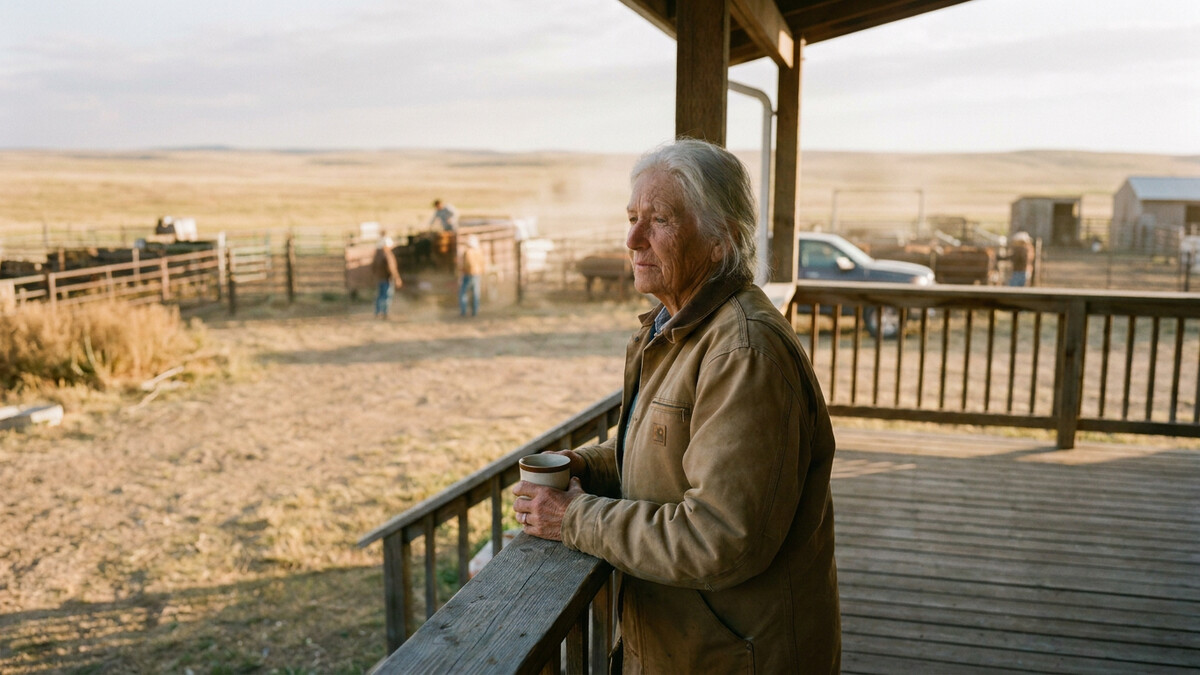
Hattie stood on the porch of the ranch house outside Crowheart Bench, Wyoming, in her barn coat, with a cup of coffee going cold in her hand, and watched them do it.
She did not say anything.
She was eighty-four. She had learned a long time ago that there was a time to argue and a time to watch. This was a time to watch.
Hattie had been married to Elwood for sixty-three years. She had been his second wife. His first wife, Marlene, had died in 1959, leaving him with two little boys, Clint and Roger, aged four and two.
Hattie had married Elwood in 1962, when she was twenty and he was thirty-one. She had raised his boys from the time they were small. She had never had children of her own.
Clint and Roger had grown up calling her Hattie, not Mom. She had never asked them to call her anything else. They had grown into hard, practical men. Clint was seventy-one and ran a feed business in Riverton. Roger was sixty-nine and sold insurance in Casper.
Neither of them had ranched in forty years.
Elwood's will had been simple. He had written it in 1975 and never changed it. The ranch, the land, and everything on it went to his two sons. His wife could live in the house for the rest of her life.
"It's how Dad wanted it," Clint said at the lawyer's office, not unkindly. "The land stays in the Rasmussen family. You'll always have a home here, Hattie. Not one of us is going to put you out."
"I know that, Clint," Hattie said.
"But we can't run the cattle," Roger said. "Neither of us can. And you're eighty-four. So we're going to sell them. All of them. At the sale barn in Riverton. Before winter, while prices are good."
"All of them," Hattie said.
"All three hundred and forty head," Clint said. "It's the best thing, Hattie. You'll get a share of it, of course. Dad would want that. We'll make sure you're taken care of."
Hattie looked at her stepsons across the lawyer's table. Seventy-one and sixty-nine. She had changed their diapers.
"That's kind of you, boys," she said.
She did not tell them what she knew.
She did not tell them that there were not three hundred and forty head of Rasmussen cattle on the ranch. There were two hundred and two.
The other one hundred and thirty-eight belonged to her.
It had started in 1962, the year she married Elwood.
Her father, who ran sheep on the other side of the Wind River, had given her a wedding present. One bred Hereford heifer. "Every ranch wife should have something of her own," he had said. "Brand her yourself."
So she had.
That fall, Hattie Rasmussen drove to the county courthouse in Lander and filled out the forms with the Wyoming Livestock Board to register a brand in her own name. A capital H with a bar under it, on the left rib. She paid the fee from her own egg money. Elwood had laughed and called it her "hobby herd."
Then he had forgotten about it.
He forgot about it for sixty-three years.
Every spring at branding, while the men roped and wrestled the Rasmussen calves and put the Rasmussen Rocking R on their left hips, Hattie had quietly branded the calves from her own cows with her own iron, the H Bar, on the left rib. She kept the iron behind the saddle blankets in the tack room.
The men never noticed. Most ranchers do not look at the ribs of somebody else's calf. And her cows ran right along with Elwood's, on the same grass, through the same gates.
Every fall, she sold her steer calves and kept her best heifers. She paid Elwood a grazing fee every year, in cash, which he thought was just Hattie being stubborn. She put the rest of the money in an account at the bank in Lander in her own name.
Over sixty-three years, one bred heifer had become one hundred and thirty-eight head.
And she had kept her brand registered with the state of Wyoming. Every ten years, as the law required. She had paid every renewal from her own account.
The brand was hers. By law. And in Wyoming, the law said that whoever owned the brand owned the cow.
The cattle trucks pulled out on Tuesday morning, heading for the sale barn in Riverton.
Hattie watched them go. Then she went inside and called a man named Dwayne Skelton.
Dwayne was the brand inspector for that part of Fremont County. In Wyoming, no cow could be sold or moved across the county line without a brand inspector looking at her first and writing down whose brand she wore. The law had been written to stop cattle thieves.
"Dwayne," Hattie said. "It's Hattie Rasmussen. Are you working the Riverton sale Thursday?"
"I am, Mrs. Rasmussen. I was sorry to hear about Elwood."
"Thank you, Dwayne. I need to ask you a favor. When Clint and Roger's cattle come through on Thursday, I'd like you to look at the left ribs."
There was a pause on the line.
"The left ribs," Dwayne said slowly.
"Yes."
"Mrs. Rasmussen, I'll inspect every animal like I always do. Hide and hip and rib." He paused again. "Is there something I should know?"
"You'll know it when you see it," Hattie said.
On Thursday morning, Hattie put on her good wool coat and her late mother's turquoise brooch and drove Elwood's old pickup to the Riverton sale barn.
She did not go into the sale ring. She went to the back pens, where the cattle were being sorted and inspected before the sale.
She found Clint and Roger standing at the rail of the long alley, watching the brand inspector work. Dwayne Skelton was moving down the alley with his clipboard, looking at each cow as she came through the chute.
He had been at it an hour. He had looked at a lot of left ribs.
Hattie came up behind her stepsons and stood at the rail beside them.
Clint turned. "Hattie? What are you doing here?"
"Came to watch," Hattie said.
At the end of the alley, Dwayne Skelton stopped the chute. He looked at the cow in front of him for a long time. Then he looked at his clipboard. Then he turned around and walked back up the alley toward the three of them, slowly, with his clipboard against his chest.
He stopped in front of Clint.
"Mr. Rasmussen," he said. "I've got a problem. I can't release these cattle for sale."
Clint frowned. "What do you mean, you can't release them?"
Dwayne looked past him at the small, white-haired woman in the turquoise brooch.
"Because a hundred and thirty-eight of them," he said, "don't belong to you."