Part 1
Jim Ashby proposed to Kate Brennan at the Raton lunch counter, in front of forty passengers, with eleven days left on her contract.
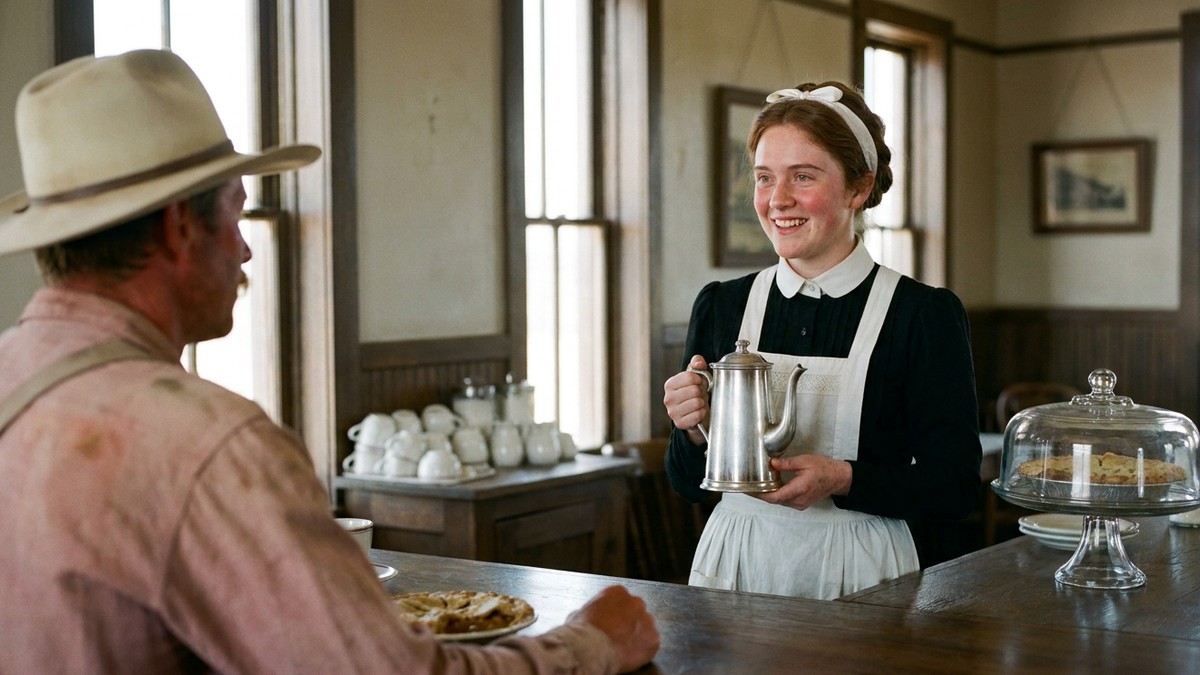
It was September 1886, in Raton, New Mexico Territory, where the Santa Fe railroad climbed down out of the mountains onto the high grass plains. Every train stopped at Raton for thirty minutes. In those thirty minutes the Harvey House fed every soul aboard, hot, on china, with linen napkins, and sent them back to their cars with a slice of pie.
Kate was twenty-three, from a farm in Missouri. She had answered an advertisement in the Kansas City paper for young women of good character, eighteen to thirty, to serve in Harvey eating houses in the West. She had signed a contract for six months. Good wages, room and board, and at the end of it, a free railroad pass to anywhere on the line.
She meant to use it to go home and bring her widowed mother west.
If she left before the six months were up, for any reason, she forfeited half her pay. And the pass.
He did it over a plate of peach pie, with his hat in his hands.
"I'll wait," Jim said. He was thirty-two, sunburned, with a small ranch out on the plain toward Sugarite Canyon, where he lived with his mother. He had eaten pie at Kate's end of the counter every day for four months. "Eleven days. I can wait eleven days, Kate. I've waited thirty-two years."
The passengers on either side of him applauded. A drummer whistled.
Kate went red to the roots of her hair and poured him more coffee.
"Eleven days," she said. "And not a minute sooner, Jim Ashby. I mean to have that pass."
The head waitress at Raton was Mrs. Bridget Kearney.
She was fifty-eight, a widow, with a voice like a train whistle and eyes that missed nothing in that dining room, not a spot on an apron or a crooked fork or a girl talking to a brakeman behind the coffee urn. She was the house mother. She locked the dormitory door at ten o'clock every night and kept the key on a chain around her neck.
"You'll keep your contract, Miss Brennan," she said that night, at the dormitory door. It was not a question.
"Yes, ma'am."
"Good." Mrs. Kearney looked at her a moment longer. "I grew up on a claim in Kansas, Kate. My mother kept a contract with the government for five years on a hundred and sixty acres of grass, with a fire guard plowed round it twice a year. Contracts are what keep a woman on her feet out here." She turned the key in the lock. "Mind you remember it."
Kate was good at the work. She had found that out in the first week.
When a train whistled at the Raton yard limit, the Harvey girls had twenty minutes to set every place. When it stopped, they had thirty minutes to seat and serve a hundred people and have them out again. Kate could carry six plates up one arm. She could take a whole table's drink orders in one pass, with the cup code: cup upright in the saucer meant coffee, upside down meant hot tea, upside down and tipped against the saucer meant iced tea. She could clear, reset, and serve a second sitting faster than any girl in the house.
"You'd make a general," Mrs. Kearney said once, watching her. From Mrs. Kearney, that was praise.
On the ninth day, the wind came up out of the southwest.
It came hot and dry across the plains, smelling of dust and cured grass. The prairie that year had been dry since July, gone gold and then gray, and the grass stood knee-high and brittle as straw. All afternoon the dining room windows rattled.
At four o'clock, between trains, Kate stepped out onto the platform to shake a tablecloth, and smelled smoke.
She turned. Out on the plain to the southeast, low along the horizon, a long brown smudge was rising into the sky and leaning north with the wind.
Behind her, in the dining room, a man shouted.
It was a section hand from the railroad, red-faced and out of breath. "Grass fire," he said. "Below Sugarite. It's running north on this wind. It'll be at the Ashby place inside two hours."
Jim had gone out with his hands that morning to drive steers to the shipping pens at Springer. Forty miles south.
His mother was alone on the ranch.
Kate did not think. She had already untied her apron.
She was halfway across the dining room with it balled in her hand when Mrs. Kearney stepped out in front of her, between the tables, like a locked gate.
"Where are you going, Miss Brennan?"
"To the Ashby place. His mother's there alone. She's seventy."
"The seven-forty train is due in three hours, and you are on the floor." Mrs. Kearney's face was like iron. "You know the rules. If you walk out that door without leave, you've broken your contract. Half your pay. And your pass." She did not move. "Two days, Kate. You'd throw it away with two days left?"
Out the window behind her, the brown smoke was climbing higher.
Kate stood in the middle of the Harvey House dining room with her apron in her fist and looked at the woman who held the key to every door.