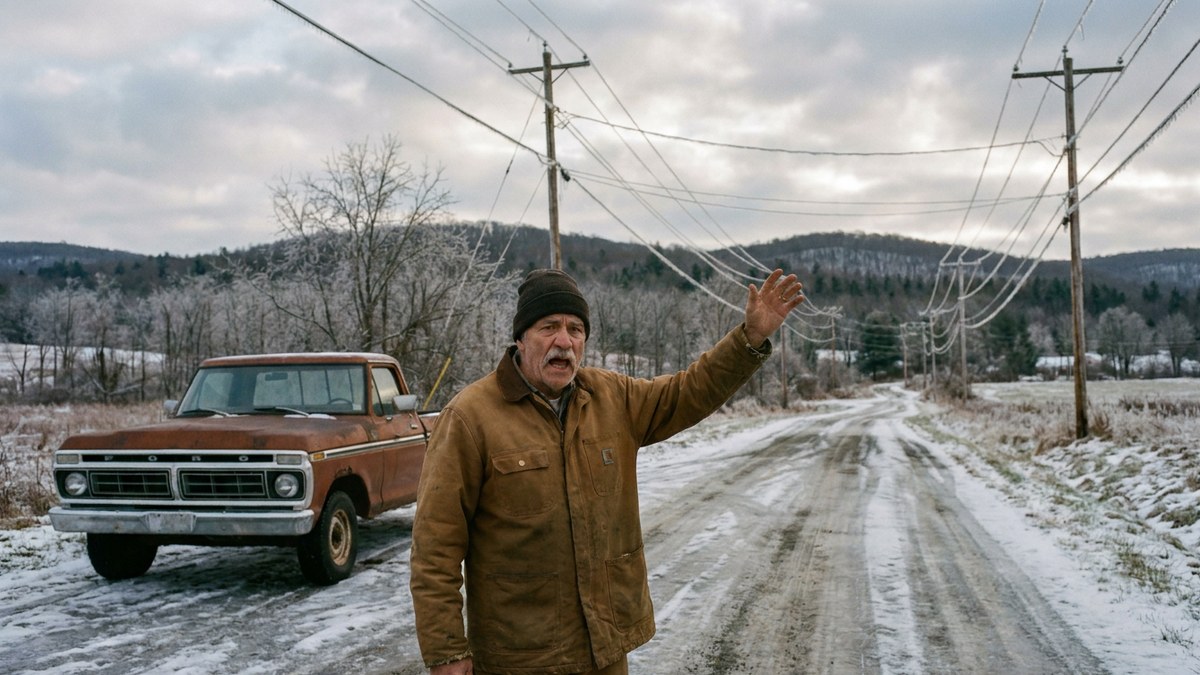
The ice storm came through Calder County on a Tuesday night in January, and by Wednesday morning, half the county was dark.
Gus Ferrell listened to it come down from his kitchen. First the rain, then the tick of it freezing on the windows, then, after midnight, the long cracks out in the woods as the tree limbs gave way under the weight. Every few minutes the sky lit up blue-green over the ridge, the way it does when a power line comes down and arcs.
Gus was seventy-four. He'd been a lineman for Calder Rural Electric for forty-one years, and he'd seen that blue-green flash more times than he could count.
He'd worked the Blizzard of 1978 and more ice storms than he could name. His late wife, Bonnie, used to say she'd spent half their marriage keeping his supper warm on the back of the stove.
He counted the flashes anyway, out of habit. He got to eleven before his own lights went out.
At the Liars' Table the next morning, Dot ran the diner off the old gas range and a coffee pot she heated on a burner.
"Maple Grove's out," she said. "Whole care home. Their generator ran about two hours and quit."
Gus set down his cup. "Quit how?"
"I don't know how, hon. It quit. They've got thirty-eight residents over there and a bunch of them on oxygen machines. They're running them off the little tanks now, and they've got maybe a day of those."
"Diesel generator?"
"I suppose."
"It gelled," Gus said. "Twelve degrees last night. Diesel turns to jelly in the fuel filter when it gets cold enough, if they didn't treat it."
Floyd Eckert looked at him over his glasses. "How do you know that?"
"Because I spent forty-one years fixing what other people forgot to treat," Gus said, and went to get his coat.
The maintenance man at Maple Grove was named Terry. He was fifty, exhausted, and on his knees beside a big yellow generator behind the building with a flashlight in his teeth.
Gus didn't tell him what to do. He asked questions.
When was the fuel delivered. Fall. Did anybody add anti-gel.
Terry didn't know. When was the filter changed. Terry didn't know that either.
They pulled the fuel filter. It was full of something that looked like cloudy honey.
"That's your trouble," Gus said. "You've got a spare filter?"
Terry had two. They changed it, and Gus showed him how to wrap the fuel line with a heat blanket from the supply closet, and they poured in a bottle of anti-gel from the hardware store that Gus had bought on his way over.
The generator coughed, ran rough for a minute, and settled.
Terry sat back on his heels in the snow. "I could kiss you," he said.
"Please don't," Gus said. "It's only a stopgap. You've got to get the power back on before that fuel runs low. You've got maybe a day and a half."
The co-op crew got to the Maple Grove line at two that afternoon.
There were three of them in a bucket truck. The crew leader was Brett Kinney, twenty-eight, a good lineman who'd trained under men Gus had trained. His apprentice was a big quiet kid named Josh, nineteen, in his first winter.
The trouble was a half mile up Hollow Creek Road. A big oak had come down across the line in the night, snapped a pole, and dropped the wire across the road and into the ditch.
Gus parked his truck on the shoulder behind them. He brought a thermos of coffee and a sack of Dot's ham biscuits, and he stayed out of the way.
It was a long, cold job. They cleared the tree with chainsaws.
They set a new pole. Brett went up in the bucket to rebuild the crossarm while Josh worked on the ground, pulling the fallen wire out of the ditch and getting it ready to lift.
Gus watched. He'd watched a thousand jobs like it. He watched the ice drip off the wire, and the light going out of the sky, and the way the young men moved in the cold, a little too fast, the way men move when they're tired and they want to go home.
He watched the pole-mounted transformer on the next pole down the road. The one that fed the four houses past the bend.
And he listened.
Linemen learn to listen. A good transformer that's carrying power has a hum to it, low and steady, a sound you feel in your back teeth more than you hear. A dead one is quiet.
The line was supposed to be dead. Brett had opened the switch at the substation side himself.
He'd hung his tag on it. By every rule of the job, that wire was safe.
But the transformer on the next pole was humming.
Gus stood very still by his truck.
It was faint. Very faint, under the wind and the drip of the ice. But he'd spent forty-one years listening for that sound, and he knew it the way he knew his own wife's voice.
On the ground, Josh had pulled the fallen wire up out of the ditch. He'd taken off one glove to get a better grip on a tangle of ice. He reached out with his bare hand toward the line.
"Josh," Gus shouted. "Don't touch it."