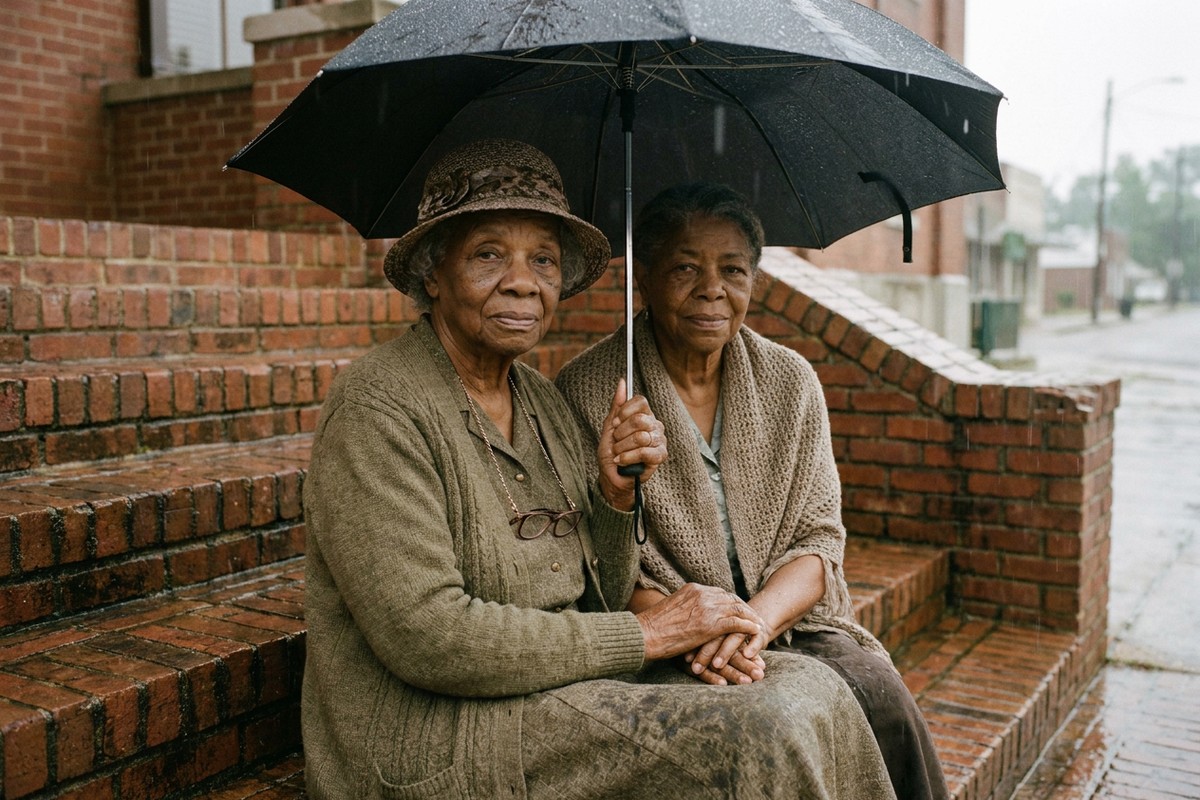
On Monday morning, it was raining.
Mavis noticed it the moment she stepped off her porch, the same steady, soaking spring rain as the night of the break-in. By the time she'd walked the half block from the parking lot to the courthouse steps under her umbrella, the hem of her skirt was wet and her shoes squished.
She smiled a little. Clarence would have said the Lord liked a good joke.
The other eleven came in damp and grumpy and sat down at the long table. Mavis had brought a plate of lemon bars she'd baked on Sunday afternoon, because in her experience, people listen better with something sweet in front of them.
She didn't make a speech. She'd never been good at speeches. She just turned her chair toward the end of the table, where the retired mailman was sitting.
"Mr. Lee," she said, "how many years did you carry mail?"
Otis Lee looked surprised to be asked anything. "Thirty-one."
"On foot?"
"Walking route, downtown, the first twenty."
"In the rain?"
"Every kind of rain there is, ma'am."
"Then I'd like your opinion," Mavis said. "If a young man ran two miles in a hard rain like the one we've got this morning, in a cotton hoodie, no coat, no umbrella. How wet would he be when he got there?"
Otis Lee looked out the window at the rain coming down on the courthouse square. He was quiet for a long moment.
"Soaked," he said finally. "Soaked to the skin. A cotton sweatshirt would weigh about five pounds. You could wring it out."
"And the deputy wrote that his clothes were dry."
"Yes ma'am. He did." Otis Lee rubbed his knees. "I believe I'd like to change my vote."
That was one.
Mavis went around the table the way she used to go around a wedding dress. Slow.
One seam at a time. Never pulling too hard.
Tasha, the nurse's aide, worked nights and walked from the bus to the hospital in every kind of weather. Mavis asked her what her scrubs looked like after a two-block walk in a storm. Tasha laughed in spite of herself and said she kept a spare set in her locker for exactly that reason.
The foreman, Lamar Dubose, had spent thirty years adjusting insurance claims. Mavis asked him what he'd say about a claim where the story didn't match the evidence on one important point.
"I'd say I needed to look again," Lamar said slowly. "Before I paid it."
A young man who taught high school history asked the bailiff to bring in the map of town they'd been shown in court. He measured the route from the church to Delta Street with a ruler and the scale at the bottom.
It was 2.1 miles. Twenty-five minutes to do it, running in the dark with a heavy bag, in a downpour, and arrive without a wet thread.
By ten-thirty, the vote was nine to three for not guilty. By eleven, it was eleven to one.
The one was Wayne Coker.
Wayne stood at the window again, looking out at the rain.
The others went quiet. Mavis got up and walked over and stood beside him.
She didn't say anything for a while. She just looked at the rain with him.
"Your church," she said at last. "The one that got broken into. What did they take?"
Wayne didn't turn around. "The communion silver. It was my mother's gift to the church, when my daddy died. They never found it."
"I'm sorry, Mr. Coker."
"I wanted somebody to pay for it," he said. "That's all. I wanted somebody to finally pay."
"I know," Mavis said. "So do I. But if we send that boy to prison and he didn't do it, then the man who broke into Bethel's pantry is still out there tonight. Still breaking into churches. And this time the sheriff won't even be looking for him."
Wayne was quiet for a long time. The rain ran down the window glass.
Then he turned around and went back to the table and sat down, heavily.
"Not guilty," he said. "Write it down, Lamar."
They read the verdict at 2:15 that afternoon.
Jaylen Booker didn't make a sound when the clerk said the words. He just put his head down on the defense table. In the second row, his grandmother closed her eyes and pressed her purse against her chest and moved her lips without making a sound.
Mavis walked out of the courthouse at three, into the rain. She stopped on the steps to open her umbrella.
The boy's grandmother was standing there, at the bottom of the steps, in her church hat, getting wet. She'd been waiting.
"You're the one," she said. "Aren't you. The bailiff told me. You're the one who wouldn't."
"I'm just the one who asked about the rain," Mavis said.
The old woman came up the steps and took both of Mavis's hands in hers, and held them, and didn't say anything else. So Mavis opened her umbrella and held it over the two of them, and they sat down together on the courthouse steps in the rain like two old friends waiting for a bus.
Two weeks later, the Pearl Bend Ledger ran a short story on page three. A thirty-four-year-old man had been arrested trying to sell a church's stolen cash box at a pawn shop in Hattiesburg. He was wanted for break-ins at four churches in two counties.
The story said that when they arrested him, it was raining, and he was wearing a black raincoat.