Part 1
The packers on the Chilkoot laughed at Winnie Tolley's flour all the way to the summit, and she let them.
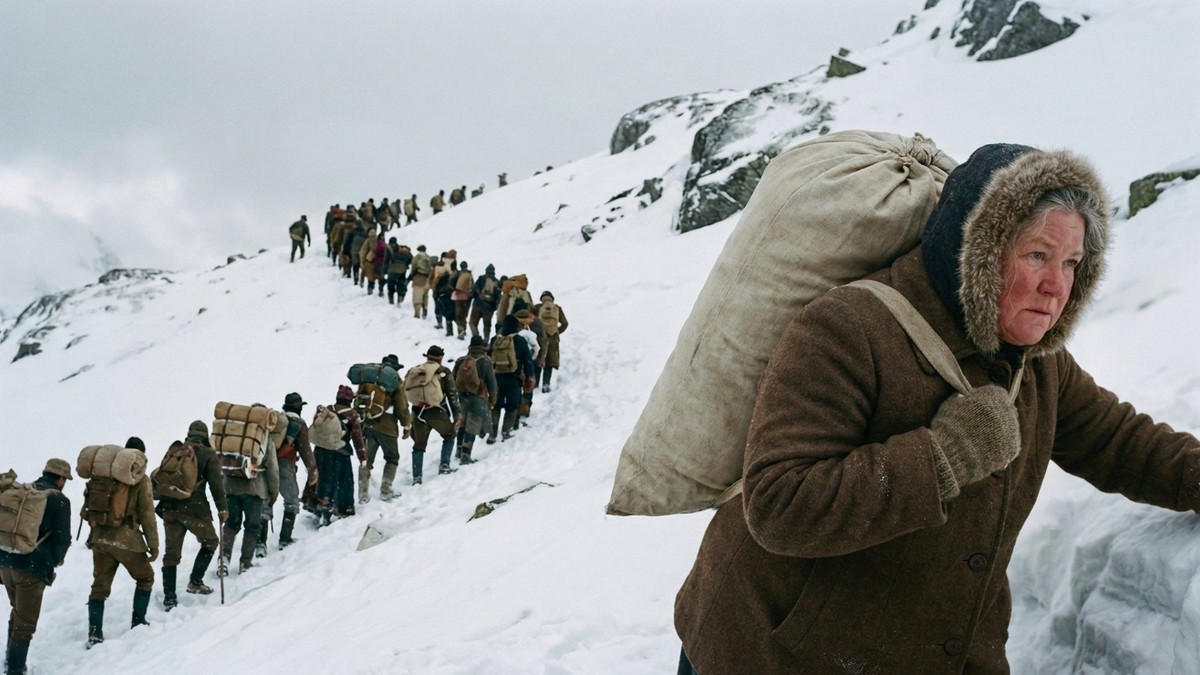
It was September 1897, on the trail to the Klondike, where the gold rush had sent thousands of people north toward Dawson City with whatever they could carry. Winnie was fifty-eight, a widow, a baker from Seattle. She had sold her shop on Second Avenue in August and bought a ticket north with the money. Her husband had been dead six years. Her only son was in the ground at Lake View. She was not going north to find gold.
"I'm going," she had told her sister, "to sell bread to the people who find it."
She had forty sacks of flour.
Fifty pounds each. A ton of it, near enough, and she was hauling it over the Chilkoot Pass in relays, one load at a time, the way everyone did. Up the Golden Stairs, the long line of steps hacked into the ice, with a pack on her back. Down again, empty. Up again. Thirty, forty trips. Her knees screamed. Her lungs burned. She paid an old Tlingit packer named Joe Kooshan to carry the heaviest loads, and he was the only one on the trail who did not laugh at her.
"Forty sacks," said a young man from Ohio named Lew Danby, at the scales. He had a gold pan, a pick, and a sack of beans. "For a bakery? In a tent? Ma'am, there's going to be twenty thousand men in Dawson. They're not going to want cake. They're going to want whiskey."
The men around him laughed.
"They'll want bread," said Winnie, "come January."
"In January, ma'am," said Lew Danby, "I'll be rich enough to buy the whole bakery."
Joe Kooshan said little. But on the last trip up, when they stood together at the summit in the wind, he made a small fire behind a rock and boiled a handful of green spruce tips in a can, and gave her a cup of it, bitter and hot. Then, looking down at Lake Lindeman far below, he said one thing.
"The river will close early this year," he said. "My uncle has watched it forty winters. He says the boats will not get through, and there are too many people, and not enough food."
Winnie looked at him.
"Keep your flour," said Joe Kooshan. "Whatever they say."
She thought about it all the way down.
She reached Dawson on the fourth of October, on a homemade scow, with forty sacks of flour, a sheet-iron stove, two bread pans, a tent, and a sack of dried apples.
Dawson was a mudflat at the mouth of the Klondike River, swarming with people. Tents and log cabins and saloons and men, men everywhere, thousands of them, and more coming down the river every day.
And there was not enough food.
The last steamboats of the season had come up the Yukon light, loaded with liquor and hardware instead of food, and six more were stuck on sandbars far downriver. The trading companies were rationing what they had. Flour that sold for a dollar a sack in Seattle was going for two dollars a pound in Dawson. Then there was no flour for sale at any price.
On the last day of September, the government officials had posted a notice. There was not food enough in the district for the winter. Every man who did not have a year's supply should leave at once, down the river, before the ice came.
Hundreds left.
Winnie did not.
She set up her tent on Front Street, against the hillside, and her stove inside it, and on the eighth of October she baked her first loaves.
Within an hour there was a line down the street.
She sold the bread for a quarter a loaf, which was what it cost her in flour and freight and fire, and not a penny more. The men stared at her. They thought it was a joke. Then they paid, and took the bread, and some of them ate it right there in the street, standing up, with their eyes closed.
Lew Danby came by on the tenth. He looked thinner. He did not say anything about cake.
"A quarter?" he said.
"A quarter."
He bought two loaves, and stood looking at them in his hands.
"Ma'am," he said, "about the Chilkoot. I..."
"Eat your bread, Mr. Danby," said Winnie Tolley.
The Yukon froze in the last week of October. After that, nothing came into Dawson until spring. Nothing at all.
By November the line at Winnie's tent stretched two blocks and started before dawn, in the dark, at thirty below zero. By December men were offering her gold dust for a loaf. A pinch. Then a teaspoon. Then an ounce, sixteen dollars, for a loaf that had cost her a quarter to bake.
She would not take it.
"A quarter," she said. "Or a quarter's worth of dust. That's my price, and it doesn't change."
But she could do sums, and she did them every night by candle. Forty sacks. She had baked through nine already. At this rate she would be out of flour by the first week of February. And the first boat would not come until June.
On the twentieth of December, a man named Hugh Corbin came into her tent, out of the cold.
He owned one of the richest claims on Eldorado Creek. He wore a beaver coat and a gold watch chain as thick as her finger. Behind him, two of his men carried a pair of heavy leather pokes and set them down on her bread table with a thump.
"Mrs. Tolley," said Hugh Corbin, "there's a hundred ounces of gold in those bags. Sixteen hundred dollars." He looked at the flour sacks stacked against her tent wall. "I want every sack you have left. Today. My men are hungry, and I'm not about to let them starve so a lot of bums off the boats can eat cheap bread."
Winnie looked at the two leather bags on her table. Sixteen hundred dollars. More money than she had seen in her life.
Outside, through the tent flap, she could see the line. Two blocks long, in the blue dark, at forty below. Men stamping their feet. A woman with a baby wrapped in a blanket. Lew Danby, near the front, with his face gray and his gums bleeding from the scurvy.
"Well, Mrs. Tolley?" said Hugh Corbin.