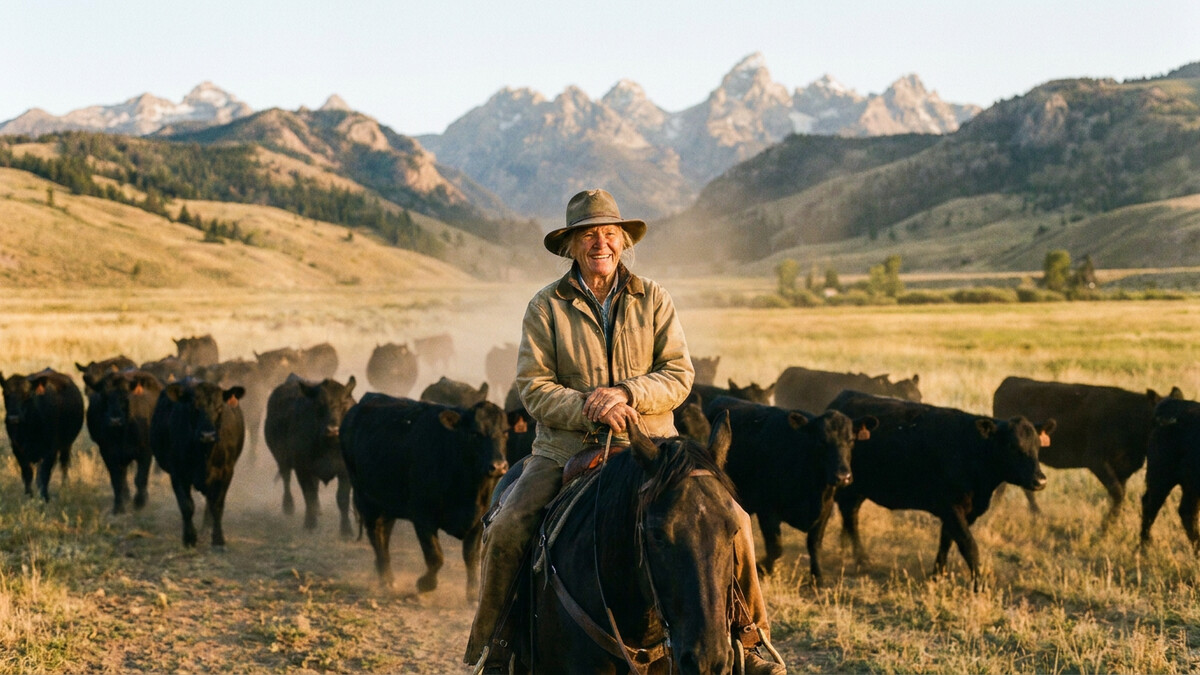
Ione Sorensen's sons told her on a Sunday in May that she was too old to ride the cattle drive to summer pasture, and on the Tuesday after that, at four o'clock in the morning, she saddled her horse anyway.
She did it in the dark, by feel, in the barn her husband had built in 1966. She had saddled a horse in that barn something like twenty thousand times. She did not need a light.
She was seventy-eight.
When she led the horse out into the yard, there was already somebody standing by the corral gate in the gray light, with a horse of her own, saddled, and a thermos.
"I figured," said her granddaughter Tess. "I'm riding drag."
The Sorensen place was eleven thousand acres of grass and sagebrush along Shields Fork, Montana, in the shadow of the mountains. Ione had married into it in 1966, at eighteen, when Arne Sorensen came to a dance in town with a broken nose from a horse wreck and asked her to waltz anyway.
Every June for fifty-five years, they had moved the cows and calves up to the summer allotment in the high country. Twenty-two miles. Two days. On horseback, the way Arne's grandfather had done it in 1911.
Arne died in 2021. Ione had ridden the drive every year since without him.
But last fall, she had fallen off the hay wagon and cracked her pelvis. She was healed now. The doctor had said she could ride. Her sons had not been listening when he said it.
"Mom, we're trucking them this year," her oldest son, Russ, had said at Sunday dinner. "We hired a hauler from Big Timber. Six trucks. Done in a day."
"We've never trucked them," Ione said.
"We're trucking them this year," Russ said again. He was fifty-six and ran the ranch now and was a good, careful man who had been frightened half to death when he found his mother on the ground by the hay wagon. "It's twenty-two miles of rough country, Mom. Two creeks. You're seventy-eight with a healed pelvis. If something goes wrong up there, we're four hours from a hospital."
"Your father rode it at eighty-one."
"Dad had help," said Gary, her younger son. "Dad had all of us."
Ione looked at her two sons across the table. Good boys. Grown men. She loved them more than her own life.
"This is my last one," she said quietly. "I know that. I'm not a fool. I want to ride it one more time. Like your father did. Like I did for sixty years." She paused. "I'm not asking for permission."
Russ put down his fork.
"Mom," he said. "The trucks are coming Thursday. That's final."
Ione did not argue. She just nodded and passed the potatoes.
Tess, who was seventeen, watched her grandmother across the table and did not say a word.
So on Tuesday morning, two days before the trucks, the two of them opened the gate of the big pasture at the foot of the mountain, and Ione rode in among the cows.
There were a hundred and eighty pairs. Black Angus cows and their spring calves, bawling in the cool morning. Ione rode slowly through the herd, looking, until she found the one she wanted.
An old black cow with a white spot on her forehead and a bell around her neck. Fourteen years old. The oldest cow on the ranch.
"Morning, Old Blue," Ione said.
Old Blue had led the drive up the mountain every June for eleven years. The other cows followed her. They always had. Arne used to say Old Blue knew the way better than any cowboy on the place.
Ione rode up beside her, turned her horse toward the mountains, and clucked softly.
Old Blue looked at her. Then she started walking. The bell rang. And one by one, behind her, a hundred and eighty pairs began to follow.
Tess swung in at the back of the herd, at drag, in the dust, the way her grandfather had taught her when she was six.
They made good time the first morning. The sun came up over the grass. The calves settled down. Ione rode at the front beside Old Blue, sitting straight in the saddle, her old felt hat pulled low, and for the first time since Arne died, she felt like herself.
At ten o'clock, her phone buzzed in her shirt pocket. She did not answer it. It buzzed six more times.
At noon, they stopped at the first creek to let the cattle drink.
Tess rode up from the back, dusty to the eyebrows, grinning.
"Grandma, Dad's called me eleven times."
"I know," Ione said. "Me too."
"He's coming. Him and Uncle Gary. In the truck, up the county road. He says they'll meet us at the second creek."
"Good," Ione said. "They can help."
They reached Cutbank Creek, the second creek, at four o'clock that afternoon.
Ione topped the rise above it on her horse, and stopped.
The creek was not a creek anymore.
The snow had melted late and fast in the high country that spring. Cutbank Creek was running bank to bank, brown and fast and loud, twice as wide as she had ever seen it in sixty years. The old wooden ford where they always crossed was gone, under four feet of rushing water. Whole branches went tumbling past.
Behind her, the herd was bunching up, bawling, pushing forward toward the smell of water.
And at the back of the herd, Tess's horse was dancing sideways on the steep, muddy bank, right at the edge, slipping, with the calves crowding against its legs.
Ione saw the bank give way under her granddaughter's horse.
"Tess," she shouted.