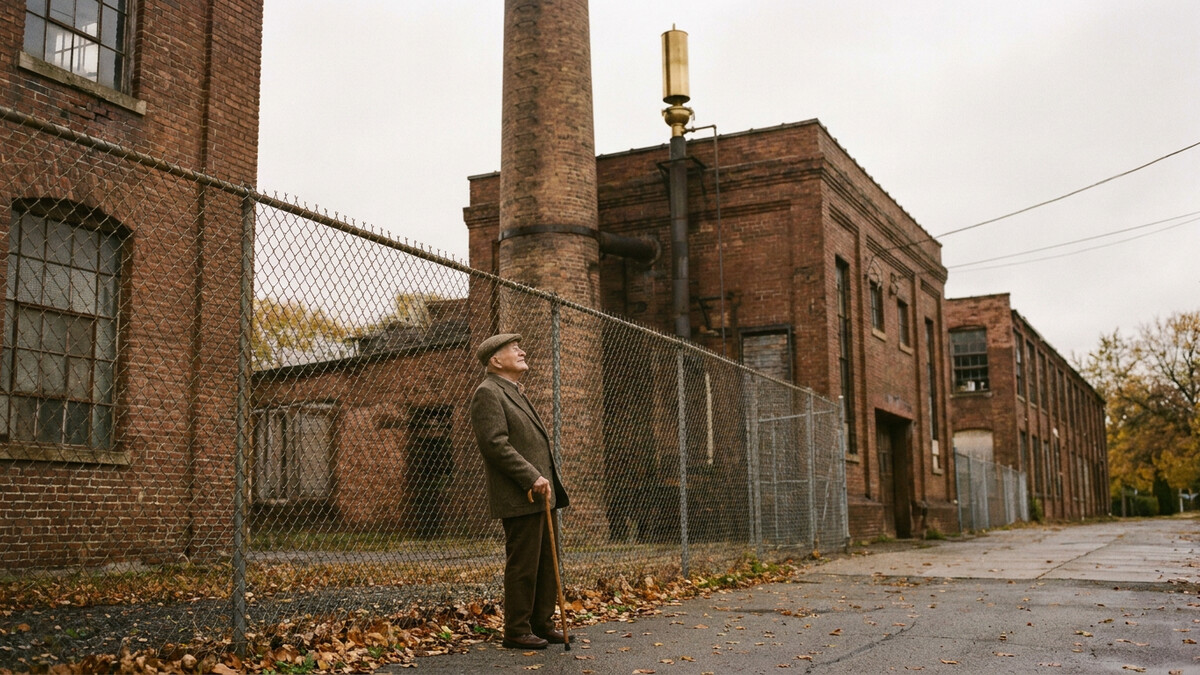
Armand stared at him through the chain-link fence.
"You're Jeannine's grandson?"
"Her oldest boy's son," Nick Roy said. "I run the excavator for the demolition company. I didn't even know it was this job until last month." He looked up at the boiler house. "Grandma talked about that whistle my whole life. The eight of you. The booth at Gagnon's. She made me promise too, at the end. In the hospital. She said, Nicky, if Armand's the last one, you help him."
Armand could not say anything.
"I heard what the boss told you," Nick said. "About the roof and the insurance and the steam." He lowered his voice. "Can you be back here tomorrow at four o'clock? After the crew goes home?"
Armand was back at four o'clock on Thursday.
Nick Roy was waiting at the gate. So was the site manager, the young man from Portland, with his white hard hat under his arm, looking slightly embarrassed.
"Nick told me who his grandmother was," the site manager said. "And then three of my guys told me who their grandfathers were." He sighed. "Turns out half my crew had somebody at Dumont."
"So what are we doing?" Armand asked.
"We're not going up on the roof," the site manager said. "That's final. It isn't safe." He nodded toward the big yellow machine parked beside the boiler house. "But Nick says he can reach it from the ground."
It took Nick Roy forty minutes.
He sat in the cab of the excavator with the long arm stretched up seventy feet, and he worked the controls so slowly and gently that Armand, watching from the gate, could barely see the claw move. He closed it around the old pipe below the whistle. He pulled once. The rusted bolts held. He pulled again, a little harder.
The pipe broke free with a crack.
Nick swung the arm down, slow as a crane bending to drink, and set the old brass whistle on the ground in the mill yard, as gently as if it were an egg.
Armand walked over to it with his cane.
It was taller than he expected. Almost three feet. Green with age and streaked with pigeon droppings. The brass bell on top. The lever arm on the side, with a ring on the end for a rope.
He put his hand on it.
"Still standing," he said quietly.
"There's still the steam problem," the site manager said. "No steam, no whistle."
"There's no steam," said a new voice. "But there's air."
It was the Riverbend Falls fire chief. A heavyset woman in her fifties named Denise Thibodeau. She had pulled up in a red pickup truck without anybody noticing.
"My grandfather was Roger Thibodeau," she said. "The one who made you all promise." She looked at the whistle. "Steam whistles blow just fine on compressed air. We've got a compressor on the ladder truck. And a lot of hose."
At three o'clock on Friday afternoon, after the boiler house had come down that morning in a long roar of brick and dust, there were more people standing along the chain-link fence of the old Dumont mill than Armand had seen in one place in Riverbend Falls since the Bicentennial parade.
He did not know how they had heard. Somebody had called the radio station. Somebody had put it on the computer. Somebody had told the priest at St. Anne's, who had mentioned it at the noon Mass.
Old men and women from the triple-deckers on the hill. Their children. Their grandchildren. People who had worked at Dumont and people whose parents and grandparents had. People who had never set foot inside it. A fourth-grade class from the elementary school, with their teacher.
The old brass whistle stood on a wooden pallet in the middle of the mill yard, in front of the rubble of the boiler house. A long red hose ran from it to the fire department ladder truck. Nick Roy had tied a rope to the ring on the lever arm.
At three twenty-five, Armand Pelletier walked out into the yard with his cane, with Nick Roy on one side of him and Denise Thibodeau on the other.
He stopped beside the whistle.
He looked out at the crowd along the fence. Then he took off his cap.
"In 1985," he said, and his old voice carried better than he expected in the cold air, "eight of us made a promise in a booth at Gagnon's Diner. Whoever was last would blow this whistle one more time. For the shift that never came back."
He was quiet for a moment.
"I'm the last," he said. "So I'm going to say their names."
He said them slowly. One at a time.
"Roger Thibodeau."
Denise Thibodeau, beside him, closed her eyes.
"Lucien Gagnon. Yvette Ouellette. Norm Levesque. Marie-Claire Dubé. Bert Cyr."
He stopped.
"Jeannine Roy."
Nick Roy put his big hand on the old man's shoulder.
Armand looked down at the rope in his hand for a moment. Then he looked at his wristwatch.
It was three-thirty.
"And Armand Pelletier," he said. "Stitching room. Thirty years."
He pulled the rope.
The Dumont whistle blew.
Two long notes and a short one. The same notes it had blown every day at three-thirty for ninety years. Loud and deep and a little hoarse after forty-one years of silence, rolling out across the river and up the hill, over the triple-deckers and the church steeple and the empty lots, all the way across Riverbend Falls.
In the crowd along the fence, an old woman put her hands over her face.
Up on the hill, people came out onto their porches. Some of them had not heard that sound since they were children. Some of them had never heard it at all, and stood on their steps not knowing what it was, only that the old people next door were crying.
The fourth graders put their hands over their ears and then, one by one, took them away.
The whistle blew for a long time. Then it stopped.
Armand let go of the rope.
The whistle did not go to a museum. Armand would not allow it.
It went to the new fire station on Front Street, where Denise Thibodeau mounted it on the roof, on a new brass pipe, hooked to the station's air compressor.
It blows once a year now. On October 18, at three-thirty in the afternoon. Two long notes and a short one.
And every year, at the same moment, in the corner booth at Gagnon's Diner, Lucien's grandniece sets eight cups of coffee on the table, and one slice of blueberry pie.
Armand Pelletier drinks one of the coffees. Nick Roy drinks another.
The other six cups sit there until closing, full, in a row.