The package was wrapped in brown paper and string, and the postmark on it said December 16, 1974.
Tanner Mullins held it out on the porch of the Collier house like it might break. He was twenty-six, a carpenter, with sawdust on his jacket and his truck still running in the road.
"We're tearing out the old post office for the new library branch," he said. "This was down behind the sorting case. Fell back there, I guess. Must have been there since before I was born." He looked at the address. "It's got your name on it, ma'am. Well. Somebody named June."
June Collier was sixty-three. She stood in the doorway in her apron and looked at the handwriting on the brown paper for a long time.
Miss June Collier. General Delivery.
Copper Hollow, W. Va.
"That's me," she said, and didn't reach for it.
Tanner set it carefully on the porch swing. He stood there a second longer, as if he wanted to say something, and then he went back down the steps to his truck.
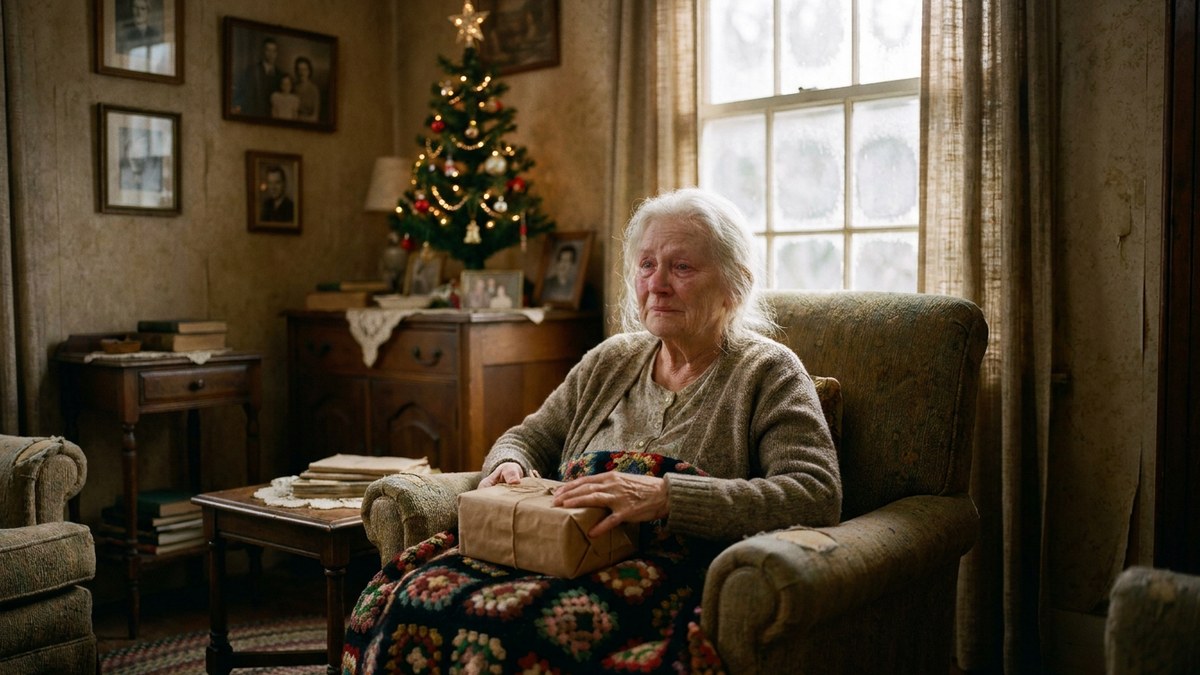
Ada Collier was eighty-eight. She was sitting in her chair by the window with her afghan over her knees when her daughter came back into the front room carrying the package.
Ada knew the handwriting from across the room. She'd have known it from across the county.
"Oh," she said. "Oh, Lord. Ray."
June set the package on the coffee table and stood back from it.
Ray Collier had been gone fifty-two years. He'd died on January 6, 1975, in a roof fall at the Number Four mine, two miles up the hollow.
June had been eleven. Ada had been thirty-six, with two little boys besides June and a stack of bills on the kitchen counter.
She'd raised all three of them in this house. She'd never married again. She'd worked the lunch line at the grade school for twenty-six years, and she kept Ray's work boots on the back porch until 1990, when the leather finally cracked clean through.
"I don't want it, Mama," June said.
"Junie."
"I mean it." June's voice was very even, the way it got when she was holding something down. "You know what that is. You know exactly what that is."
Ada did know. She'd known for fifty-two years.
In the fall of 1974, the mine had cut back to three days a week. Ray took a second job. He drove to Charleston on his days off and hung drywall for a contractor building apartments, two hours each way on the old two-lane, and he came home on Sunday nights so tired he fell asleep at the supper table.
June had been eleven, and she'd wanted one thing that Christmas. A doll from the window of a big store in Charleston, with a blue gingham dress and eyes that opened and closed. Ray had seen her looking at it in the catalog.
"You leave that to me," he'd told her.
Christmas morning came. There were oranges in the stockings and a sled for the boys and a sweater Ada had knitted. There was no doll.
June didn't cry. Ada remembered that most of all.
June hadn't cried, and she hadn't asked. She'd just looked at the bottom of the tree for a long time, and then she'd put on her sweater and said thank you.
Ray came home for New Year's. He'd only been home four days when he went back to the mine.
June never asked him about the doll. And after the sixth of January, there was no way left to ask him.
"I was eleven, Mama," June said now, standing in the middle of the front room. "I thought he forgot me. That was my last Christmas with him, and I thought he forgot."
"He didn't forget you."
"You always said that." June laughed, and it came out wrong. "Every Christmas. Your daddy didn't forget you, Junie. Like if you said it enough, I'd believe it."
"Did you?"
June didn't answer.
The package sat on the coffee table between them. The brown paper had gone soft and pale with age, and one corner was water-stained. The string was still knotted, the way a store clerk would knot it.
"I raised three kids," June said, quieter now. "I've got four grandbabies. I've had a good life. I let that go a long time ago." She looked at the package. "I don't need to open it now and find out he spent money we didn't have on a doll that got lost in a wall. I don't want to be eleven again."
Ada was quiet for a long moment.
Then she put her hands on the arms of her chair and pushed herself up. It took her a while. June reached to help, and Ada waved her off.
She walked to her bedroom, slow, one hand on the wall. June heard the drawer of the old dresser open.
When Ada came back, she was carrying her Bible. It was the one she'd had since her wedding in 1960, black leather gone brown at the edges, stuffed full of funeral programs and pressed flowers and church bulletins.
She sat down and opened it to the back. Tucked inside the cover was an envelope, yellow as a leaf, with a ten-cent stamp on it.
Ada held it out to her daughter.
"He wrote me this from Charleston," she said. "The week before Christmas. Fifty-two years, Junie, and I never showed it to you."
June stared at the envelope. Then she looked at her mother.
"You knew?" she said. "All this time, you knew?"