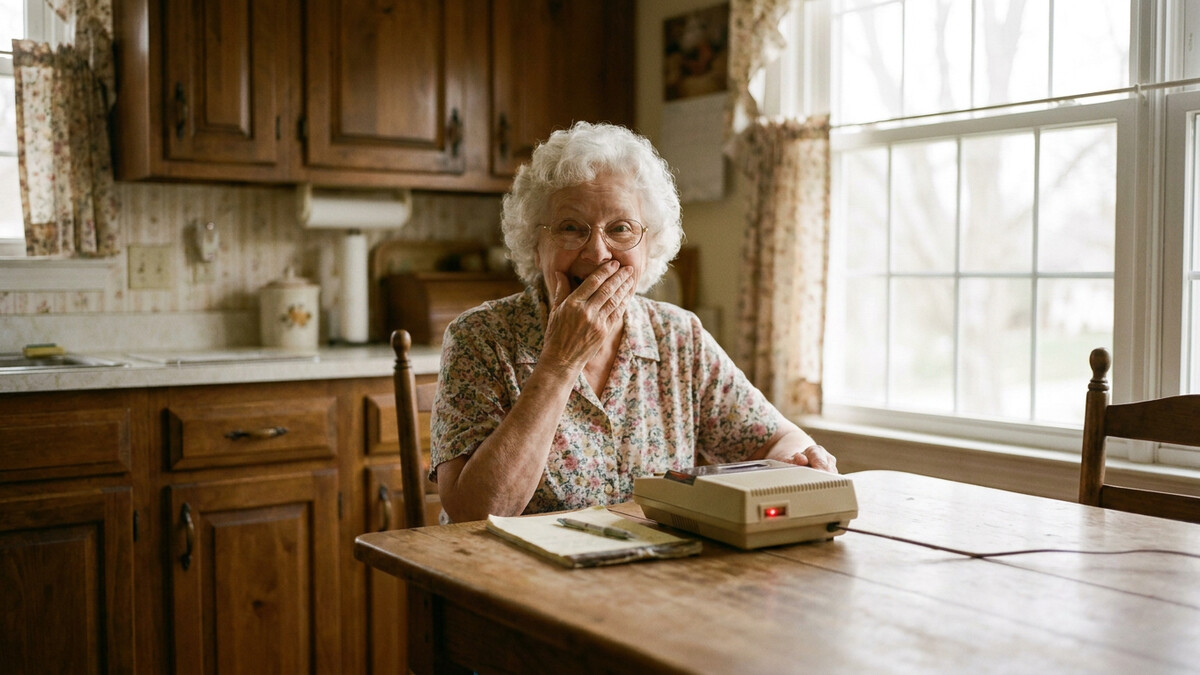
Message number thirty-eight was short.
It was a voice like gravel in a bucket.
"Lucille," it said. "This is Buford Pettus. From the mower shop." A long pause. Lucille could hear a radio playing somewhere behind him, and the sound of a wrench clinking on concrete. "I know you didn't write that thing in the paper. You'd never in your life put hearts around anything." Another pause. "But if you'd like a catfish supper, I'll be at the Catfish Shack on Saturday at six. If not, your mower's ready. Twenty-two dollars. It was the spark plug."
Click.
Lucille played it four times.
Then she got up and put on her good blue blouse, even though it was only Thursday, and drove to Pauline Hatcher's house for bridge.
The three of them were waiting for her at the dining room table, with the pimento cheese sandwiches and the cards already dealt.
They looked very innocent.
Lucille sat down. She picked up her hand. She arranged her cards slowly, the way she had for thirty-one years.
Then she looked across the table at Pauline.
"Pauline," she said pleasantly, "did you put an advertisement in the paper with my telephone number?"
Pauline touched her left earring.
"Frances," Lucille said, "did you help her write it?"
Frances cleared her throat.
"Jo Ann," Lucille said, "did you draw the little hearts?"
Jo Ann looked at the ceiling.
Lucille laid her cards face down on the table.
"I have been reading the three of you across this table since 1995," she said. "You couldn't hide a two of clubs from me if your lives depended on it. You think you could hide a newspaper ad?"
There was a long silence.
Then Pauline burst out laughing. Then Frances. Then Jo Ann, who laughed so hard she had to put her head down on the table. And finally, against her will, Lucille.
"We just wanted you to be happy, Lucille," Pauline said, wiping her eyes.
"I am happy," Lucille said. "I was happy before. I'll be happy after." She picked up her cards again. "But I will tell you one thing. I'm going to supper on Saturday."
All three of them sat up very straight.
"With who?" Pauline said.
"With a man who called about the ad," Lucille said. "A man who knew I didn't write it."
"Which one?" Frances said. "The cowboy? The man with the boat?"
"Message thirty-eight," Lucille said, and laid down the ace of spades.
She would not tell them anything else. Not one word. They tried for two hours.
On Saturday, at five minutes to six, Lucille Thornton pulled into the gravel lot of the Catfish Shack in her blue blouse.
Buford Pettus was already there. He was sitting at a corner table by the window in a clean plaid shirt, buttoned to the neck, with his bald head shining under the light. There was no grease under his fingernails. He must have scrubbed them for an hour.
He stood up when she came in. He nearly knocked over his iced tea.
"Lucille," he said.
"Buford."
He pulled out her chair. He did not say anything else for a while. He was not a talker. Neither, it turned out, was she, not really, not when it mattered.
They ordered the catfish platter, two of them, with hush puppies and coleslaw.
Halfway through supper, Lucille noticed the booth across the room.
Three women in a booth by the jukebox, wearing sunglasses. Inside a restaurant. At six-thirty in the evening. One of them was hiding behind a menu. One of them was touching her left earring.
Lucille did not say anything. She just smiled and ate a hush puppy.
Buford noticed her noticing. He followed her look across the room.
"Is that Pauline Hatcher," he said, "in sunglasses?"
"It is," Lucille said.
"And Frances and Jo Ann?"
"Yes."
Buford looked at them for a long time. Then he did something Lucille had never seen him do in fifty-five years of knowing him.
He laughed. A big, rusty, surprised laugh that made the waitress turn around.
"Lucille," he said, "I asked you to the junior prom in 1966."
"I remember."
"You said no."
"I was going with Wendell."
"I know you were," Buford said. "He was a good man. I always thought so." He turned his iced tea glass around on the table. "I just want you to know I've been waiting sixty years to buy you supper. And I'd have done it without the hearts."
Lucille looked at him across the table.
She thought about Wendell, and fifty-four good years, and the recliner, and the football game. She thought about the dentist and the deacon's mother and the man with the boat and a heart full of love.
"Buford," she said, "do you play cards?"
"A little," he said. "Not good."
"Thursday afternoons," Lucille said. "Pauline's house. We could use a fifth when somebody gets sick." She glanced at the booth by the jukebox. "And I would very much like to see the three of them play against a man who doesn't have any tells at all."
Buford Pettus came to bridge the following Thursday in his clean plaid shirt. He was terrible. He lost every rubber.
He did not touch his earring. He did not clear his throat. He did not look at the ceiling.
Pauline, Frances, and Jo Ann could not read a single thing on his face the whole afternoon, and it drove them half out of their minds.
At five o'clock, he drove Lucille home in his old truck. He walked her to the door. He did not try to kiss her. He just stood on the porch with his cap in his hands.
"Next Thursday?" he said.
"Next Thursday," Lucille said.
She went inside and closed the door and stood in the hallway for a minute, smiling at nothing.
Then she went to the answering machine, played message number thirty-eight one more time, and saved it.