Part 1
Twenty men ate at Tamsin Pascoe's long table every night, and in the week before Christmas 1879 not one of them was talking to her.
It was December in Leadville, Colorado, two miles up, where the silver boom had packed some fifteen or twenty thousand people into a town that had been a gulch three years before. There were a hundred and twenty saloons and fifty-nine boardinghouses. There were very few kitchens where anybody cooked the way a mother would.
Tamsin's was one of them.
She was sixty-three, a Cornish widow, small and round and fierce, with flour in the creases of her knuckles that never quite washed out. She had come to Leadville the spring before with her son Jory, who had gone to work in the Chrysolite and died of pneumonia in October. The miners at the boardinghouse on Chestnut Street had carried his coffin. She had stayed on as their cook because she could not think what else to do.
"Up here water boils cooler," she told the new boy, Davy Holm, on his first night. He was sixteen, from Minnesota, and he had asked why the beans took so long. "Two miles up, it boils before it's properly hot. So everything takes longer. Beans. Puddings. Getting warm." She ladled stew into his bowl. "You can't hurry it, my lover. You just have to start early."
Davy had laughed. He coughed when he laughed. Tamsin had not liked the sound of it.
She kept a letter in her apron pocket.
It had come in November from her late husband's sister in Cincinnati, and she had read it once, standing at the stove, and then put it away and not taken it out again. When the miners asked about her people back east, she said her sister-in-law had a fine big house on Walnut Street, with a parlor organ, and there would always be a room for her there.
She said it often. It was a comfort to say.
Then, in the second week of December, the men began to whisper.
They stopped when she came in from the kitchen. They looked at their plates. Big Ike Trevenna, the shift boss, who had known Jory in Cornwall, could not meet her eye. Even Davy went red to the ears when she set down his coffee.
"What's the matter with you all?" Tamsin said on the Thursday. "Have I put salt in the custard?"
Nobody answered. Twenty men suddenly very busy with their forks.
Mr. Gaskell, who owned the boardinghouse, came into the kitchen on the Friday morning while she was rolling pastry.
"I'll be closing the dining room Christmas week," he said. "Half the men will be drunk on Harrison Avenue and the other half will be in bed. No sense cooking for nobody."
Tamsin stopped rolling.
"And where will they eat, Mr. Gaskell? Those that aren't drunk?"
"At the chophouse. Same as everybody." He shrugged. "Mrs. Pascoe, flour costs me three times up here what it costs in Denver. Every candle comes over the pass on a mule. I'm not a charity. I charge what this town will bear and I close when it won't."
He went out. Tamsin stood with the rolling pin in her hand, thinking about Davy Holm's cough, and about Jory, who had coughed just like that in September, and laughed it off, and gone down the shaft anyway because the shift boss was short of men.
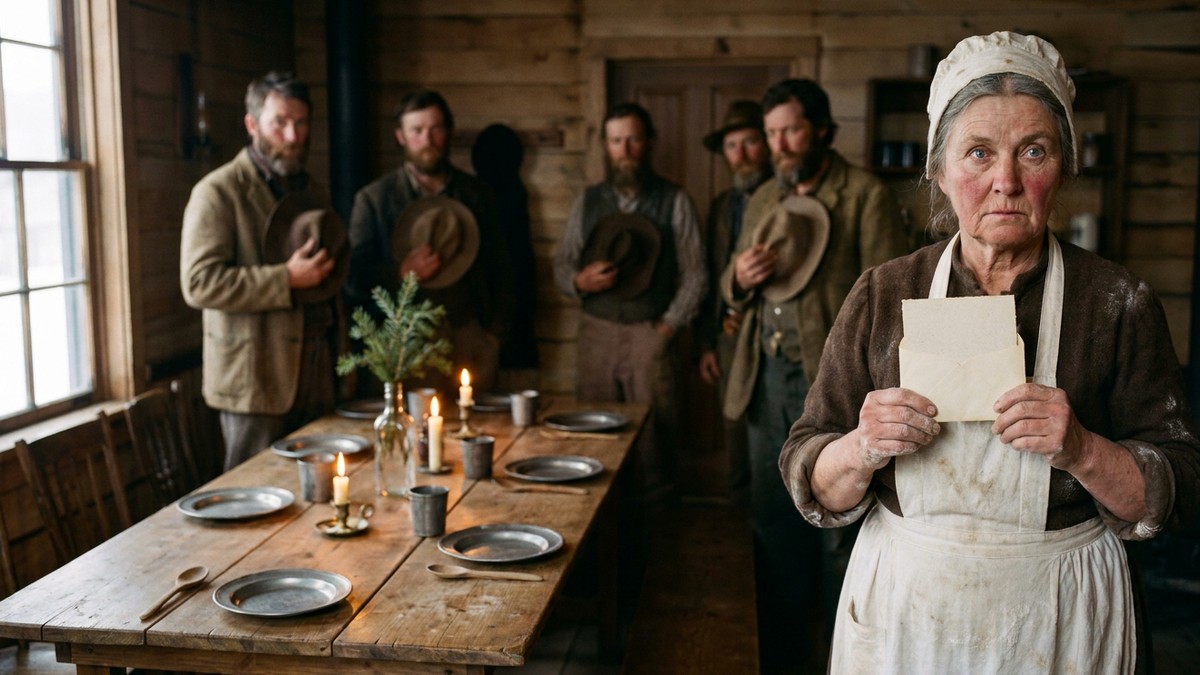
On the evening of the twentieth, when she came in from the kitchen with the pudding, all twenty men were standing up.
They stood around the long table with their hats off and their hair slicked down with water. The candles were lit. Somebody had stuck a sprig of spruce in a bottle at the head of the table.
Big Ike Trevenna cleared his throat.
"Mrs. Pascoe," he said. "We've been talking. The boys and me."
"I'd noticed," said Tamsin.
A little laugh went round the table and died.
"You've fed us like our own mothers," Ike said. "Since the spring. You nursed Swede Nyberg through the mountain fever, and you sat up with Jory..." He stopped. He turned his hat around in his big hands. "And we've heard you talk about your sister on Walnut Street. And the parlor organ. And a room always waiting." He drew a breath. "Well, it's Christmas. And a woman ought to be with her own people at Christmas. Not with a pack of rough fellows two miles up a mountain."
He took an envelope out of his coat and held it out to her.
"So we passed the hat," he said. "Every man here. Some of them twice."
Tamsin set the pudding down. She wiped her hands on her apron and took the envelope.
Inside was a stage ticket to the railhead, leaving on the twenty-second at dawn, and a railroad ticket, first class, all the way through to Cincinnati. Folded around them were four ten-dollar bills.
Nearly a hundred dollars. A week's pay for every man at that table, and more.
She looked at the tickets. She could feel the letter in her apron pocket, against her hip.
Then she looked up at them. Twenty faces in the candlelight. Ike with his hat. The Swedes at the far end. Davy Holm, flushed and bright-eyed, with his hand over his mouth to hold in a cough.
"Well, Mrs. Pascoe?" Ike said gently. "You'll be home for Christmas."