Ramón had taught her what to do in the summer of 1979, the first time.
They'd been sitting on the porch after supper, newly married, and the lion had crossed the arroyo below them in the dusk. Josie had grabbed his arm. And Ramón, who had grown up on this land and whose grandfather had run sheep here before there were roads, had told her quietly, without taking his eyes off the cat.
If you ever meet one close, Josefina, you never run. Running makes you food. You make yourself big.
You make yourself loud. You look it in the eye and you don't look away. And you never, ever turn your back.
She'd been twenty-nine. She'd never forgotten a word of it.
"Mateo," Josie said.
She said it calmly. Not loud. The way you'd tell a child to come in for supper.
"Mateo, mijo, don't move. Stand very still for Grandma."
The boy turned his head. He saw her face and stopped smiling. Then he followed her eyes to the top of the fence and saw what was on it, and his mouth opened.
"Don't run," Josie said. "Don't run, baby. Don't make a sound. Grandma's coming."
She walked toward him.
Not fast. Not slow.
Steady, the way you'd walk up the aisle at church. Every step brought her closer to the boy and closer to the lion, and every step, she kept her eyes locked on the cat's pale yellow eyes and didn't blink.
As she walked, she raised her arms high over her head, as high as they would go. She grabbed the corners of her big flour-covered apron and spread it wide between her hands like a sail. She was a small woman, five foot two, but with her arms up and the apron out she was suddenly something much bigger, a strange flapping white shape coming steadily toward the fence in the dusk.
Then she started to shout.
She shouted with everything she had, in Spanish first, the way Ramón's grandmother would have.
"Vete. Vete de aquí. Go on. Get out. Get away from him."
Her voice rang off the barn and the cliffs above the arroyo like a shot.
The lion flattened its ears. It hissed, a long, low, terrible sound like air out of a tire.
Josie didn't stop.
She stepped in front of Mateo. She put her whole body between the boy and the fence, with her back to her grandson and her face to the lion, and the cat was close now, so close. Ten feet.
Eight. She could see the black tip of its tail twitching.
She could see the whiskers. She could smell it, a hot, musky, wild smell, like an animal den in the rocks.
"Mateo," she said, without turning around. "Grab Grandma's apron. Hold on tight. Don't let go."
She felt his small hands grab the back of her apron strings.
"Vete," she shouted at the lion again, stamping her boot. "Go. Go on."
She bent her knees, slowly, without looking down and without taking her eyes off the cat, and scooped her grandson up onto her hip. He was six and heavy.
She didn't feel it. She held him against her side with one arm and kept the other arm high in the air with the apron flapping from it like a flag.
The lion stared at her. She stared back.
For a long, long moment, the old woman and the mountain lion looked at each other over the corral fence in the last of the light. Nothing moved. Not the cat.
Not the boy. Not the horse.
Then the lion's eyes slid away.
It turned its head toward the arroyo. It gathered itself and dropped down off the far side of the fence, soundless, like water poured out of a cup. It trotted away along the line of junipers toward the dry wash, not fast, not looking back, a tawny shape fading into the tawny dusk.
Then it was gone.
Josie didn't turn her back until she was on the porch.
She backed all the way to the house, slowly, step by step, with Mateo on her hip and her eyes on the arroyo the whole way. At the screen door, Sofia was standing with the cordless phone in both hands and tears running down her face.
"I called," Sofia said. "I called Officer Lucero's number off the refrigerator. He's coming. I told him the lion was at the corral."
Josie went down on her knees on the porch boards and pulled both children into her arms, and held them, and didn't let go. Then, finally, she cried.
Officer Lucero arrived with a second truck in forty minutes. They set the trap that night in the arroyo, with what was left of Canela for bait.
They caught the lion on Saturday morning. A young male, a hundred and ten pounds, thin from the drought. The state moved him to the high country north of the ranch, a long way from any goats or children.
Lucero stopped by the house afterward to tell her.
"Mrs. Quintana," he said, standing on the porch with his hat in his hand. "I teach a class on lion encounters at the schools every year. Don't run, make yourself big, make noise, pick up small children, never turn your back." He shook his head slowly. "You did every single one. In order. With flour on your hands. I've never had anybody do it that right."
"My husband taught me," Josie said. "In 1979."
"He taught you well."
"Yes," said Josie. "He did."
The grandchildren went home to Albuquerque on Sunday. Two weeks later, her son called her, laughing.
Mateo had gone to first grade on the first day of school and told his whole class about his summer. He'd done it standing on a chair, with his arms over his head and his mother's dish towel flapping from his hands. His teacher had called home.
"Mama," her son said, "the kids at school are calling him the lion boy. And they're calling you the lion lady."
Josie laughed out loud in her kitchen, with the phone against her ear and flour on her hands.
That evening, she walked down to the corral at dusk.
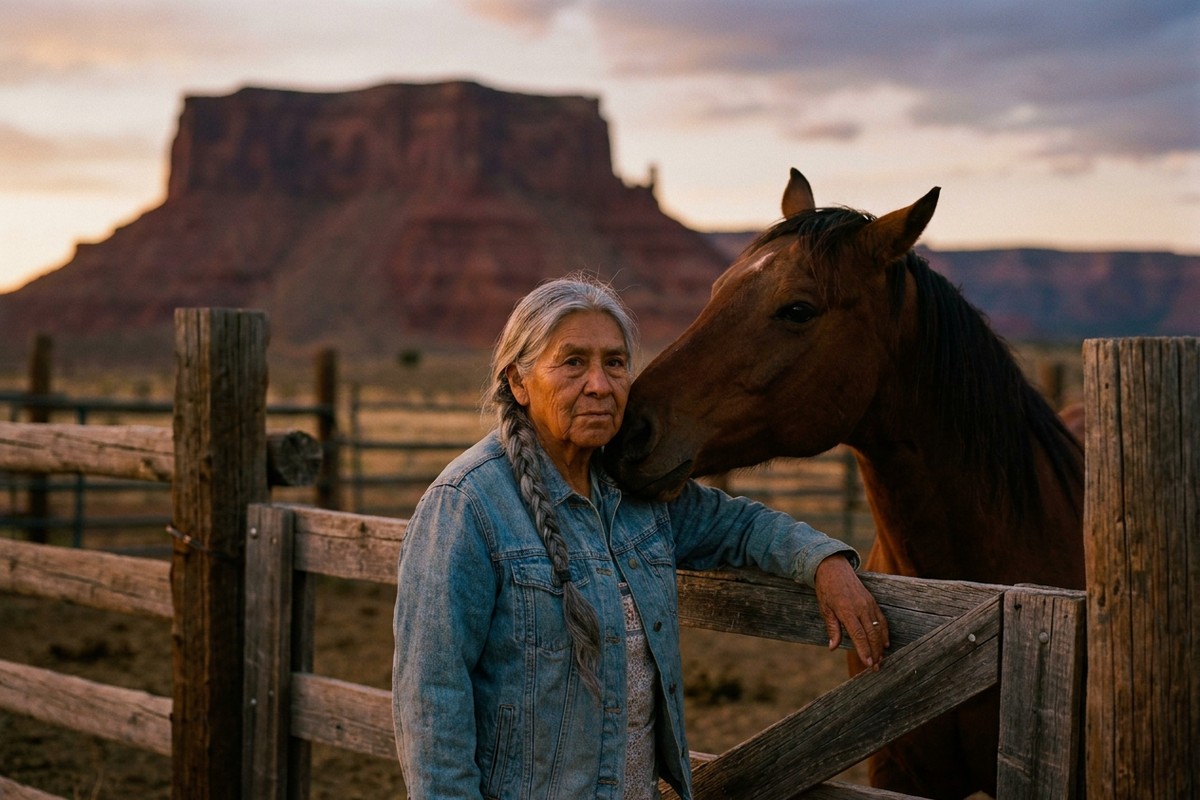
She didn't need to. The lion was long gone. But she went anyway, the way Ramón used to walk the fences every evening, and she stood at the old cedar gate in the blue light with her hand on the top rail where the lion had crouched.
Paloma came over and put her soft nose against Josie's shoulder.
"I know," Josie told the horse. "I know. I was scared too."
She stood there a long time, tall as a five-foot-two woman can stand, looking out at the arroyo and the red mesa going dark against the sky. In her mind, a small boy was holding on to her apron strings with both hands, and he wasn't letting go.