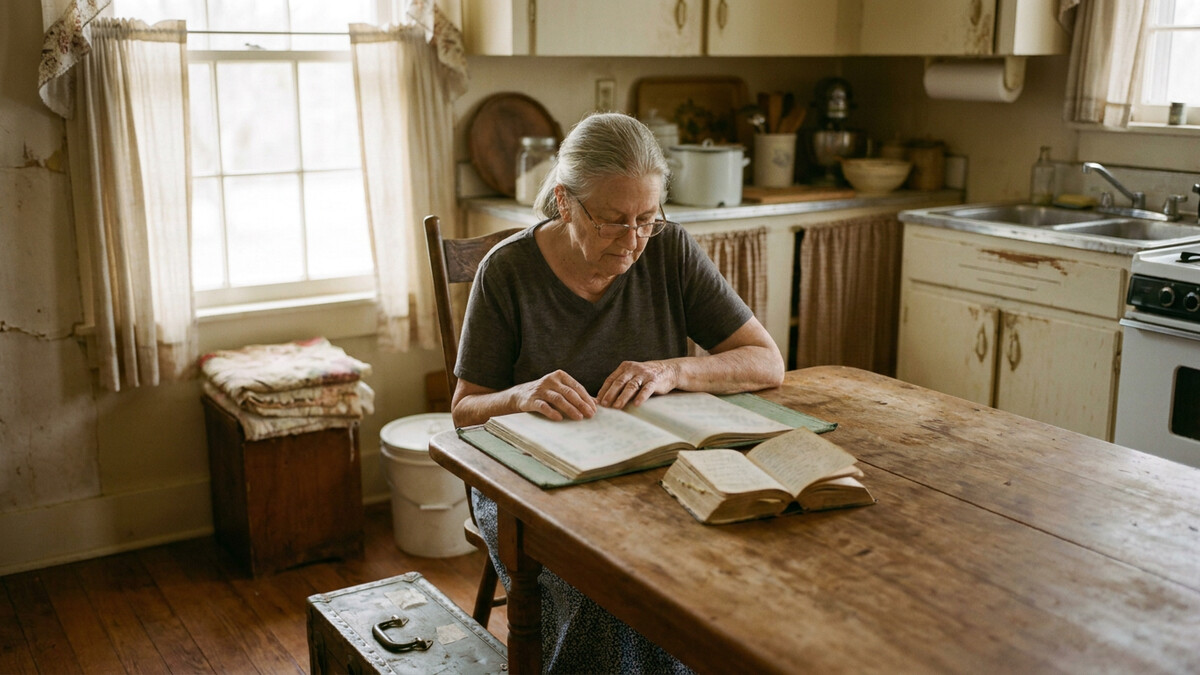
Imogene did not sleep that night.
She sat at the kitchen table until the sky went gray over the ridge, with the ledger open in front of her and Clyde's dress uniform folded on the chair beside her.
She was angry. She had not expected that. She was angry at Roy Harlow, who was long dead. At Winston Harlow Jr., who was long dead. At the whole town of Coal Branch, which had let a girl's name be dragged through the mud for fifty-two years because the sheriff said so.
And she was angry at Clyde, who had known, and had sung bass in the choir every Sunday for twenty-seven years with that inside him.
But mostly, by the time the sun came up, she was just sad. For a twenty-eight-year-old deputy with a baby on the way. For the man on the porch at night, looking down the hollow toward the river.
Do what I couldn't.
She got dressed. She put the ledger in a canvas tote bag. And she drove to see Peggy Ann Lusk's little brother.
Buddy Lusk was seventy now. He had been eighteen when his sister disappeared. He still lived in their mother's house at the head of Lusk Hollow, and he had spent fifty-two years telling anyone who would listen that Peggy Ann never took a dime in her life.
He sat at his kitchen table while Imogene read him the shorthand, translating each line slowly, with her finger under the marks.
When she finished, Buddy did not say anything for a long time. He was a big man, a retired mine electrician with scarred hands. He sat with those hands flat on the table and stared at them.
"I knew it," he said finally. "Mama knew it. We always knew it."
"I'm sorry, Buddy," Imogene said. "I'm sorry Clyde didn't tell you. I'm sorry I didn't know."
He looked up at her.
"You know now," he said. "What are you going to do?"
"I'm going to do what he couldn't," Imogene said.
She did not go to the sheriff. The sheriff was a good man, but he had been elected with Harlow money, the way every sheriff in Bluestone County had been for a hundred years.
She went to the state police barracks in Beckley. She had worked with the troopers there for twenty-six years. One of the old sergeants she had known had a granddaughter who was a detective now, a sharp young woman named Corporal Dana Shrewsbury.
Corporal Shrewsbury listened to the whole thing. She looked at the ledger. She looked at the shorthand, which meant nothing to her.
"Mrs. Fortney," she said carefully. "With respect. You're the only living person who can read this. How do I know it says what you say it says?"
Imogene had expected that. It was exactly what she would have asked.
"Get me a shorthand dictionary," she said. "Any library in the state has one. And get me a court stenographer from the Kanawha County courthouse. They still have a few old ones who learned Gregg. Let her read it herself. Then go look under Bluestone Bridge."
The court stenographer was sixty-eight and drove down from Charleston on a Thursday. She read the shorthand in the margin of the ledger with a magnifying glass and the green 1965 dictionary, in silence, for forty minutes.
Then she looked up at Corporal Shrewsbury and nodded.
"It says what she says," she said quietly. "Every word."
The state police divers went into the deep pool under Bluestone Bridge the following Tuesday, in December, in the cold, with the whole town of Coal Branch standing on the riverbank in their coats.
They found the Plymouth on the second dive. It was upside down in thirty feet of water, buried to the doors in fifty years of river silt, its blue paint long gone to rust.
And they found Peggy Ann.
Imogene stood on the bank beside Buddy Lusk when they brought her up. She held his arm. He did not cry. He just stood there, very straight, with his hat in his hands, and said, "There she is. There's my sister. I told them."
Winston Harlow III came to see Imogene two days later.
He was sixty-four, gray and soft-spoken, in a plain brown coat. He stood on her porch for a long time before he knocked.
"Mrs. Fortney," he said. "I've read the state police report. And your husband's notes." He swallowed. "I was twelve years old in 1974. I didn't know any of this. I swear to you I didn't."
"I believe you, Winston."
"The old company office is mine now. The safe is still there. In the basement. Not one of us has opened it since my grandfather died in 1979. I never had the combination." He looked down at his hands. "I called a locksmith from Charleston yesterday. Corporal Shrewsbury was there."
Imogene waited.
"It was in a canvas bag," Winston said. "Coal Branch Savings and Loan, stenciled on the side. Forty-one thousand dollars. The bank had recorded the serial numbers on the bills. That's why they couldn't spend it. So they just locked it away."
He was crying now, quietly, standing on her porch.
"My family did that to that girl," he said. "And to her mother. And to Clyde. And to you."
The money went back to the bank, which was part of a big bank in Charleston now. The bank sent it straight to Buddy Lusk, with fifty-two years of interest and a letter from the president.
Buddy gave every dollar to the Coal Branch high school, for a scholarship. It would go every year to one senior who wanted to work in a bank.
Winston Harlow III stood up at the next county commission meeting and read a public apology, in his own words, into the record. He did not try to explain it. He just said what his family had done, and that he was sorry, and then he sat down.
Peggy Ann Lusk was buried on a Saturday in the Methodist cemetery on the ridge, beside her mother, under a new stone. The whole town came. Nearly every person who had ever said she stole the money stood in the cold and sang.
That spring, Imogene took Clyde's old ledger to the county courthouse herself and put it on the counter of the records office.
"It's been missing since 1974," she told the young clerk. "It belongs to the county."
The clerk looked at it with wide eyes. "Mrs. Fortney, what are all these marks in the margin?"
Imogene thought about it.
"A man trying to tell the truth," she said, "in the only alphabet he had."
Then she went home, sat on the porch where Clyde used to sit, and looked down the hollow toward the river until the light went.