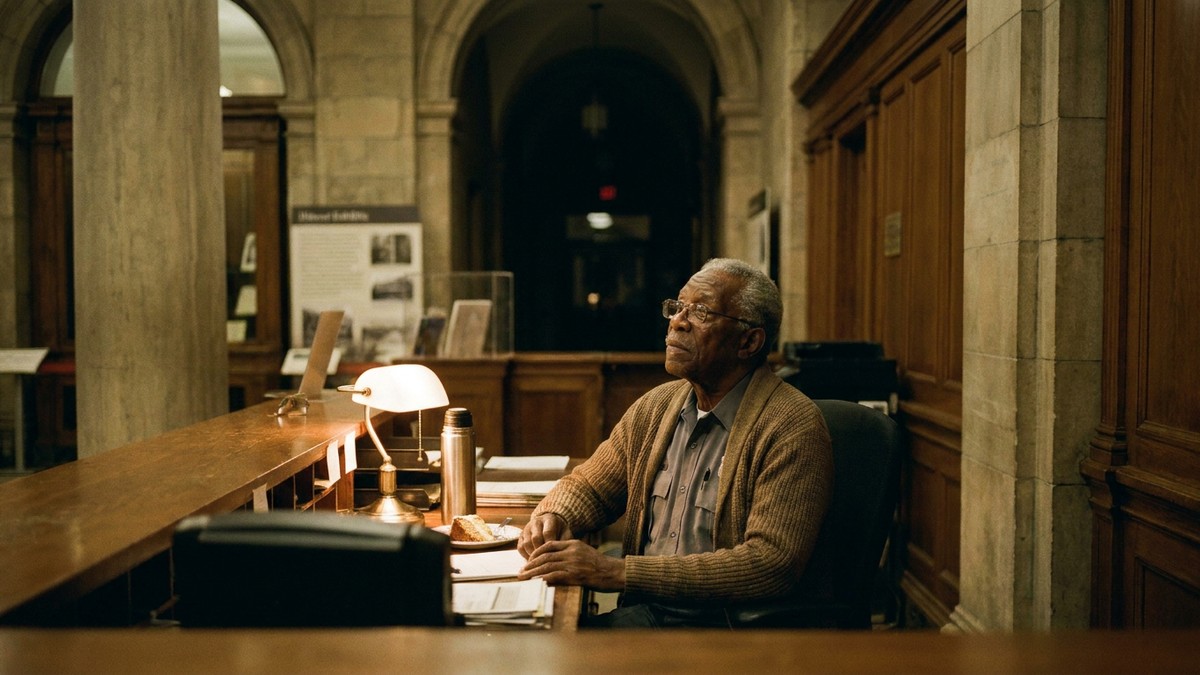
It was Delroy Mapes's last night on the job, and at 2:10 in the morning, somebody cut the glass on the back door.
He heard it from the front desk. A small, careful sound, like somebody scoring a pane with a ring. Then the soft tap of the glass coming loose, and a hand reaching in for the deadbolt.
Delroy set down his thermos.
He was seventy-four. He'd been the part-time night watchman at the Ashby County Historical Museum for nine years, three nights a week, eleven to seven. In the morning, a company from Lexington was coming to install security cameras in every room, and the county had thanked him for his service and given him a cake.
He'd eaten two pieces of it at midnight. He'd thought it was going to be a quiet last night.
The museum was in the old Farmers and Drovers Bank on Main Street in Boone's Crossing, Kentucky. It was built of limestone blocks in 1891, three stories high, with iron bars on the windows and walls so thick that a cell phone couldn't get a single bar of signal anywhere inside.
The bank had closed in 1983. The county had turned it into a museum.
There were arrowheads and butter churns and a moonshine still and a quilt that had won at the state fair in 1934. In the basement, behind a steel door eight inches thick, was the bank's original vault, which the county used to store old records.
The vault door still worked. It latched from the outside with a big brass handle, and there was an air vent in the back wall the size of a dinner plate, put in after a college intern got shut in by accident one afternoon in 1990. Delroy had heard that story his first week on the job.
And in a glass case in the main hall, under a single spotlight, was the most valuable thing in Ashby County.
A cavalry saber, carried at the Battle of Perryville in 1862 by a colonel from Boone's Crossing. A man on a television antiques show had appraised it two years ago at ninety thousand dollars. The museum had been on the news.
Delroy had told the board then that it might bring the wrong kind of visitors.
Before he was a night watchman, Delroy Mapes had been a juvenile probation officer for thirty-one years.
He had sat across tables from a few thousand scared, angry, foolish, half-grown young men. Boys who'd stolen cars and boys who'd stolen beer and boys who'd stolen nothing but got caught standing next to the one who did.
He'd learned that most of them weren't bad. They were scared, and scared people do stupid things fast.
He'd learned that the most important thing in any room was the calmest person in it.
He'd also learned to keep his voice low and slow, the way you'd talk to a nervous horse. And he'd learned that the boy who talked the most was almost never the one in charge.
For twenty summers, he'd coached Little League, too. The Ashby County Hornets.
He figured it was easier to keep a boy out of trouble at twelve than to get him out of it at seventeen. He still got Christmas cards from some of them.
The back door swung open. Two men came in out of the dark.
Delroy watched them from the shadow of the front desk. The first was big, maybe forty, in a black jacket and a ski cap, carrying a crowbar.
The second was younger and thinner, in a gray hoodie, with a duffel bag. He kept looking over his shoulder at the door.
They went straight for the glass case. They knew exactly where it was.
Delroy picked up the desk phone. The line was dead. They'd cut it outside.
He thought about the back door, and the parking lot, and his car, and the sheriff's office four blocks away. He thought about how long it would take a seventy-four-year-old man to walk four blocks.
Then the big man swung the crowbar at the glass case. It bounced off with a dull thunk. The case was museum glass, laminated, made not to break.
The big man swore and swung again.
Delroy stood up and turned on the lights.
The hall flooded with light. Both men spun around.
"Evening, gentlemen," Delroy said. He kept his hands where they could see them. "That glass won't break. You could swing at it till sunup and all you'd get is tired."
The big man stared at him, breathing hard. He was bigger than he'd looked in the dark, and the crowbar was heavy in his hand.
"Who are you?"
"Night watchman. Delroy." He nodded at the case. "And you're wasting your time with that one. That's a replica. The real one's been downstairs in the vault since Tuesday, for the camera installation. The board didn't want it sitting out with workmen in here."
It was a lie. Delroy said it so easily that he almost believed it himself.
The big man looked at the saber in the case. Then at Delroy. Then at the younger one, who had gone very pale.
"He's lying," the big man said.
"Could be," Delroy agreed. "Only one way to find out."
The younger man swallowed. He took a step closer to his partner and said, in a voice that shook, "Man, let's just tie the old man up and go look."
Delroy went still.
He knew that voice.