The post's minute books were kept in a steel cabinet in the commander's office, which was the only room in the hall the rain hadn't reached.
Lloyd sat at the desk that evening with the first one open in front of him. It was a ledger bound in black cloth, and the first page said VFW Post 4417, Pine Hollow, Ohio, in fountain pen. The minutes were written by hand by the post's first adjutant, a man named Carl Dietz, who'd come home from the Pacific in 1945 with malaria and the neatest handwriting Lloyd had ever seen.
Lloyd had read parts of it before. Never the whole thing. Never carefully.
He read it carefully now.
The post had been chartered on June 9, 1946, by twenty-six men who'd come home from the war. They'd met in the back room of the feed store until they could afford a hall. The minutes were mostly dues, and coffee, and arguments about whether to buy a flagpole or a coffee urn first.
On July 1, 1946, Carl Dietz had written:
The post having no colors, Mrs. Emil Lutz of Lutz Hollow Road presented to the post a flag of forty-eight stars of her own making, sewn on her machine from cloth purchased in Zanesville. She was assisted in the work by her daughter. The members rose and gave three cheers.
Motion to hang the colors in the hall when we have one. Carried.
Lloyd read it twice.
Mrs. Emil Lutz. Emil Lutz had been the stonemason who set the cornerstone at the glass works, and later sold his farm to Walt Brenner. His wife had been dead for fifty years.
But her daughter.
Lloyd took off his reading glasses and rubbed his eyes. Then he picked up the phone and called Maple Grove.
Ada Pike was ninety-two years old, and she was sitting up in a chair by the window of her room when Lloyd came in the next morning, with a crocheted blanket on her knees and Walt Brenner's chestnut table at her elbow.
She was very small and very sharp. She looked at Lloyd's VFW cap and then at the folded flag in his arms, and she knew.
"Oh, my," she said softly. "Oh, my. You found my name."
"Yes ma'am."
She laughed. It was a young laugh, much younger than the rest of her. "I was eleven. Mother let me do the heading because it didn't show. She did the stars and stripes on the treadle machine in the kitchen, and I sat at the table and did the heading by hand, with a needle, every stitch." Ada shook her head. "When I got to the end, I stitched my name in the fold. I didn't tell her. I thought she'd make me pick it out."
"She never knew?"
"Not unless she looked. She never looked. She was too proud of it." Ada reached out one thin hand and touched the faded cloth on Lloyd's arm. "My brother Karl was in the Navy. He came home in 1946, and Mother wanted to give something to the men. That was what she knew how to give."
Lloyd sat down in the chair across from her.
"Mrs. Pike," he said, "the flag's ruined. Water and mold. It can't hang again. The law says it should be retired, and that's what I want to do. But it's your flag as much as anybody's. I came to ask what you want."
Ada Pike looked at the flag in his arms for a long time.
"It was made to be a flag," she said finally. "Not a keepsake. A flag that can't fly anymore should be put to rest properly, with the men it was made for standing by." She looked up at him. "But I'd like to be there, Lloyd. If you'd let me."
They did it on the next Saturday morning, at eight o'clock, in the grassy lot behind the post hall where the sycamore limb had come down.
It was cold. The air was perfectly still. There was frost on the grass and a thin skin of ice on the puddles, and the sky had gone clear and pale blue over the hills.
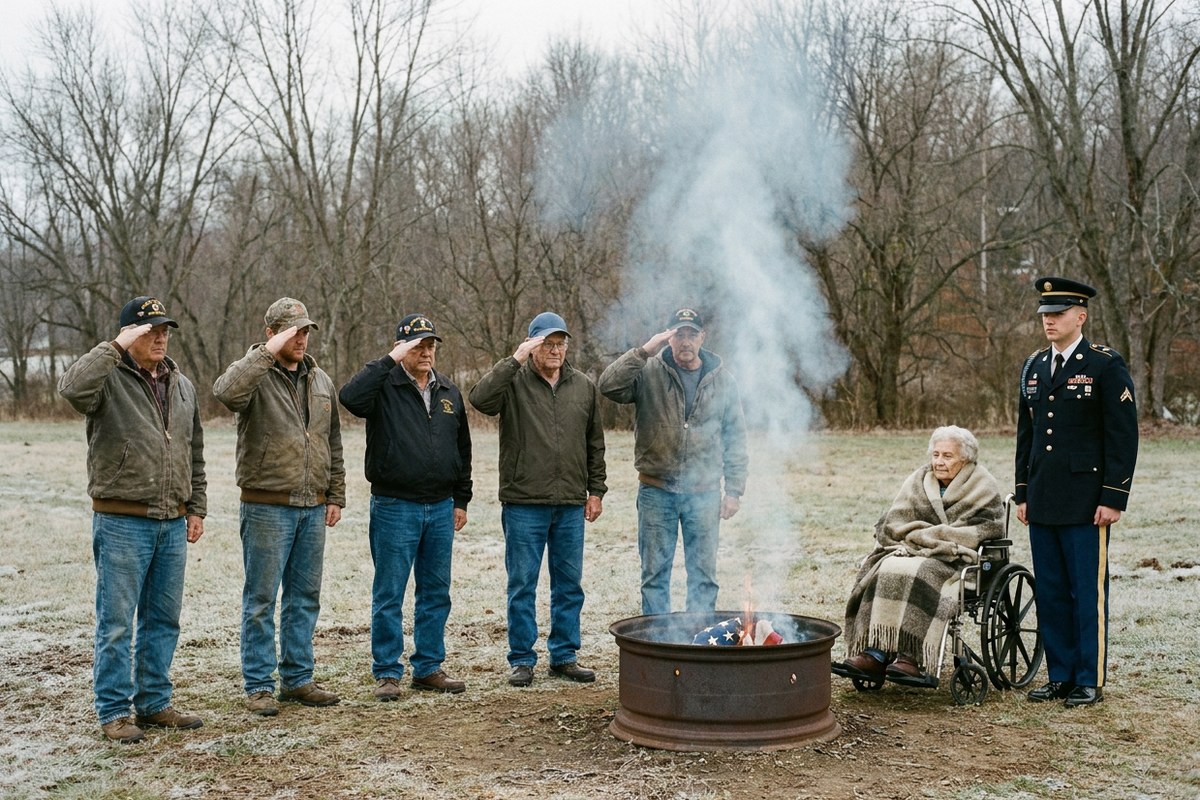
Pastor Sam built the fire in the post's old steel fire ring, oak and hickory from Walt's woodpile, and let it burn down to a hot clean bed. The members of Post 4417 stood in a line beside it in their caps.
Fourteen of them, from Lloyd at eighty down to Danny Ortiz at thirty-three. Marcus Bell held the bugle.
Ada sat in a wheelchair at the end of the line, wrapped in her crocheted blanket. Beside her, in his Army dress uniform, stood her grandson, Staff Sergeant Nathan Pike of the Ohio National Guard, who'd driven down from Columbus at five in the morning when he heard.
Half of Pine Hollow stood behind them in the cold. Walt was there, and Earl, and Dot, and Ruth Ann with her camera put away.
Lloyd didn't need a card. He'd known the ceremony for fifty years.
He called the post to attention. He read the words about the flag's long service and its honorable condition. Danny and Marcus held the old flag out flat between them, one last time, for the crowd to see, faded pink and blue and spotted, with its forty-eight hand-sewn stars.
Then they folded it, slow and square, in the triangle, thirteen folds, the way it's done.
Lloyd took the folded flag from them and carried it to the end of the line, and knelt, a little stiffly, beside Ada Pike's chair.
She put both her hands on it and held them there for a moment. She didn't say anything. Her lips moved a little, like a prayer.
Then Lloyd stood, and walked to the fire, and laid the flag on the coals.
"Present," he said. "Arms."
Fourteen hands came up in salute. And Nathan Pike's. And, beside him, slowly, from the wheelchair, a small thin hand that had stitched a name in a heading in 1946.
Marcus played taps.
The smoke rose from the fire ring straight up into the cold, still air, white and thin and unbroken, higher and higher over the post hall roof, until it was gone into the blue.