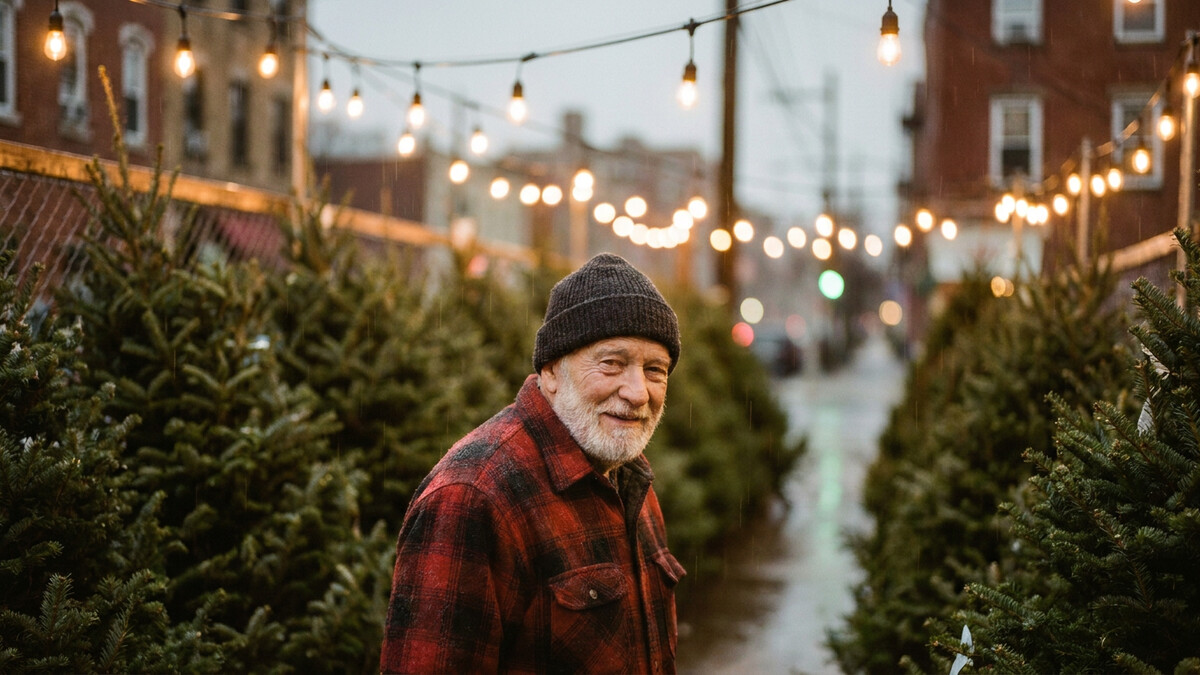
For sixty Decembers, Nils Berglund sold Christmas trees on the corner of Front Street and Pine in Skagit Falls, Washington, and for sixty Decembers, whenever a family came to his lot who could not afford a tree, he said the same four words and handed them one anyway.
"Pay me next year."
He never wrote it down. He never asked. He never once, in sixty years, took a dime of it back.
On the morning of December 23, the last day of his last season, the Skagit Falls Herald came out with a full page in the middle of it that Nils had not paid for, and when he unfolded it in the little plywood shack on his lot, he had to sit down.
Nils was eighty-five. He had grown up on a dairy farm in the foothills above Skagit Falls, the son of Swedish immigrants. In 1962, when the dairy went under, he and his father planted the back forty in Douglas fir and noble fir seedlings, because a man at the county extension office said Christmas trees would grow on ground too steep for cows.
The first trees were ready in 1967.
Nils hauled them down the mountain in his father's old flatbed truck and set them up on the vacant corner lot at Front and Pine, across from the hardware store, with a string of bare light bulbs and a hand-lettered sign. BERGLUND TREES. FRESH CUT.
He had been there every December since. From the day after Thanksgiving until the twenty-third, from eight in the morning until nine at night. Sixty seasons.
He had sold something like forty thousand trees on that corner. He had watched children he sold trees to grow up and bring their own children, and then their grandchildren.
And every season, a few times, a family came onto the lot and walked slowly among the trees and looked at the price tags and did not say anything. A young mother counting the bills in her purse. A father in a mill jacket, laid off, with three kids. An old widow on a pension.
Nils always knew. He did not know how. He just knew.
He would walk over and pick out a good one. Not the scraggly one in the back. A good one.
"Pay me next year," he would say, and tie it on their car.
This was his last season. The whole town knew it.
His knees were done. He had fallen twice on the ice in the lot last December. His daughter, Kristin, who lived in Seattle, had cried on the phone and made him promise. The tree farm had been sold to a young couple from Mount Vernon who would run it as a choose-and-cut farm, where families drove up the mountain and cut their own.
There would be no more trees on the corner of Front and Pine.
Nils had not made a fuss about it. He was not the kind of man who made a fuss. He had put a small sign on the shack the day after Thanksgiving. LAST SEASON. THANK YOU, SKAGIT FALLS. 1967 TO 2026.
That was all.
Something strange had started happening the second week of December.
People came onto the lot who did not buy a tree.
A man in his fifties, in a good coat, who handed Nils an envelope and said, "For 1979," and walked away before Nils could say anything. Inside was a hundred-dollar bill and a note. You gave my mom a tree when Dad was on strike at the mill. I was eight. Thank you.
A woman with gray hair who said, "For 1984," and pressed something into his hand. A twenty, folded small, and a photograph of three little girls in front of a Christmas tree in a living room with wood paneling.
A young man who said, "For my grandmother. 1971," and left an envelope with no money in it at all. Just a recipe card, in an old woman's handwriting, for Swedish rye bread. My Nils bread, it said at the top.
There were eleven of them that week. Then nineteen the next.
Nils did not remember most of them. He had never written anything down. He tried to give the money back. They would not take it.
He put the envelopes in a coffee can in the shack. He did not know what else to do.
On the morning of December 23, the last day, he unlocked the shack at seven-thirty in the dark and turned on the string of bare light bulbs. It was raining a little, the way it always rained in Skagit Falls in December.
The Herald was on the counter. The boy who helped him on weekends always left it there.
He unfolded it with his coffee.
On page seven, the whole page was a single notice, with a black border.
At the top, in big letters:
WE STILL OWE NILS.
And below it, in small type, in columns, filling the entire page, were names.
Names and years. Hundreds of them. The Kowalczyk family, 1967. The Ortiz family, 1971. Mae Henley, 1973. The Larsen boys, 1975. Pastor and Mrs. Ames, 1981. On and on, down the page, sixty years of them.
Nils sat down on the stool in the little plywood shack.
At the bottom of the page, in the same black border, there was one more line.
Tonight. Front and Pine. 7 p.m. Bring what you owe.
Nils read it three times.
Then he set the newspaper down on the counter, and looked out through the little window of the shack at his last thirty-one trees standing in the rain under the bare light bulbs, and he did not know what to do with his hands.