He called her on Monday night. It took him three tries to dial the number.
She answered on the second ring. Her voice was older and lower than he remembered, a little hoarse, with that flat central Nebraska way of saying things. But he knew it.
"Hello?"
"Arlette," he said. "It's Leland Dahl."
There was a long pause on the line.
"I wondered if you'd call," she said. "I almost didn't mail it. I wrote that letter four times." Another pause. "Well? Do you?"
"Do I what?"
"Still have the red Farmall."
"I do," Leland said. "It's in the shed. It still runs."
Arlette Svoboda Kral let out a breath on the other end of the line that was almost a laugh.
"Then I'd like to see it," she said.
Brynn said he could not drive a seventy-five-year-old tractor thirty miles to St. Paul on a two-lane highway.
Leland said a Farmall M could do sixteen miles an hour in road gear, and the shoulder was wide, and he'd driven that tractor on that highway before Brynn's mother was born.
Brynn said she was calling her father.
Leland said fine, but she was riding along behind him in the pickup with the flashers on.
So on Saturday morning, Leland Dahl drove his father's red 1952 Farmall M east on the state highway at sixteen miles an hour, in his church clothes, with his hair combed wet, while his granddaughter followed behind in his pickup with the hazard lights blinking and her phone held up out the window, filming the whole thing. It took two hours and ten minutes.
Three different farmers honked and waved. One of them pulled over and took a picture.
On the seat beside him was a box from the drugstore in Loup Crossing. Inside was a corsage.
Arlette was sitting on the front porch swing of a little white house on the edge of St. Paul when the tractor came up the street.
She stood up.
She was eighty-one, small and straight, with white hair cut short and a pair of gold-rimmed glasses and a pale blue dress. She came down the porch steps slowly, holding the rail. She walked across the grass to the curb, where Leland had parked the red Farmall with its engine ticking as it cooled, and she stood there and looked up at him.
Leland climbed down. His knees didn't like it. He stood in front of her with the drugstore box in his hand.
"Arlette," he said.
"Leland." She looked at him for a long time. Then at the tractor. Then back at him. Her eyes were wet behind the gold-rimmed glasses. "You came on the Farmall."
"Seemed like the thing to do."
"You've still got good teeth," she said. "The ad was right."
He laughed. He couldn't help it.
They sat on her porch swing for three hours. Brynn sat on the steps at the far end and pretended to read her phone.
Arlette told him. She'd been waiting sixty-six years to tell somebody, she said, and she was going to tell him whether he wanted to hear it or not.
The night of the harvest dance in September 1961, a storm had been coming. The radio said hail by morning. Her father had two hundred acres of corn standing in the field, and he'd been picking for three days straight, and he needed somebody to drive the grain truck back and forth to the elevator all night long while he ran the picker.
Arlette was the oldest. Her brothers were too young to drive.
"I wanted to go so bad," she said. "I'd bought a dress. I'd been waiting for you to ask me since the eighth grade." She shook her head. "And then you showed up in the yard on that red tractor, in your church clothes, with that corsage, and my father was standing right there on the porch. He said, she can't, son. She's working tonight. And I was fifteen and so embarrassed I couldn't look at you. So I just said no. That's all. Just no. And you went back down the road."
She looked down at her hands.
"I drove that grain truck until four in the morning," she said. "Crying the whole time. I saved the corn. Daddy said I saved the whole farm, that year." She laughed softly. "And then on Monday at school, I heard you'd gone to the dance by yourself, and you'd met a girl from Ord named Marlys Jensen, and you'd danced with her all night long."
Leland sat very still on the swing.
"I was so mad," Arlette said. "For a whole year. And then I was happy for you. You two were the best couple in the county. You could see it from across a church."
"If you'd said yes," Leland said slowly, "I'd never have met her."
"I know." Arlette smiled. "I figured that out a long time ago. That's why I never regretted the corn. Only the way I said no."
She'd married Ed Kral in 1964, a good, quiet man who sold seed corn. Fifty-five years.
Three children, nine grandchildren. Ed had died in 2019.
Her daughter lived in Loup Crossing. Her daughter had read the ad in the Prairie Farm Weekly and called her mother laughing.
"She said, Mom, there's only one widowed farmer in Loup Crossing with all his own teeth," Arlette said. "And then she said, he's still got that red tractor, you know. He drives it in the parade." Arlette looked at the Farmall at the curb. "So I wrote four letters. And I threw three of them away. And the last one, I just asked the one thing I wanted to know."
"Why the tractor?" Leland asked.
"Because if you'd kept it," Arlette said, "I figured you were the kind of man who keeps things."
Leland stood up from the swing.
He picked up the drugstore box from where he'd set it on the porch rail. He opened it.
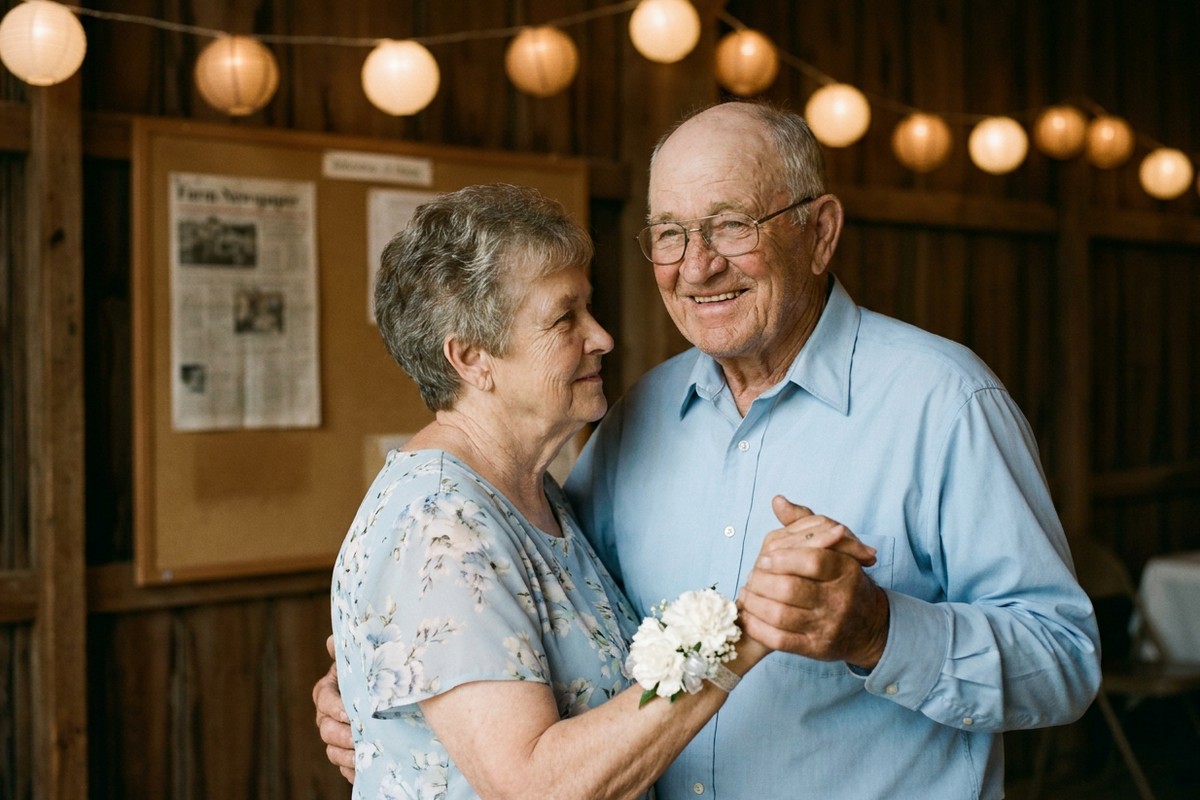
Inside was a white carnation corsage with a little blue ribbon. It looked almost exactly like the one he'd bought in 1961, because he'd described that one to the girl at the drugstore counter, and she'd done her best.
"Arlette," he said. "The harvest dance at the Sokol hall is the third Saturday in September. I'd be obliged if you'd go with me."
Arlette looked at the corsage for a long time. Then she looked up at him.
"Leland Dahl," she said, "I have been waiting sixty-six years to answer that properly." She held out her wrist. "Yes."
At the far end of the porch steps, Brynn burst into tears and dropped her phone.
The Loup Crossing Harvest Dance has been held at the old Sokol hall on Main Street every September since 1922. There's a polka band from Ord, and kolaches from the Czech bakery, and a long table of pies, and a bulletin board by the door covered in old photographs.
That year, there was something new pinned to the bulletin board, right in the middle, with four red thumbtacks. A page fourteen from the Prairie Farm Weekly. A little classified ad in a box with a border, circled three times in red marker.
Widowed farmer, 82, good teeth, own tractor, seeks lady for pie and conversation.
Under it, in a sixteen-year-old's handwriting, on an index card: It worked.
Out on the worn wooden floor, under the paper lanterns, an eighty-two-year-old farmer in a seed cap and an eighty-one-year-old woman in a pale blue dress with a white carnation on her wrist were dancing a slow waltz. They weren't very good at it. They kept stepping on each other's feet and laughing.
They'd only had sixty-six years to practice.