Dot hadn't seen that card in forty-three years.
The last time, she'd been standing at the Greyhound stop in front of the feed store in the fall of 1984, putting it into the hand of a skinny twenty-two-year-old boy with a duffel bag and a job waiting for him at a hotel kitchen in Columbus.
Leonard Haskins.
He'd come to the diner's back door in the summer of 1978, sixteen years old and hungry, with a black eye and no place to sleep that he wanted to talk about. Dot had fed him. Then she'd put an apron on him and taught him to wash dishes, and then to fry eggs, and then, over six years, everything she knew.
He'd slept on a cot in the storeroom the first winter. He'd called her Miss Dot until the day he left.
She'd taught him the pie last of all. And when he left, she'd given him the only copy of her mother's recipe in the world, because she had it in her hands already and he didn't have anything from anybody.
"My mother would've adopted you," she'd told him at the bus stop. "Take Hazel with you."
Dot looked up from the card at the tall woman with the tired brown eyes.
She could have said all of it right then. But forty-nine years of running a diner had taught her that the truth goes down easier if you let people bring it to the table themselves.
So she turned to Joan Albaugh instead.
"Joan, hon, I've got one question about the crust," she said. "You said it was flakier than mine. Was there vinegar in it?"
Joan blinked. "Vinegar?"
"A spoon of cider vinegar in the ice water. And lard, not shortening. And it was rolled out cold, and folded over once on itself before the last roll. That's what makes the layers." Dot looked at Renee. "It's not on that card. My mother never wrote down her crust. I only ever taught it to one person by hand."
Renee Moore went very still.
"My dad's crust," she said slowly. "Lard and ice water and a spoon of vinegar. Fold it once. He made me do it a hundred times before he'd let me bake a pie alone." She stared at Dot. "He said a lady taught him. In a diner, when he was a kid. He never said where."
"Your dad's name is Leonard," Dot said. "Isn't it, hon."
They sat down in two folding chairs at the end of the pie table, while Ruth Ann quietly steered people the other way.
It came out of Renee in pieces.
Her dad never talked about where he grew up. Not ever. Southern Ohio, he'd say, and change the subject.
She'd learned when she was little not to ask. But every Thanksgiving and every birthday, he'd bake one pie, and he'd set that card in its frame on the kitchen counter beside it, and he'd say the same thing.
"This is Grandma Hazel's pie."
"So I thought she was my grandmother," Renee said. "His mother. I grew up calling her Grandma Hazel. I thought she must have died before I was born, and it hurt him too much to talk about." She turned the card in its plastic sleeve. "My real grandmother, his mother, I never met. I didn't even know her name until I was thirty."
"Where's Leonard now?"
Renee's eyes filled.
"He had a stroke in October. He's all right. He's home, he's talking, my mom's taking care of him. But his right hand doesn't work anymore." She wiped her eyes. "He can't bake. He sat in the kitchen at Christmas and watched me make the pie and cried the whole time. And afterward, I took the card out of the frame to clean the glass, and on the back, it says Kessler's, Main and Elm, Pine Hollow."
She turned the sleeve over. There it was, in Dot's own young handwriting from 1984, in ballpoint.
Kessler's, Main and Elm, Pine Hollow. Come home and visit.
"He never came back," Renee said. "Not once. But he used to say, someday I'm going to take Hazel's pie back down to Calder County and win a ribbon with it." She laughed a little, wetly. "So I came down. I didn't know it was your pie, Dot. I swear. I didn't know there was a you."
Dot took her hand.
"Hon," she said. "It was never my pie. It was Hazel's. I just kept it warm."
That evening, from the diner, Renee called her father on speakerphone.
Dot hadn't heard Leonard's voice in forty-three years. It was slower now, a little slurred from the stroke.
But she'd have known it anywhere. When Renee told him where she was, and who was standing next to her, the line was quiet for so long that Dot thought the call had dropped.
"Miss Dot," Leonard said finally.
"You never came home to visit," Dot said. "I wrote it right on the back."
"I know." His voice cracked. "I was ashamed, I guess. Of where I came from. You were the only good part."
"Well, you're coming now," Dot said. "Tuesday. Pie day. Renee'll drive you. And you're going to sit at my counter and tell her how to fold the crust, since you can't do it yourself, and I'm going to sit right beside you and tell you you're doing it wrong."
There was a sound on the line that might have been laughing. It might have been something else.
"Yes ma'am," Leonard said.
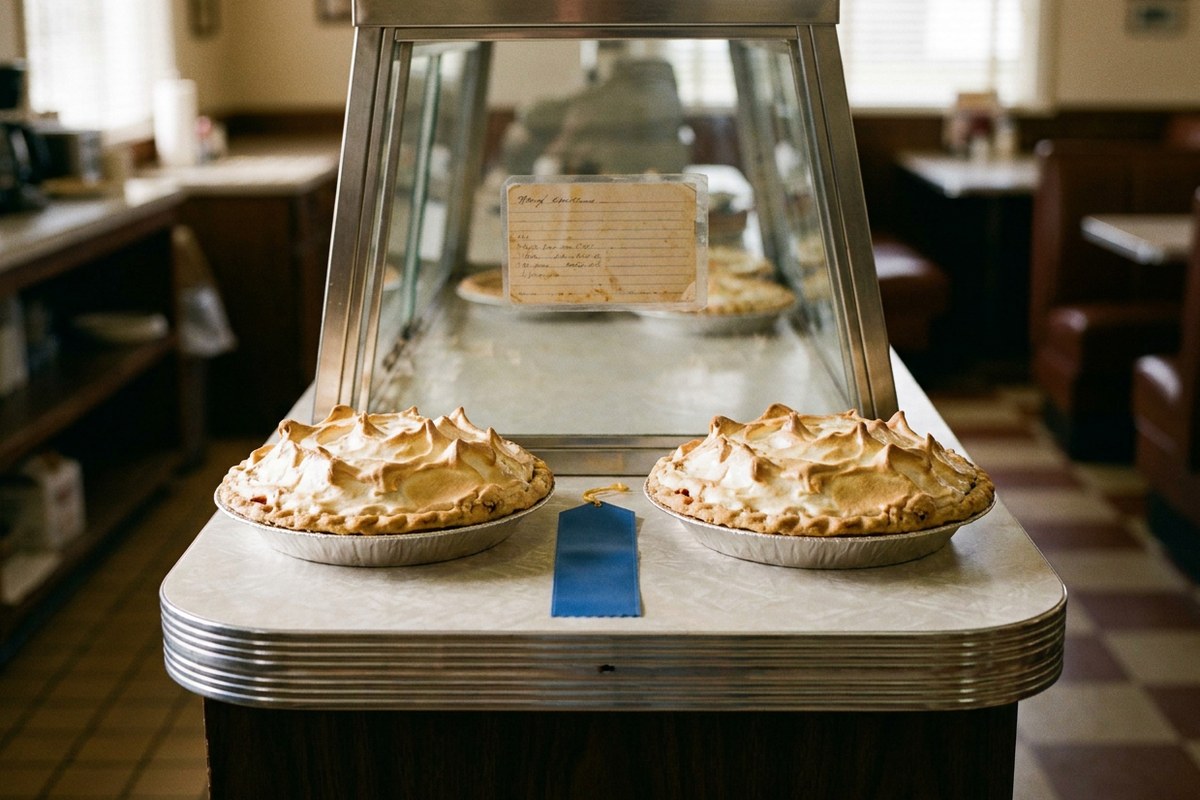
On Tuesday morning at Dot's Corner Diner, there were two sour cream raisin pies cooling side by side on the counter.
One had been baked by Dot, the way she'd baked it every Tuesday since 1978. The other had been baked by Renee Moore, while her father sat on the stool beside her with his good hand on his cane and told her when to fold.
Between them, propped against the napkin holder, was one blue ribbon.
Renee had tried to give it to Dot. Dot had tried to give it back. In the end, they'd left it right there in the middle, where it belonged.
Above the pies, taped to the pie case where the whole counter could see it, was an old index card in a plastic sleeve, in a slanting, looping hand.
Hazel. March 1961.