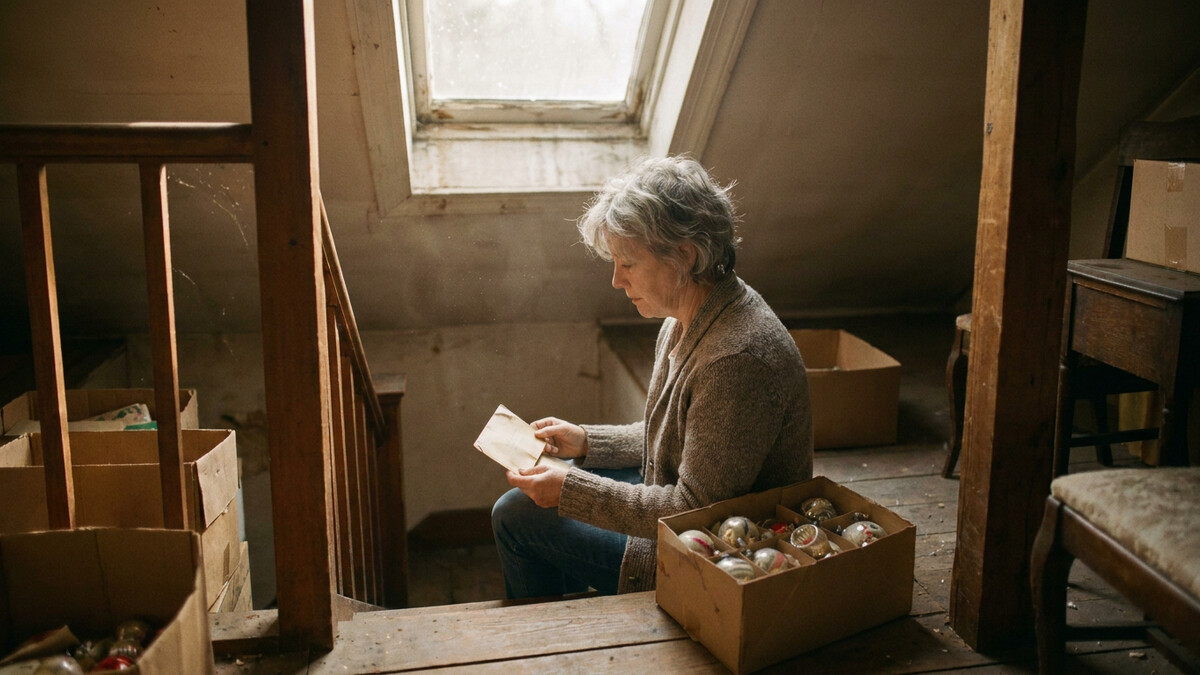
Joyce Wisniewski went up to her late mother's attic to find the box of glass Christmas ornaments, and came down with a yellow envelope from the St. Hedwig's Home for Infants in Detroit, dated 1934, with her mother's name on it.
Not her mother's married name. Not even her maiden name.
A name Joyce had never seen in her life.
Baby girl. Mother: Unknown. Placed with Mr. and Mrs. Stanley Nowak, Hamtramck, Michigan. Name given at the Home: Anna.
Joyce sat down on the attic stairs with the envelope in her lap and the ornament box forgotten beside her.
Her mother's name had been Helen.
Joyce was sixty-eight. She had been a line inspector at the Chevrolet plant in Gratiot Falls, Michigan, for thirty-two years, until it closed in 2009. She knew how to look at a thing carefully and see what was wrong with it. She had spent her working life finding the one bad weld in a thousand.
She had never once thought to look at her own mother.
Helen Nowak Wisniewski had died in October, at ninety-two. She had been born in Hamtramck, raised in Hamtramck, married in Hamtramck, and moved to Gratiot Falls in 1958 when Joyce's father got on at the plant. She had baked paczki every Fat Tuesday for sixty years and gone to Mass every Sunday and spoken Polish to her sisters on the phone when she did not want Joyce to understand.
Her sisters. Aunt Stella and Aunt Bernie. Both gone now.
Joyce looked at the envelope again.
If her mother had been adopted, then Stella and Bernie had not been her mother's sisters at all. Not by blood.
And Joyce had no idea who she was.
She called her daughter that night. Kim was thirty-eight, a nurse in Grand Rapids, practical and kind.
"Mom, lots of people were adopted back then," Kim said. "Especially in the Depression. Families couldn't feed their kids. It doesn't change who Grandma was."
"I know it doesn't."
"So why does it bother you so much?"
Joyce looked at the envelope on her kitchen table.
"Because she knew," she said. "Kim, this envelope was in her hope chest, under her wedding veil. She kept it seventy years. And she never said one word."
The envelope held three things. The placement paper from St. Hedwig's. A small black-and-white photograph of a baby in a christening gown. And a folded slip of paper, very old and soft, with a few lines written in pencil in a language Joyce could not read.
She took a picture of it with her phone and sent it to Father Tomasz at St. Florian's, the old Polish parish in Gratiot Falls, who was from Kraków and had buried her mother.
He called her the next morning.
"Joyce," he said. "This is not Polish."
"It's not?"
"It's Ukrainian. Old style. And some Polish words mixed in, the way people from the border wrote." He was quiet a moment. "It says: My daughter. I cannot keep you. Forgive me. Your name is Anna. Your mother is Kateryna. I will bake you a kolach every Christmas until I die."
Joyce sat down.
"A kolach?"
"A Christmas bread," Father Tomasz said. "Ukrainian. A braided ring. They put a candle in the middle on Christmas Eve."
Joyce did not know what to say.
Her mother had baked a braided bread every Christmas Eve of Joyce's life. A big round loaf, three braids woven together into a ring, with a white candle in the middle. She had called it "Grandma's bread." She had never said whose grandma.
Joyce spent the next two weeks on it. It was the first thing since her mother's funeral that made her want to get up in the morning.
She wrote to the Archdiocese of Detroit, which had the old St. Hedwig's records. She wrote to the State of Michigan. She learned that opening sealed adoption records from 1934 took paperwork, and fees, and time.
She did not have much time. Christmas was in three weeks.
So she did what she had done on the line at the Chevy plant, when the paperwork said one thing and her eyes said another.
She went and looked.
The photograph of the baby had a photographer's stamp on the back. Faint, in purple ink. Boyko Studio. Joseph Campau Avenue.
Joseph Campau Avenue was the main street in Hamtramck.
Joyce drove there on a Saturday in December, ninety minutes down I-75 in the snow. She had not been to Hamtramck since Aunt Stella's funeral in 2005. It had changed and not changed. The old Polish bakeries were still there, with lines out the door for paczki. Next to them were new shops with signs in Arabic and Bengali. The big church still stood at the end of the street.
Boyko Studio was gone. In its place was a bakery.
Joyce stood outside on the sidewalk and looked up at the sign.
Boyko's Ukrainian Bakery. Since 1931.
It was a small, warm place with a glass case full of poppy-seed rolls and a woman of about fifty behind the counter in a flour-dusted apron. On the wall behind her were old photographs in frames. Weddings. Christenings. Men in caps in front of the shop in the 1930s.
And on the top shelf behind the register, in a place of honor, was a braided Christmas bread in a ring, three braids woven together, with a white candle standing in the middle.
Joyce stared at it.
"Can I help you, ma'am?" the woman behind the counter asked.
"That bread," Joyce said. "On the shelf. Is it for sale?"
"Oh, no, ma'am. That one's not for sale." The woman smiled. "That's my great-grandmother's kolach. We bake one every Christmas season and put it up there. It's a family thing."
"Why?"
"We don't really know anymore," the woman said. "She started it. Kateryna Boyko. She said it was for somebody who was coming home."
Joyce put her hand on the glass case to steady herself.
The woman behind the counter looked at her more carefully. Then she looked down at the yellow envelope in Joyce's hand, with the St. Hedwig's seal on the front.
Her face went pale under the flour.
"Ma'am," she said quietly. "Where did you get that?"