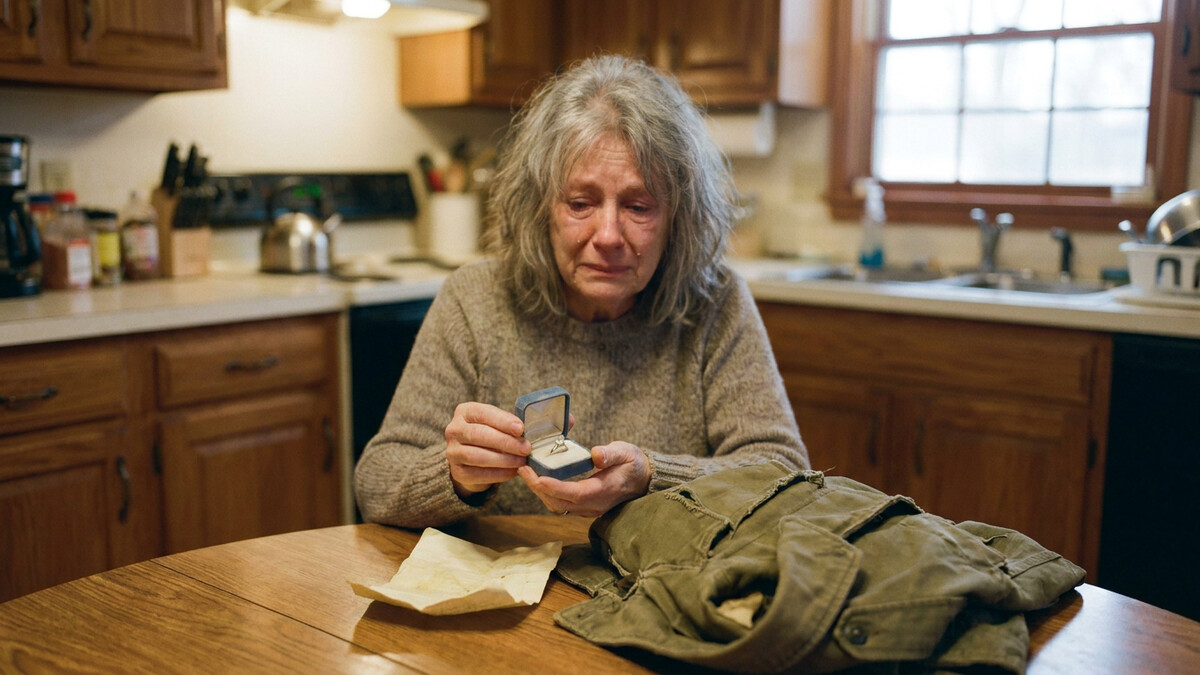
Frances did not say anything. She had sat in a lot of living rooms with a lot of widows. She knew when to wait.
Patsy picked up the ring box at last. She held it in her palm.
"I was nineteen," she said. "Ray was twenty. We'd been going together since the spring. Daddy didn't like him. He said Ray was a lineman's boy from the wrong side of the creek with no prospects, and he was going to war, and girls who married boys going to war ended up widows at twenty."
She turned the little box in her hand.
"After that Sunday dinner, Ray stopped coming around. He shipped out in January. He wrote to me twice from Vietnam. Short letters. Nothing in them. I thought he'd changed his mind about me." She shook her head. "Then he came home in 1969, and he came to the church social, and he walked straight across the fellowship hall and asked me to marry him. With a dime-store ring. I said yes before he finished."
"Mrs. Timmons," Frances said gently, "is there anybody still living who might know what was said on that porch?"
Patsy thought about it.
"My brother," she said. "Carl. He was fifteen that year. He was always listening at doors." She almost smiled. "He's ninety... no. He's seventy-four. He lives in Lynchburg."
She picked up the phone right there, in the living room, and called him.
Frances listened to her side of it. Patsy told him about the jacket, and the ring, and the receipt. Then she was quiet for a long time, listening, with the phone to her ear and her other hand flat over her mouth.
When she hung up, she did not speak for almost a minute.
"Carl remembers," she said finally. "He was in the front hall. He heard all of it."
She looked down at the ring.
"Ray asked Daddy for my hand. He showed Daddy the ring. He'd been saving since he was sixteen. And Daddy said no." Her voice wavered. "He said, Son, you're going to Vietnam in three weeks. If you give her that ring and you don't come back, you'll have made my daughter a widow before she's even a wife. If you love her, you'll wait. Come home first. Then ask me again."
Patsy closed her eyes.
"And Ray said, Yes, sir. And he put the ring in his pocket. And he never told me. Not one word. In fifty-six years."
They sat in the quiet living room.
"He carried it," Frances said slowly. "Through the war. In that jacket. Sewn into the lining so he wouldn't lose it."
"Why didn't he give it to me?" Patsy said. "When he came home? Daddy said come home and ask again. He came home. He asked again. Why the dime-store ring?"
Frances had an idea. She did not say it right away. She had written a lot of obituaries for veterans. She had sat with a lot of their wives.
"Mrs. Timmons," she said carefully. "Did Ray ever talk about Vietnam?"
"Never," Patsy said. "Not once."
"Some men I wrote about," Frances said, "didn't want to bring anything home from over there. Not even good things. They wanted to start clean. That ring had been with him the whole time. Every day. Every night." She paused. "Maybe it had seen too much."
Patsy looked at the little diamond for a long time.
"So he bought me a new ring," she said slowly. "A clean one. From the dime store. Because that was all he could afford. And he kept this one sewn in his jacket for fifty-six years."
"I think so," Frances said. "I think he couldn't give it to you. And he couldn't throw it away."
Patsy stood up. She went down the hall to the bedroom, and Frances heard a drawer open and close.
She came back with a small, worn jewelry box and opened it on the coffee table. Inside, on a bed of faded satin, was a thin gold band, worn almost flat on one side from fifty-six years of dishes and gardens and grandchildren.
"I took it off in April," Patsy said. "My knuckles got too big. I couldn't stand to have it cut."
She took the little diamond out of its velvet box. She looked at it for a long moment.
Then she held out her right hand, the one without arthritis, and slipped Ray Timmons's ring onto her finger.
It fit.
Frances did not stay much longer. She knew when a living room needed to be empty.
At the door, Patsy took both of her hands.
"Mrs. Coleman," she said. "You've written seven thousand obituaries. Did you ever get one wrong?"
"A few," Frances said. "Names, mostly. A date or two."
"Then do one thing for me," Patsy said. "Ray's. In the Ledger. They left something out."
The following Sunday, the Danford Ledger ran a small notice on the obituary page, in the space where corrections usually went. Frances wrote it at her kitchen table in one draft, the way she always had.
Correction: The obituary of Raymond Lee Timmons, published March 2026, omitted the following. In December of 1967, before leaving for Vietnam, he asked for the hand of Patricia Ann Burcham and was told to wait. He waited. He came home and asked again. He kept his first ring for fifty-six years, in the lining of his Army jacket, and his wife received it this month. She is wearing it.