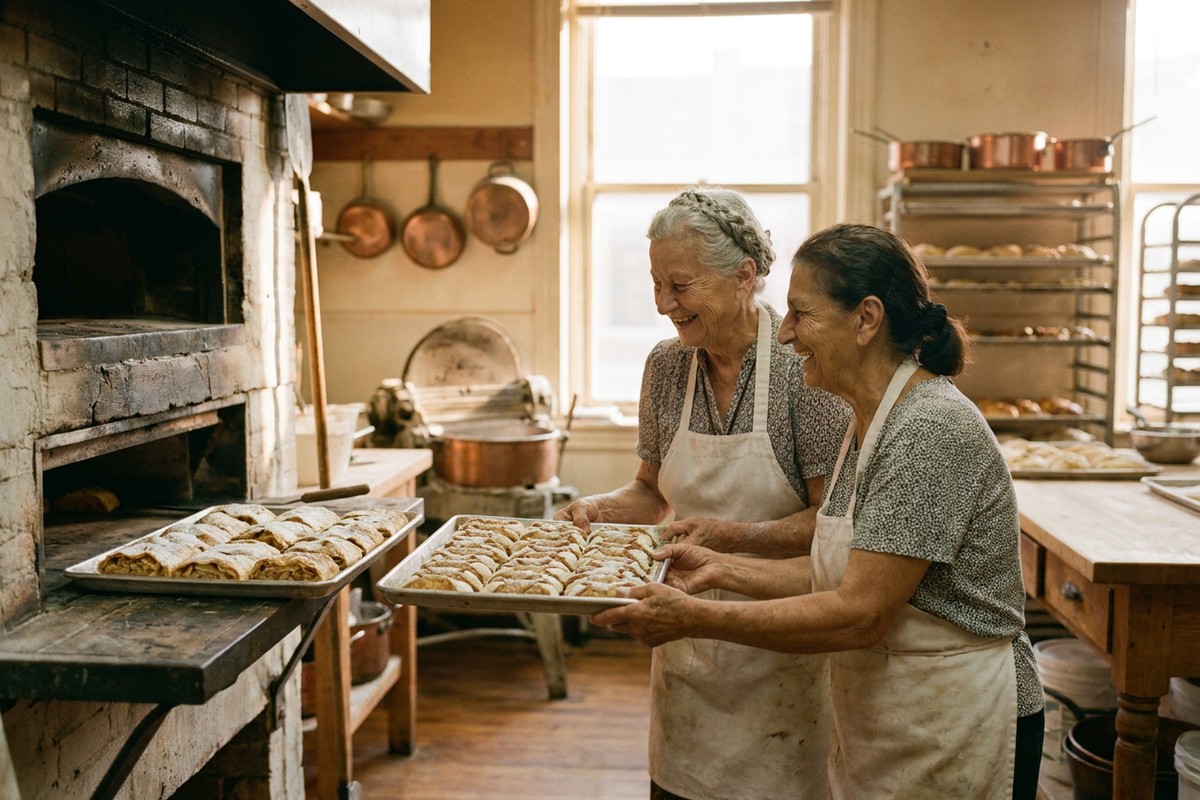
Greta stood in the doorway in her apron, with the smell of rising dough coming out around her into the dark alley. She looked at Lucia Castellano for a long moment.
Forty-one years.
She thought about the two hand-painted signs. She thought about a small woman in a pink bathrobe standing alone in the middle of Vine Street with a blanket around her shoulders.
"I close at four," Greta said. "The ovens are free from four until I start the next morning's bread at three. You tell your mother she can have them." She paused. "And you tell her that I'm not cleaning up after her."
Lucia put her hand over her mouth. Then she nodded, fast, and turned and almost ran down the alley.
Greta closed the door and went back to her pretzels. Her hands were shaking a little. She told herself it was the cold.
Rosa Castellano came through the back door of Hoffmeier's German Bakery at 4:05 that afternoon, with Lucia behind her carrying three boxes of ingredients and her own rolling pins.
She was wearing a clean white apron. Her chin was up. She did not look at Greta.
"Good afternoon," Rosa said, to the wall.
"Good afternoon," Greta said, to the mixer.
Then Rosa looked at the big Hoffmeier deck oven and frowned.
"It runs hot," she said. "On the left side. I can tell from here."
"It does not run hot."
"It runs hot. Look at the color of those pretzels on the left. That's twenty degrees, at least."
Greta looked at her pretzels. The ones on the left were, in fact, a little darker. She'd been rotating the trays for thirty years and never told a soul.
"Use the right side," she said stiffly.
It went on like that for three days.
They fought over oven time. They fought over counter space. They fought over the mixer, and the sink, and whether the radio should be on the German station or the Italian one.
Greta said Rosa used too much sugar. Rosa said Greta's kitchen was too cold for pastry. Lucia and Greta's part-time helper, a college student named Devin, stood in the corner and watched them like a tennis match.
But somewhere around midnight on the second night, something changed.
Rosa was rolling out dough for sfogliatelle, the shell-shaped pastry with a thousand paper-thin layers. It's one of the hardest pastries in the world to make. She was stretching it by hand, the old way, on the long wooden table, until it was thin as tissue.
Greta, cleaning up at the sink, stopped and watched.
"You stretch it like strudel," she said, surprised.
"Of course," said Rosa. "How else?"
"Most people use a machine now."
"Most people," said Rosa, "are lazy."
Greta dried her hands. She came over to the table.
She watched Rosa's quick, sure fingers for a long time. Then, without asking, she reached out and took the other end of the dough, and lifted it, and began to stretch it from her side, gently, with the backs of her hands, the way her grandmother had taught her in a farmhouse kitchen outside Stuttgart in 1952.
Rosa looked at her. She didn't say anything. She kept stretching.
They stretched it together until you could read a newspaper through it.
After that, they traded.
Greta showed Rosa her strudel filling. Apples cut a certain way, with brown butter and toasted breadcrumbs, and a secret she'd never told anyone outside her family: a spoonful of apple brandy. Rosa showed Greta how she drained her ricotta overnight in cheesecloth for the cannoli, and the drop of orange blossom water that made people drive in from Kentucky.
At two in the morning on the third night, with the last of Rosa's cannoli shells cooling on the racks, the two old women sat at the long wooden table with cups of coffee and talked about their husbands.
"Klaus painted that sign," Greta said, out of nowhere. "In 1986. BEST ON VINE STREET SINCE 1952." She shook her head. "I was mortified. I told him to take it down. He wouldn't."
Rosa stared at her. Then she started laughing.
"Vito painted ours the same night," she said. "I told him he was an idiot. He said, Rosa, you don't let a German win."
"Klaus said, Greta, you don't let an Italian win."
They laughed until they had to wipe their eyes with their aprons. Lucia and Devin, asleep on flour sacks in the corner, woke up and stared at them.
"Forty-one years," Rosa said finally, quietly. "For two stupid signs."
"Two stupid men," said Greta. "God rest them both."
The Vine Street Harvest Fest opened on Saturday morning in bright September sunshine, with fifty thousand people on the brick street and a brass band playing outside the old Germania building.
There were two bakery tables on the street, the way there always were. One on the east sidewalk in front of Hoffmeier's. One on the west sidewalk in front of Castellano's.
Except this year, there weren't.
This year, there was one long wooden table, right in the middle of Vine Street, on the yellow line between the two bakeries. Greta's strudel and pretzels and bee-sting cake on one end.
Rosa's cannoli and sfogliatelle and ricotta cheesecake on the other. Two old women in flour-dusted aprons standing behind it side by side.
Over the table hung a new sign, hand-painted, in gold and red and green. Lucia had painted it.
BEST ON VINE STREET. BOTH OF US.
The lines went down the block in both directions. People bought a strudel and a cannoli and carried them away in the same box.
The tour guides stopped and told the story. By noon, the neighborhood had a name for it.
The peace table.
They sold out by three. Rosa made enough to pay her taxes. Greta made more than she'd made at any festival in twenty years.
At the end of the day, when the street was emptying out and the band was packing up, Rosa turned to Greta behind the empty table.
"Same time next year?" she said.
Greta looked across Vine Street at her own red brick bakery, and at the dark yellow one with the boarded window that would open again in October.
"Five-thirty," she said. "And this time, you can wave."