Brayden turned and stared at her.
"Your dad was born in 1972," Darlene said. "By then your grandfather was home, and he'd decided that a father didn't talk about being scared. So he never did. And I never did either, because it was his to tell. I think that was a mistake. I think we should have told Rick, and I know I should tell you."
She looked out at the corn.
"His draft notice came in March of 1969. We'd been married three weeks. He was supposed to report to the induction station in Des Moines on the fourteenth of April, at seven in the morning."
"The night before, he didn't sleep. Neither did I. About three in the morning, he got up and went out and sat in the car in the driveway. I went out and sat with him, in my nightgown and his barn coat."
She smoothed the envelope on her knee.
"He said, 'Darlene, I can't do it.' He said he'd heard you could get across into Canada at Emerson, up in Manitoba, and they wouldn't send you back. He said we could be there by suppertime."
Brayden was very still.
"Grandpa wanted to go to Canada?"
"He was nineteen and he'd never been farther than Minneapolis," Darlene said. "He was scared of dying, and he was scared of killing somebody, and he was scared of being the one who couldn't do it. Just like you."
"What did you say?"
"I said, 'All right. I'll drive.'" She almost smiled. "I meant it, too. I had the keys in my hand. I'd have gone anywhere he wanted to go."
"But you didn't."
"No. We sat in that car till the sun came up. Didn't say much. And when it got light, he took a deep breath and said, 'Des Moines.' So I drove him to Des Moines."
She was quiet for a moment.
"He didn't go because he wasn't scared, honey. He went scared. That was the thing he never told your father. I always thought it was the bravest thing I ever saw him do."
She handed him the envelope.
It was addressed to Mrs. Duane Huber, Rural Route 2, Garner, Iowa, in pencil, in a careful, cramped hand. The postmark said Fort Leonard Wood, Missouri, April 1969. The stamp was a six-cent Roosevelt.
Brayden opened it with fingers that weren't quite steady. Inside was a single sheet of lined paper, folded in thirds.
He read it out loud, slowly.
"Dear Darlene. I made it. They shaved my head and gave me boots two sizes too big and the sergeant yells all day. The first night I didn't sleep at all and I thought about that car in the driveway. But a boy from Ottumwa in the next bunk cried all night and in the morning I helped him make his bed, and it turned out he was a lot more scared than me, and after that I wasn't as scared. I am still scared, but less. Tell Mom the food is terrible. I love you. Duane."
Brayden sat with the letter in his lap for a long time.
"I am still scared, but less," he said quietly.
"Every day he was there, it got a little less," Darlene said. "He told me so. He wrote me every single day for eight weeks, and then for two years after that. I've got all of them in a shoebox under my bed."
She buckled her seat belt again.
"Now, I'll take you home if you want me to. I mean that, same as I meant it in 1969. I won't tell your mother why, and I won't think one bit less of you, and you can call your recruiter from my kitchen."
She put her hand on the key.
"Or I'll take you to Des Moines. You tell me."
The wind moved in the corn. A long way off, a combine was working, and its dust hung gold in the low sun.
Brayden folded the letter carefully, in thirds, the way it had been folded for fifty-eight years. He put it back in the envelope.
"Can I keep this?"
"It's yours," Darlene said. "That's why I brought it."
He took a deep breath, the way his grandfather must have, in a car in a driveway at dawn.
"Des Moines," he said.
She dropped him at the hotel at a quarter to five. A sergeant in a pressed uniform was waiting in the lobby with a clipboard and a row of nervous boys. Brayden hugged his grandmother for a long time on the sidewalk, and she held on, and neither of them said anything at all.
Then he picked up his bag and went in. At the door, he turned around, and held up the envelope, and waved it.
Darlene drove home alone in the dark, the same road she'd driven in 1969. She cried most of the way.
It was all right. She knew the way.
His first letter came nine days later, in his own big, sloppy hand, the first real letter he'd ever written.
Inside it, he'd folded the old yellowed envelope with the six-cent Roosevelt stamp. And a note.
"Grandma, will you hold on to this for me until graduation. I don't want it to get messed up. There's a kid from Arkansas in my bay who cried the first night, so I helped him make his bed. I am still scared, but less. The food is terrible. Love, Brayden."
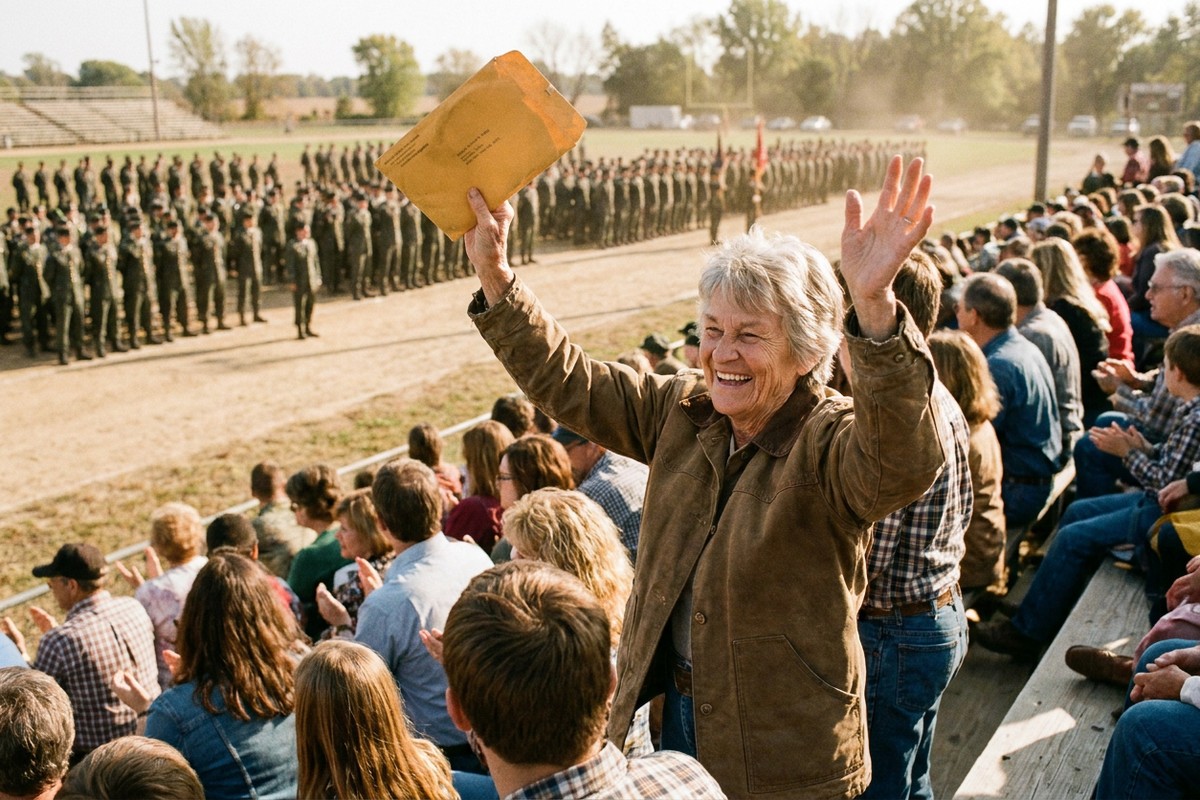
Ten weeks later, on a bright cold morning in January, Darlene stood in the bleachers at Fort Leonard Wood with Rick and Jen and Brayden's little sister. There were hundreds of families around them, waving flags and signs and phones.
The new soldiers came marching out onto the field in rows, in their dress uniforms, and she couldn't find him, and then she could. Tall, thinner, standing straighter than she'd ever seen him stand.
Rick was crying, openly, for the first time she could remember since he was a boy. Darlene had told him everything on the drive down. All of it. The car in the driveway. Canada. Des Moines. Rick had pulled into a gas station outside Kirksville and sat with his head in his hands for ten minutes, and then he'd said, "I wish he'd told me," and she'd said, "I know. Me too."
Down on the field, the ceremony ended, and the rows broke, and Brayden came running toward the bleachers looking for them.
Darlene stood up, a small gray-haired woman in her husband's old barn coat. And she lifted the yellowed envelope high over her head, and waved it like a flag.