Clay stood at the window and watched the bus pull out of the station and turn east toward the interstate.
He thought about Wheeling. A bus station on the river at ten o'clock on a February night, and an old man with a duffel bag, a dead phone number, and no money left for the rest of the ride.
Then he limped out to his truck as fast as his hip would let him.
It was a hundred and thirty miles on I-70 from Columbus to Wheeling. The bus would stop in Zanesville and Cambridge and St. Clairsville, and it would take its time.
Clay didn't.
He called Marlene from the truck. He told her where he was going, and why. Marlene listened without interrupting, the way she'd listened for thirty-nine years.
"Bring him home," she said. "I'll make up the spare room."
"He's proud, Marlene. He might not come."
"Then you'd better think of a reason he can't say no to," Marlene said. "You've got two hours."
The Wheeling bus station was a small concrete building near the river with three benches, a vending machine, and a man mopping the floor. Clay sat down on the bench nearest the door at 8:50 and put his hat on his knee.
The bus came in at 9:25.
Lonnie was the fourth passenger off. He came down the steps slow, with his duffel bag over his shoulder and his hat pulled low, and he walked into the little station and stopped.
Clay stood up.
For a long moment, Lonnie didn't say anything at all. He just stood there in the doorway with the bus idling behind him, looking at Clay Hollister like he was seeing a ghost.
"Well, I'll be," Clay said. "Fancy meeting you here."
"How," Lonnie said. "How did you."
"Interstate's faster than a bus," Clay said. "Even with my hip. Sit down, Lonnie. I've got something to say, and I'd rather say it sitting."
They sat on the bench together. The man with the mop moved away to the other end of the room.
"I never thanked you," Clay said. "For Cheyenne."
"You don't need to. That was the job."
"It wasn't the job. The job was to ride in when it was safe. I've watched that wreck in my head ten thousand times, Lonnie, and there wasn't one second of it that was safe. You rode into the middle of it anyway."
Lonnie looked at the floor.
"I've got a hip that hurts every morning," Clay said. "And every morning when it hurts, I think, well, at least you're here to feel it. That's forty-three years of mornings. I figure I owe you for every one of them."
"You don't owe me a thing."
"I'm not done," Clay said. "There's a boy back home named Jace Doran. Seventeen. He rides saddle bronc. He's got more try than sense, and he's going to get himself hung up one of these days if somebody doesn't teach him how a bronc moves from the outside. I can teach him how to ride. I can't teach him that. I was never on the outside. You were."
Lonnie didn't say anything.
"And I've got a bull named Ten Spot who'd like nothing better than to put me through a fence," Clay said. "My wife says I'm too old to work him alone. She's right, but don't tell her I said so. And she's already made up the spare room, and she makes a pot roast on Sunday that'll make you forget you were ever in Wyoming."
He looked at Lonnie.
"So I'm not offering you charity," Clay said. "I'm offering you a job. Room and board. And I'm paying off a debt. It's a big one, Lonnie. I figure it'll take me a few years."
Lonnie sat on the bench a long time with his big rough hands hanging between his knees.
Then he reached down and unzipped the duffel bag as far as it would go. He took out the framed picture that had been sticking out of the end.
It was a photograph of a young woman in a cap and gown, maybe twenty-two, laughing.
"Rae Ann," Lonnie said. "College graduation. 2009. That's the last time I saw her. We had words about her mother. I said things a man shouldn't say. Then I was too proud to call." He held the picture in both hands. "I thought if I just showed up at her door, she'd have to let me in."
"Pittsburgh's not going anywhere," Clay said. "Neither is Rae Ann. There's a young fellow in Pine Hollow named Tyler who can find just about anybody with a computer. Let him find her. Then you write her a letter. A real one. Let her decide."
Lonnie looked at the picture a little longer.
Then he put it back in the duffel bag, very carefully, and stood up, all at once, the way an old cowboy stands.
"Where's your truck, Hollister?" he said.
Tyler found Rae Ann Bascom in about forty minutes. She was a nurse in a hospital in Pittsburgh, married, with two little boys.
Lonnie wrote her a letter at Marlene's kitchen table. It took him three days and most of a legal pad. He didn't show anybody what it said.
In the middle of March, the phone rang in the Hollister kitchen, and Marlene answered it, and then held it out to Lonnie without a word.
He took it out on the back porch. He was out there a long time.
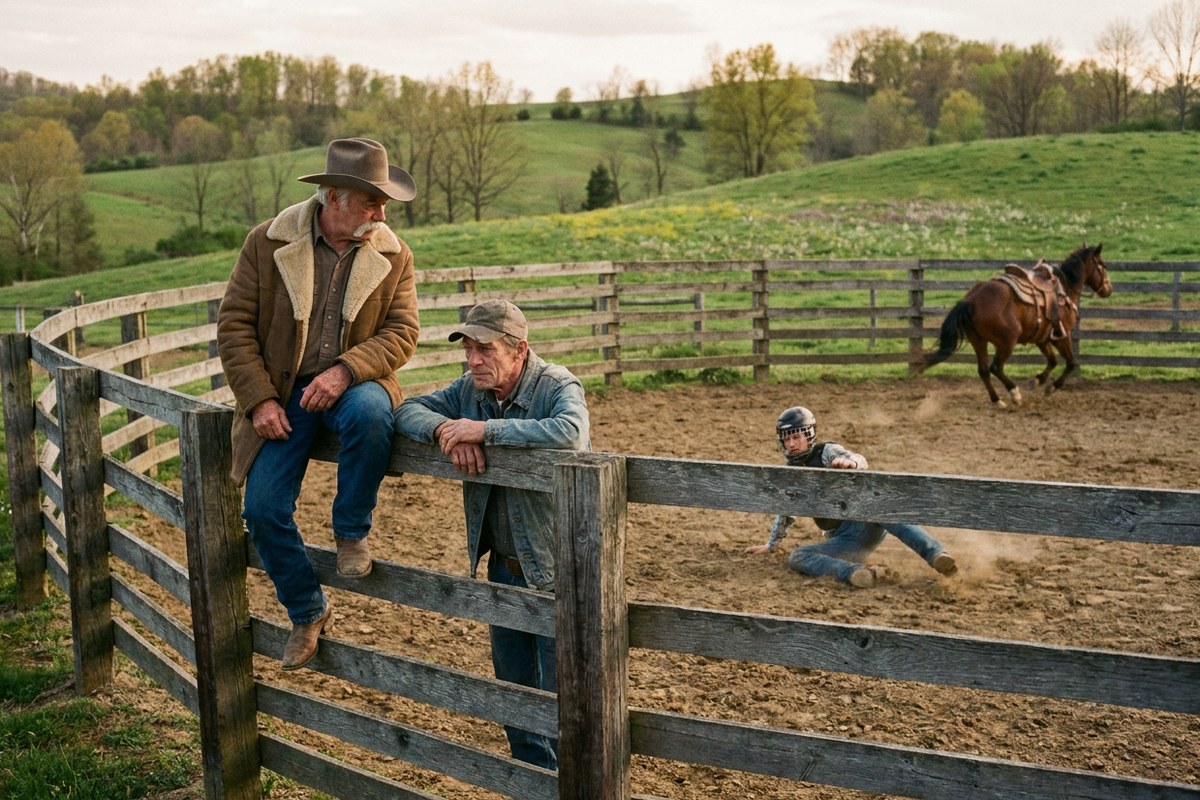
On a warm Saturday in April, Jace Doran climbed onto a practice bronc in Clay's round pen.
Clay sat on the top rail with his bad hip. Lonnie sat beside him, on the other side of the gate, where a pickup man would be.
The horse came out bucking. Jace rode it four jumps, five, six, and then lost his seat and came off clean, both boots free, and rolled up onto his feet in the dirt grinning like a fool.
"Feet were free," Lonnie called to him. "That's the whole thing, son. Keep your feet free."
Clay looked over at him.
Lonnie was leaning on the fence beside him in his old sheepskin coat with his hat pushed back, watching the boy, and for the first time since Columbus, his shoulders were down where they belonged.