Frankie told it the way she did her crossword. In ink. No erasing.
She'd been on the wing line for a year and a half by October of 1944. A good riveter, fast and steady. Her partner was Lucille Hendricks, a farm girl from up near Saginaw who'd lied about her age even worse than Frankie had.
Lucille was the bucker. She held the heavy steel bucking bar on the inside of the wing, and Frankie drove the rivets from the outside, and they talked through the metal all day long.
They talked about boys, mostly. Movies. Whose mother was meaner.
"There was a pin on the wing jig," Frankie said. "A big steel locking pin. You were supposed to check it every time they moved the section. Every time. That was my job, that morning. Lucille was telling me about a sailor she'd met at the Saturday dance, and I was laughing, and I didn't check it."
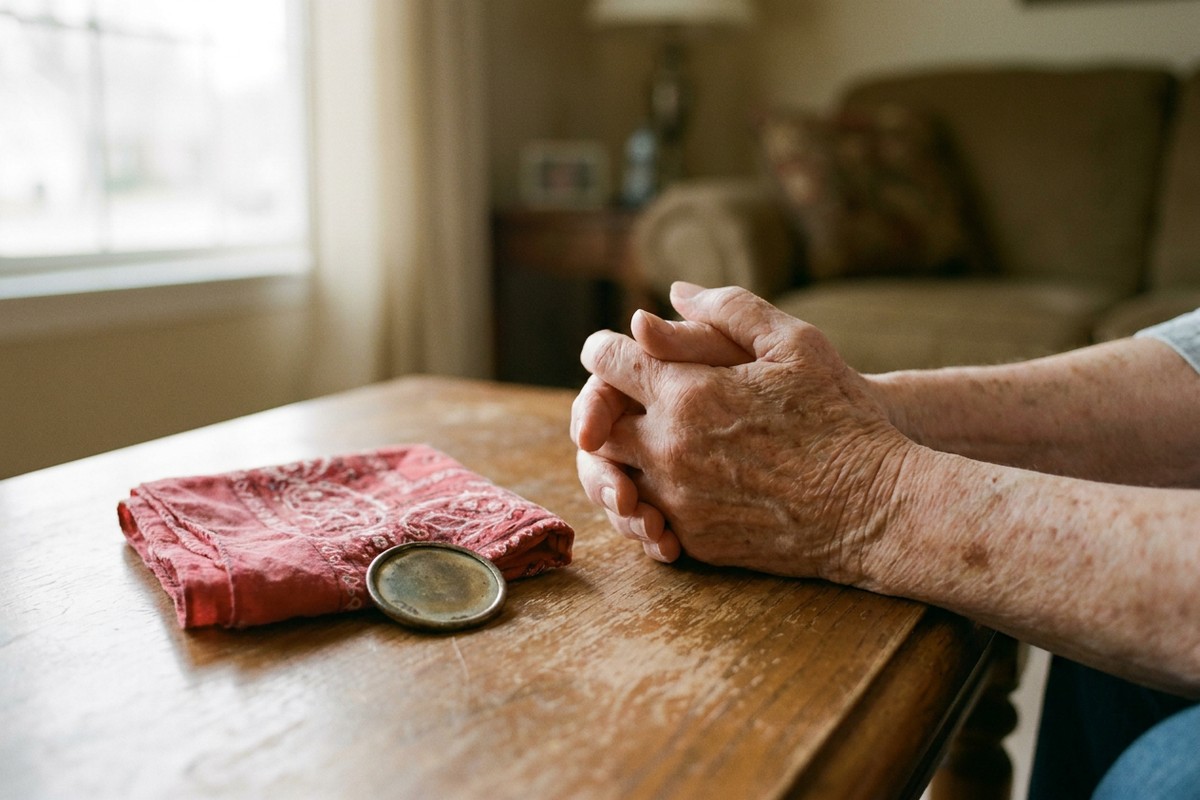
She stopped. Her hands were still in her lap, folded over the bandanna.
"The section slipped. Two inches. That's all it took." Frankie closed her eyes. "I tied my bandanna around her arm and held her hand till the nurse came. She never screamed. Not once. She just kept looking at me."
"Grandma."
"They sent her home to Saginaw. I never saw her again. I quit the next week and went and typed letters in the office until the war ended, because I couldn't stand to look at the line." Frankie opened her eyes. They were dry. "So that's my war, Megan. I'm not a Rosie. I'm the girl who wasn't paying attention."
Megan didn't argue. She knew better.
But she was a history teacher, and she knew where records lived.
It took her two months. The Ford archives at the Benson Ford Research Center had the plant's safety reports from 1944, and a kind archivist named Mr. Odum helped her find the one from October. It was a single typed page.
Wing jig accident, Department 7, Station 14. Operator injured: Hendricks, L. Cause: shear failure, locking bolt, jig assembly.
Bolt defective. All jig bolts on Line 3 replaced.
Megan read it four times.
A sheared bolt. Not a pin left unchecked. A bad piece of steel, and every jig on the line had been fixed afterward because of it.
Frankie had been blaming herself for eighty-two years for something a machine did.
Finding Lucille was harder.
Lucille Hendricks had married a man named Harold Whitlow in 1947 and lived in Bay City until she died in 2009. Megan found her obituary online.
Beloved wife, mother of three. A longtime member of the Willow Run reunion committee.
Lucille's daughter, Carol Whitlow, was seventy-nine and still lived in Bay City. When Megan called her and explained who she was, there was a long silence on the line.
"Frankie," Carol said finally, very quietly. "Frankie Kowalczyk."
"Yes ma'am. My grandmother."
"Honey," Carol said, and her voice broke. "My mother looked for your grandmother for sixty years."
Lucille had told the story her whole life. To her children, to her grandchildren, to every reunion of Willow Run women she ever went to.
How the jig slipped. How the girl beside her, a dark-haired girl named Frankie with a stubborn chin, tore off her own bandanna and tied it so tight it hurt, and held her hand, and talked to her the whole time.
Talked about movies, and boys, and whose mother was meaner, until the nurse got there. Never let go.
"Mama always said that girl saved her life," Carol said. "The doctor told her if that bandanna hadn't gone on so fast and so tight, she'd have lost the whole hand. She tried to find Frankie for years. She put notices in the reunion newsletter every single year. But she only knew her maiden name. And Frankie had married, and moved across town, and never gone to a single reunion.
"Mama wrote her a letter," Carol said. "In 1995, when she was sure she'd never find her. She kept it in her Bible. I still have it."
Megan told her grandmother on a Sunday afternoon, at the kitchen table, with the Tigers on the radio turned down low.
She laid the safety report in front of her. Frankie put on her reading glasses and read it once, slowly, her lips moving on the words.
Shear failure. Bolt defective.
She read it again.
Then she took off her glasses and sat there looking out the kitchen window at the bird feeder for a long time, and Megan didn't say anything.
"A bolt," Frankie said at last. Just that.
"A bad bolt, Grandma. They replaced every one on the line. It wasn't you."
Frankie's mouth trembled. She pressed it shut. Megan reached across the table and took her grandmother's hand, the one with the thin white scar, and Frankie let her.
"There's more," Megan said. "Lucille's daughter wants to meet you."
Carol Whitlow drove down from Bay City the following Saturday with her own granddaughter at the wheel.
She was a short, round, cheerful woman with white hair and her mother's photograph in a frame under her arm. In it, a girl of about sixteen with freckles and a wide grin stood beside a bomber wing in coveralls, holding up a bucking bar like a trophy.
Frankie looked at the photo for a long, long time.
"That's her," she whispered. "That's my Lucille."
Carol sat down beside her on the sofa and opened an envelope gone soft and yellow with age. Her hands were shaking a little.
"Mama wrote this in 1995," Carol said. "She said, if they ever find Frankie, read it to her. So I'm going to read it to you."
She unfolded the paper and read it aloud, in a voice that cracked on almost every line.
Dear Frankie. I don't know if you're still living. I hope so.
I want you to know I married a good man, and I had three children, and I held every one of them with this hand, the one you saved. I learned to play the piano with eight fingers. I'm not very good.
I've thought about you every day for fifty years. You held on to me when I was the most scared I've ever been, and you never let go. You were my hero, Frankie.
You still are. Your partner, Lucille.
The room was very quiet.
Frankie didn't say anything at all. She just reached out, slowly, and took Carol's hand in hers, the scarred hand of a riveter in the hand of a riveter's daughter.
On the coffee table between them, folded into a small neat square, lay an old red bandanna with one stained brown corner. And beside it, a round metal badge with a photograph of a stubborn seventeen-year-old girl who had finally, after eighty-two years, been told the truth about herself.